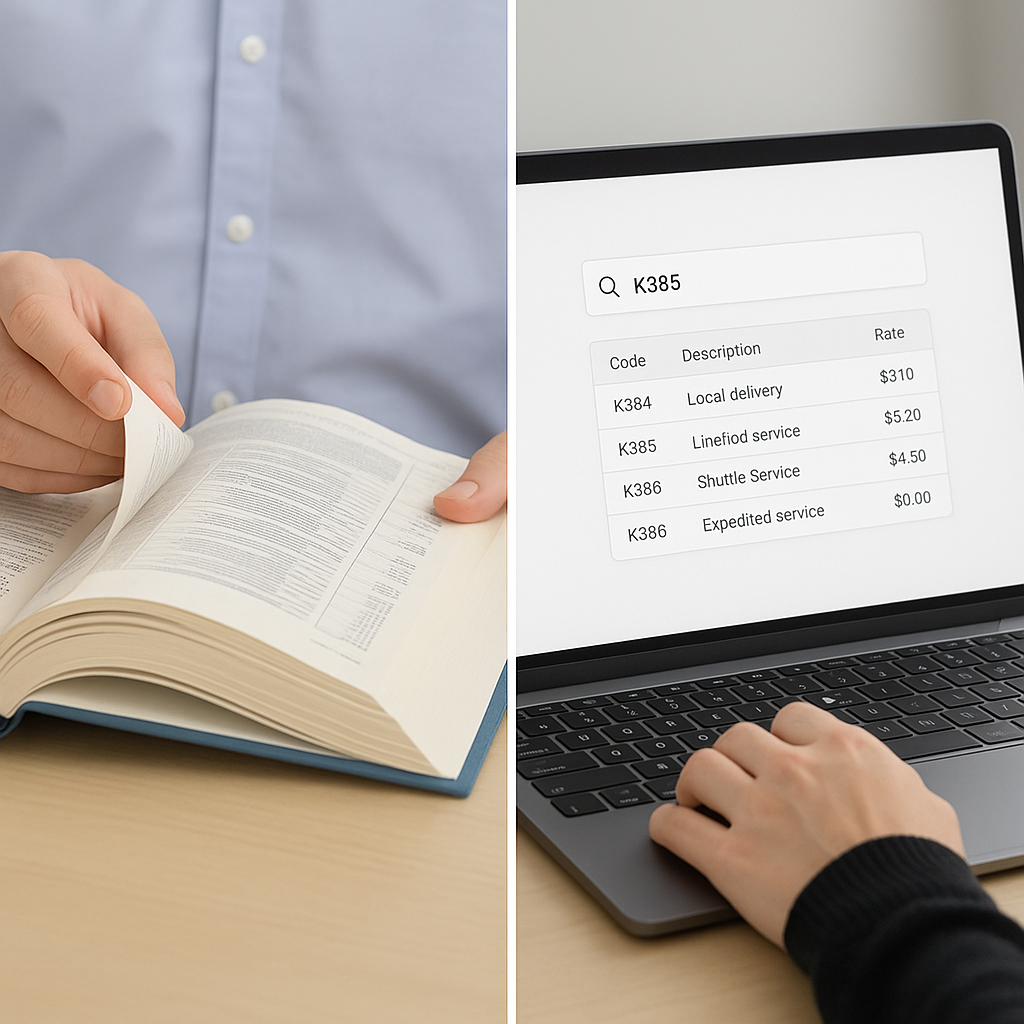
Tired of Flipping Through Rate Books? You’re Not Alone.
Every estimator has been there. You’re midway through pricing a bid, and you need labor rates for a custom item. Naturally, you turn to your trusty rate book—whether it’s RSMeans, CPWD DSR, or something equally dense. You spend an hour flipping through pages, cross-referencing line items, and hoping you didn’t miss something.
Sound familiar? It’s not just frustrating—it’s a productivity killer. According to RSMeans, the average estimator spends 12 hours per bid just on rate lookups. For firms handling 30 bids a year, that’s 360 hours gone.
Here’s the kicker: most of that time is wasted on tasks AI can do in seconds.
How AI Rate Matching Works (and Why It’s a Game-Changer)
AI-powered rate matching tools like EstimateNext use semantic search to cut through the noise. Need the labor rate for installing pre-stressed concrete girders? Just type it in. The AI scans 78,000+ SOR items across catalogs like RSMeans or CPWD DSR and finds the best matches instantly. No flipping, no guessing.
Case Study: A Texas Contractor’s $1B Bid
Let’s look at a real-world example. A mid-sized general contractor in Texas was bidding on a $1B rail bridge project. They needed rates for everything from rail ties to structural steel—DOT-approved, of course. Manually, that process would’ve taken days, requiring multiple estimators to pore over catalogs and spreadsheets.
By using AI, the contractor completed the rate lookup process in under 30 minutes. Not only did they meet the bid deadline, but they also reduced the likelihood of errors caused by manual cross-referencing.
Key Features of AI Rate Matching
AI tools don’t just save time; they also add value in ways manual methods can’t:
- Semantic Search: AI understands context. For example, if your project specifies "galvanized steel," and your catalog uses "coated steel," the AI knows they’re interchangeable.
- Learning Capabilities: Tools like EstimateNext learn from your past selections and suggest better matches over time.
- Inflation Adjustments: AI can flag outdated rates and suggest inflation-adjusted numbers based on current market data.
These tools aren’t here to replace estimators—they’re here to handle the grunt work, freeing you up to focus on strategy, cost optimization, and client relationships.
The Hidden Costs of Manual Lookups
Still skeptical? Let’s break down the math.
Say you’re paying your estimators $130/hour—a reasonable rate for experienced professionals. If you’re spending 12 hours per bid on rate lookups, that’s $1,560 per project just for this one task. Over 30 bids a year, you’re burning $46,800. And that doesn’t account for errors.
The Risk of Errors
According to a McKinsey report, manual processes like rate lookups lead to 10-20% cost overruns on construction projects. Why? Because humans make mistakes. Maybe you missed a rate update. Maybe you applied the wrong factor from a different region. Either way, it’s money out of your pocket.
AI doesn’t make those kinds of mistakes. It’s fast, consistent, and always improving. For example, a subcontractor working on a hospital project might accidentally use residential-grade labor rates instead of commercial-grade rates. An AI tool would flag this as inconsistent with the project scope.
Opportunity Costs
Beyond the direct costs, manual lookups also eat into the time your team could spend pursuing additional bids. If AI saves even 8 hours per bid, that’s 240 extra hours a year for a firm handling 30 bids. Those hours could go toward more competitive pricing, client outreach, or even training.
Common Pushbacks (and Why They Don’t Hold Up)
1. “AI can’t think like an estimator.”
True, AI doesn’t have decades of field experience. But it doesn’t need to. You’re still in control, making judgment calls and deciding on markups. The AI just handles the repetitive stuff—like finding and applying rates.
2. “What if my rates are custom?”
No problem. Tools like EstimateNext let you upload your own rate catalogs. The AI will prioritize your custom rates over generic ones, ensuring your estimates always reflect your actual costs.
3. “It sounds complicated.”
It’s not. Most tools are designed to be plug-and-play. Training takes under two weeks, and the ROI starts showing up on your very first project.
4. “I don’t trust it to be accurate.”
AI tools pull directly from your catalog or authoritative sources like RSMeans, ensuring accuracy. Plus, you can manually review suggestions before they’re applied.
The ROI of AI Rate Matching
Let’s revisit that $46,800 figure. If an AI tool like EstimateNext costs $99/month per seat, you’re looking at $1,188/year. That’s a 39X ROI—without even factoring in the additional bids you could pursue with the time you save.
Comparison Table: Manual vs. AI Rate Matching
| Metric | Manual Lookups | AI Rate Matching |
|---|---|---|
| Average Time per Bid | 12 hours | 30 minutes |
| Annual Cost (30 bids) | $46,800 | $1,188 |
| Error Rate | 10-20% | Negligible |
| Learning Capabilities | None | Adaptive |
| Inflation Adjustments | Manual | Automated |
For subcontractors responding to tight deadlines, AI can turn a 3-day quote cycle into a 4-hour process. More bids submitted means more wins. It’s that simple.
If you’re dealing with rate lookup headaches, EstimateNext can help. Get started free →


