The Brutal Truth About Manual Rate Lookups
Let’s be honest: flipping through rate books or PDFs to find pricing is a nightmare. Whether you're using RSMeans, CPWD DSR, or any of the other 2,000-page catalogs out there, it’s slow and error-prone. A single missed rate can wreck an entire bid, potentially costing you thousands—or even millions—of dollars.
I’ve seen this firsthand. One project I worked on—a state highway resurfacing—spent nearly 12 hours pulling rates for asphalt, labor, and equipment. By the time we had the numbers, half the team was already scrambling to meet the bid deadline. And that’s not uncommon. In fact, a McKinsey study found that inefficiencies in manual processes like rate lookups cost the construction industry $1.6 trillion annually. If you’re still relying on flipping pages or static PDFs, you’re part of that statistic.
How AI Changes the Game
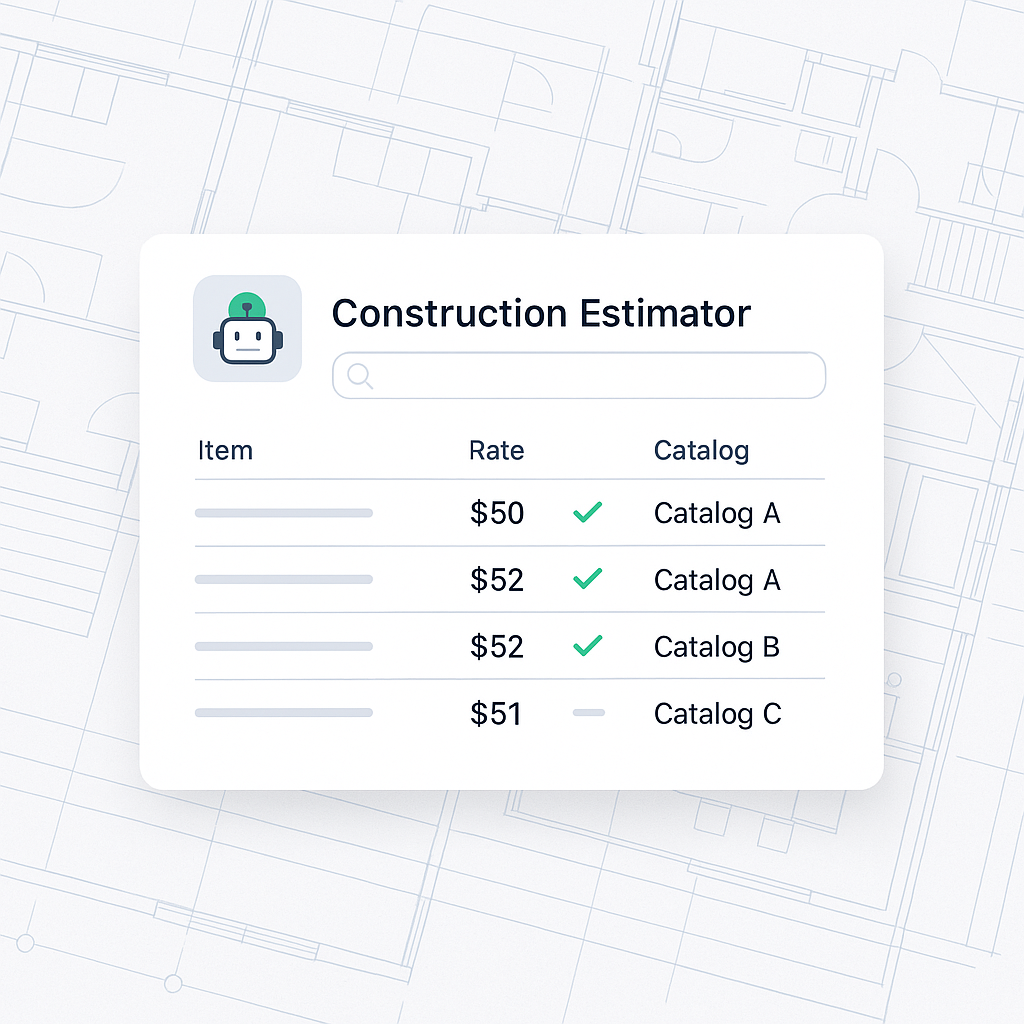
This is where AI-powered estimation tools like EstimateNext come in. These platforms use advanced semantic search algorithms to match rates across tens of thousands of SOR (Schedule of Rates) items in seconds. No manual flipping, no guessing, and no missed line items.
For example, let’s say you need the labor rate for installing pre-stressed concrete girders. Instead of digging through RSMeans or a DOT catalog, you type it into the search bar. Instantly, you get accurate matches ranked by relevance. The system doesn’t just find the rate—it adjusts for inflation, applies overhead/profit percentages, and even lets you export the rate breakdown to Excel or other estimating software.
Case Study: Skanska’s Rail Bridge Project
During Skanska’s bid for a rail bridge construction, they needed rates for everything from rail ties to structural steel. Normally, this process takes days. With AI tools like EstimateNext, it was done in minutes—accurately and without the human error that often comes with manual lookup.
Skanska’s internal report showed a 99% reduction in rate lookup time, freeing up estimators to focus on competitive pricing strategies and subcontractor negotiations. This allowed them to submit a more competitive bid, ultimately winning the project. The time savings also translated into cost savings—cutting down hours billed by senior estimators who no longer had to micromanage manual tasks.
More Examples of AI in Action
- Residential Projects: A small contractor in Texas used EstimateNext for a multi-family housing bid. They cut their rate lookup time from 7 hours to under 30 minutes—allowing them to submit the bid a full day earlier than competitors.
- Infrastructure Bids: A city government bidding out a water pipeline project used AI tools to identify region-specific labor rates and material costs, reducing errors caused by outdated catalogs.
- Custom Rates: A commercial GC uploaded their custom catalog to EstimateNext, ensuring accurate pricing for specialized materials like fire-rated glazing and high-efficiency HVAC systems.
Why Accuracy Matters More Than Speed
Speed is great, but accuracy is non-negotiable. AI tools don’t just find rates quickly—they apply logic to ensure the rates make sense. For example, if you're pricing HVAC ductwork, the system knows to suggest SMACNA-compliant labor rates, not generic construction values. It’s smarter than a simple keyword match, and it ensures you’re not losing money by underpricing or overpricing key line items.
Still, human oversight is essential. AI can’t account for every edge case, like custom materials, regional labor nuances, or scope changes mid-project. That’s why tools like EstimateNext include confidence scoring and manual override options. You’re still in control, but the grunt work is offloaded.
The ROI Is Brutal
Let’s do the math. If rate lookup takes 12 hours per estimate and you’re paying estimators $130/hour, that’s $1,560 wasted per bid. Multiply that across 5 GMP pursuits per year, and you’re bleeding $7,800 annually—just on rate lookup.
With AI, that time drops to minutes. Even at $99/month per user, the ROI is obvious. One GC director noted saving $5,200 per pursuit, thanks to faster takeoffs and rate matching. That’s a 52X return on investment.
Expanded ROI Example:
Let’s say your firm handles 30 bids per year. If AI cuts rate lookup time from 12 hours to 1 hour per bid, you’re saving:
- 11 hours per bid × $130/hour = $1,430 per bid
- $1,430 × 30 bids = $42,900 saved annually
Even if you’re paying $99/month per user for AI software, that’s only $1,188/year—leaving you with a net savings of $41,712.
The Obvious Objection: “But AI Can’t Understand Nuance”
I get this pushback all the time: “Sure, AI is fast, but it doesn’t understand construction nuances.” That’s partially true—but it’s also missing the point.
AI doesn’t replace your expertise; it amplifies it. You’re still the one making judgment calls, deciding on markup, and negotiating with subs. The AI just handles the grunt work—like rate matching and inflation adjustments. It’s a tool, not a replacement.
Comparison Table: Manual vs. AI Rate Lookups
| Feature | Manual Process | AI-Powered Tools |
|---|---|---|
| Speed | 8-12 hours per bid | Under 30 minutes |
| Accuracy | Prone to human error | Confidence scoring + overrides |
| Custom Rates Integration | Manual entry | Automated catalog uploads |
| Scalability | Limited by team size | Unlimited |
| ROI | High labor costs | 50X-100X return on investment |
Actionable Steps: Start Small, Scale Fast
- Test It on a Small Project: Pick a low-risk bid—something under $5M—and run the numbers through an AI tool like EstimateNext. Compare the output to your manual process.
- Customize Your Catalogs: Upload your own rates or adjust inflation factors. The system gets smarter with every project.
- Train Your Team: Pair junior estimators with the platform to free up senior staff for high-value tasks.
- Monitor Results: Look for measurable improvements in speed, accuracy, and bid success rates.
FAQ
Q: How accurate are AI-generated rates?
AI tools like EstimateNext are highly accurate, but no system is perfect. Confidence scoring and manual overrides let you review and adjust as needed.
Q: Can I use AI tools with existing software like Procore or Excel?
Yes. Most platforms integrate seamlessly, allowing you to export estimates directly into your workflows.
Q: What if my rates are custom?
You can upload your own catalogs or define custom rates. The AI will incorporate them into future matches.
Q: Is AI worth the cost for smaller firms?
Absolutely. For firms handling 30-60 bids/year, the time savings alone cover the subscription cost.
Q: Does AI work for complex bids like design-build or PPP projects?
Yes, AI tools can handle complex bids by cross-referencing multiple data sources and allowing manual adjustments for unique project scopes.
Call to Action
If you're tired of wasting hours on rate lookups, EstimateNext can help. Get started free →