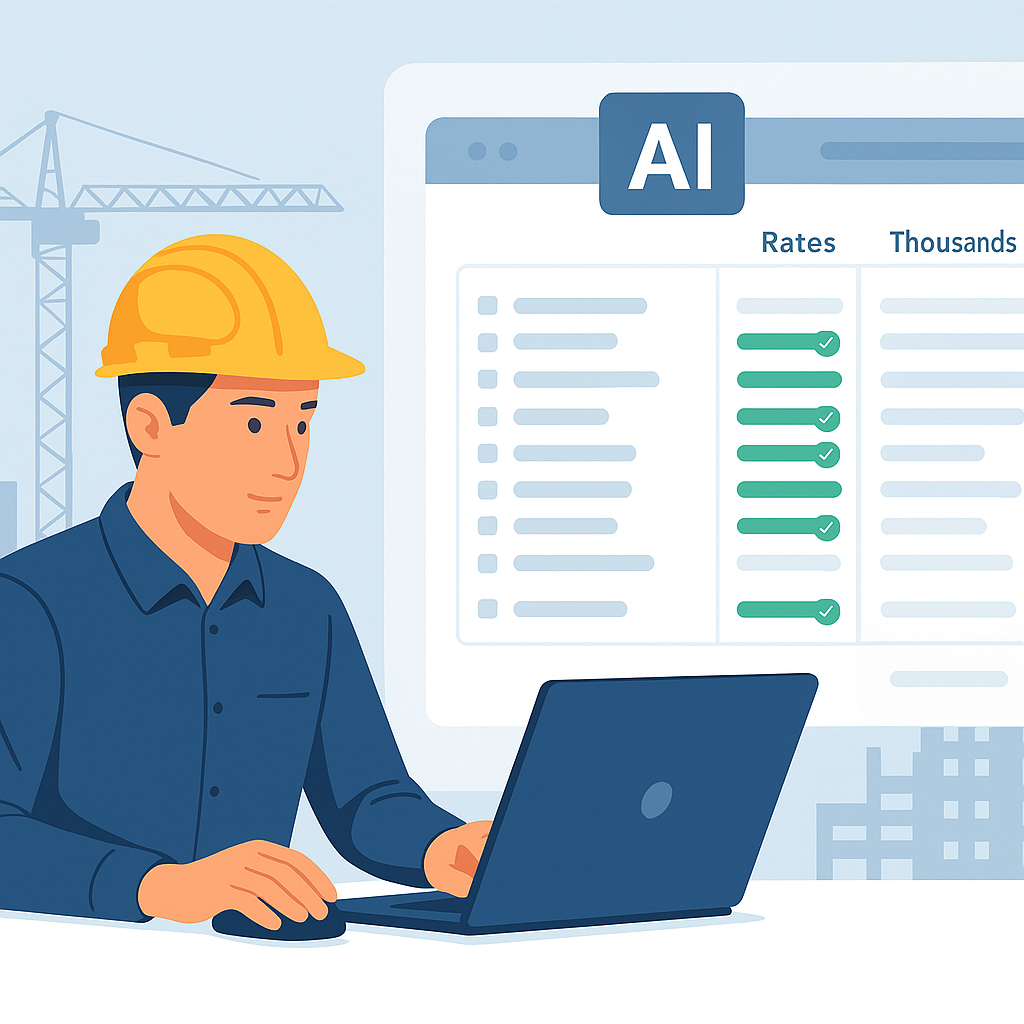
What’s the Real Cost of Manual Rate Lookups?
Ever watched an estimator flip through a 2,000-page CPWD rate book? It’s painful. On average, rate matching eats up 12 hours per estimate. And that’s just the lookup process—not counting the inevitable back-and-forth when something’s missing or wrong.
Even worse, manual data entry is prone to errors. One misplaced decimal can throw off an entire project’s budget, and guess who ends up eating the cost? You do. In fact, research from Construction Management and Economics (CME) shows that human errors in manual estimates can lead to cost overruns of up to 15% on average. For a $10M project, that’s $1.5M—money that could’ve gone toward reducing overhead or increasing profit margins.
The Fix: AI Semantic Search Across Thousands of Rates
This is where AI steps in. Tools like EstimateNext now use semantic search across 78,000+ Standard Operating Rates (SORs). Need the labor rate for installing pre-stressed concrete girders? Type it in, and you’ll get a match in seconds. Done.
Here’s a concrete example: a major contractor’s $1B rail bridge project required rates for everything from rail ties to structural steel. Traditionally, the estimators would spend days pulling DOT-approved rates manually. With AI, this process took minutes—and accuracy improved because the system flagged mismatched or missing rates automatically. This saved the team hundreds of hours of manual effort, allowing them to focus on refining the project scope and negotiating with subcontractors.
Another example comes from a mid-sized contractor pricing a $25M mixed-use development. The estimator reported spending 18 hours manually locating rates for specialized HVAC systems. Using AI-powered rate lookup, this was reduced to under an hour, and the system also flagged inconsistencies between the labor rate and equipment costs—errors that would’ve resulted in a $150,000 miscalculation.
How AI Builds Trust in Rate Matching
You might be thinking, “Sure, AI is fast, but can it handle custom rates or niche catalogs?” The answer is yes. Most modern platforms allow you to upload your own rate catalogs or define project-specific rates. AI integrates these seamlessly for future use, so your estimates reflect your actual costs—not generic benchmarks.
For instance, a specialty contractor working on a $12M hospital renovation uploaded their custom rate catalog of 2,500 items, including niche medical-grade materials. Within two projects, the AI tool not only matched rates accurately but also flagged pricing discrepancies when suppliers updated their costs. This level of precision is virtually impossible with manual workflows.
And the system gets smarter with every project. According to EstimateNext’s own case studies, accuracy improves significantly by the third project as the AI learns from user feedback. This feedback loop ensures that even edge cases—like regional pricing variations or custom labor rates—are accounted for.
Beyond Speed: The ROI of Accurate Rate Matching
Let’s talk numbers. A McKinsey report on AI adoption in construction found that early adopters saved 10-20% per project. For a $100M project, that’s $10M-$20M back in your pocket.
EstimateNext’s Vision AI adds another layer to this. By cutting drawing takeoffs from 40 hours to 10 minutes, it frees up your estimators to focus on high-value tasks like subcontractor negotiations and margin optimization. One GC director described it as “like hiring a full-time estimator without the overhead.”
Additionally, accurate rate matching reduces the risk of disputes. A study from the Chartered Institute of Building (CIOB) found that nearly 30% of construction disputes stem from pricing errors. With AI, such errors are flagged and corrected before they become costly disagreements.
What About Edge Cases?
What if your rates aren’t in the database? Or what if the AI suggests the wrong match?
Good AI tools include manual overrides and confidence scoring. If the system isn’t 100% sure about a rate match, it flags it for review. You can adjust the rate, and the system learns from that correction. It’s not perfect, but it’s miles ahead of manual processes.
For example, a contractor working on a niche infrastructure project involving underwater pipelines encountered rates that weren’t initially in the AI database. By manually inputting these rates and correcting mismatches, the system quickly adapted for future use. Within the next phase of the project, processing time for rate lookups dropped by 70%, saving the team over 200 hours.
Decision Framework: Manual vs. AI Rate Matching
| Criteria | Manual Rate Matching | AI-Powered Rate Matching |
|---|---|---|
| Speed | 12+ hours per estimate | Seconds per estimate |
| Accuracy | Prone to human error | 99%+ with feedback loops |
| Scalability | Limited to estimator capacity | Scales across projects and teams |
| Custom Rate Handling | Time-consuming | Seamless integration |
| Cost | High (labor-intensive) | Low (efficiency-driven) |
| Learning Curve | None | Improves with use |
Call to Action
If you’re tired of wasting hours on manual rate lookups, EstimateNext can help. Its AI-powered semantic search cuts this process to seconds, improves accuracy, and scales effortlessly across projects. Don’t let outdated workflows hold you back. Get started free →


