The Hidden Time Sink of Manual Rate Matching
If you've ever spent hours flipping through a 2,000-page rate book like RSMeans or CPWD DSR, you know the pain. Searching for that one elusive rate for a specific material or service can derail your entire day. Multiply that across multiple items in a Bill of Quantities (BOQ), and you’re looking at a full workday—or more—wasted. It’s an industry-wide problem, and no one talks about it enough.
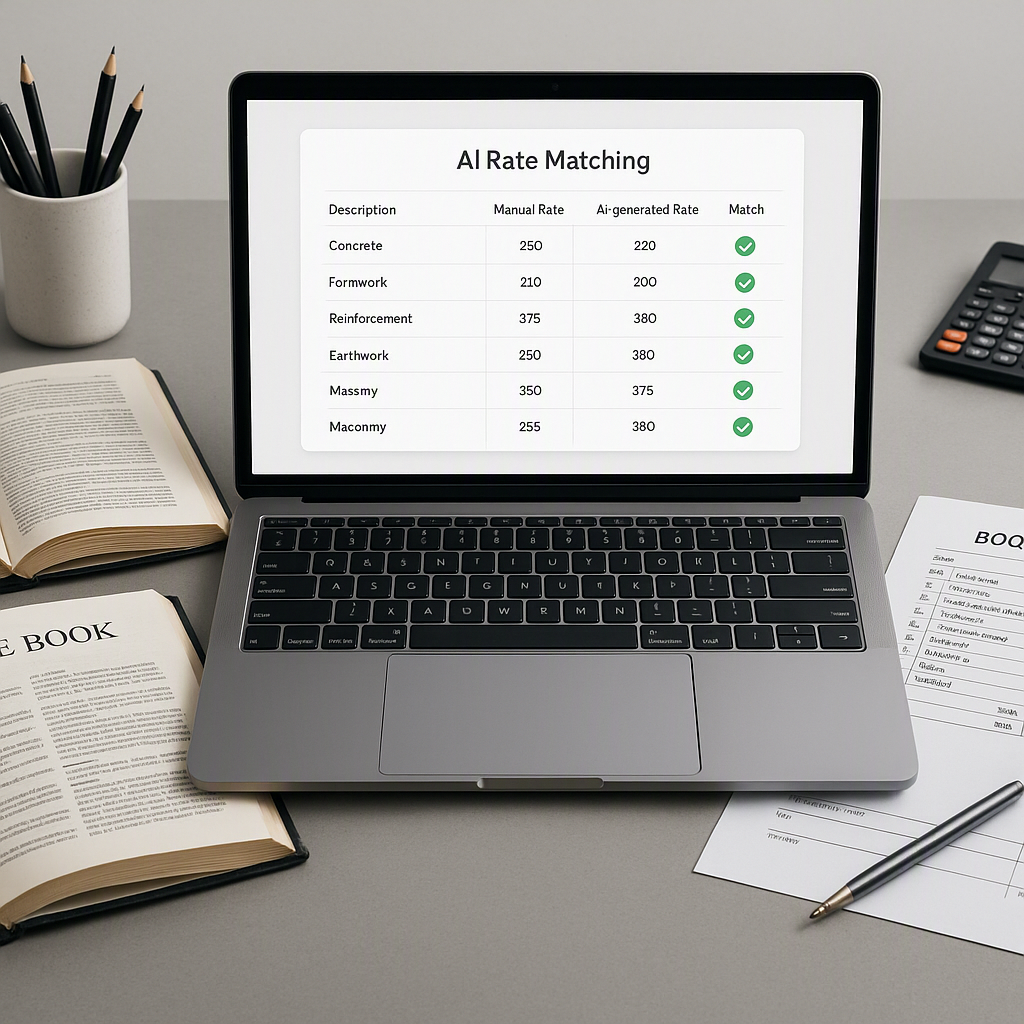
But here’s the thing: You don’t have to keep doing it this way. AI-powered preconstruction tools, like EstimateNext, are making this manual slog obsolete. Using semantic search across 78,000+ Standard Operating Rates (SORs), you can find matches in seconds. Yes, seconds. And it’s not just about speed—it’s about accuracy, consistency, and reclaiming your time for higher-value tasks.
Why Manual Rate Matching Fails
The inefficiencies of manual rate matching are more than just inconvenient—they’re costly. Here’s a closer look at why the old methods simply don’t cut it anymore:
1. Human Error
When you’re manually scanning hundreds of pages, mistakes are inevitable. Missing a rate or selecting the wrong one is all too common, especially when you’re under a tight deadline. These errors aren’t just annoying—they can lead to inaccurate estimates, jeopardizing project budgets and profitability.
Example: A construction firm bidding for a $10 million project accidentally selected a rate listed for a different region. This oversight resulted in a $50,000 underestimation, which they only caught after winning the bid. The result? A squeezed profit margin that could have been avoided with better tools.
2. Inconsistent Standards
Different catalogs use different naming conventions. What one book calls “Gypsum Board,” another might call “Plasterboard.” Without uniformity, matching rates often boils down to guesswork.
Concrete Example: Imagine searching for rates for "thermal insulation." Some catalogs might classify it under "roofing materials," while others list it as "energy efficiency upgrades." Without a unified system, finding the right rate can take hours.
3. Time Drain
Estimators spend an average of 12 hours per BOQ just on rate lookup. That’s before you even begin calculating labor, overhead, or profit margins. For large-scale projects, this can stretch into days.
Data Point: A study by Dodge Data & Analytics found that 35% of construction professionals feel their preconstruction processes are inefficient due to manual tasks. Rate matching is often cited as a major culprit.
4. No Learning Curve
Every new project feels like starting from scratch. Instead of building a reusable knowledge base, you’re stuck repeating the same tedious process. This lack of scalability is a massive barrier to growth.
How AI Fixes It
AI-powered tools like EstimateNext are transforming rate matching from a frustrating chore into a seamless process. Here’s how:
1. Semantic Search
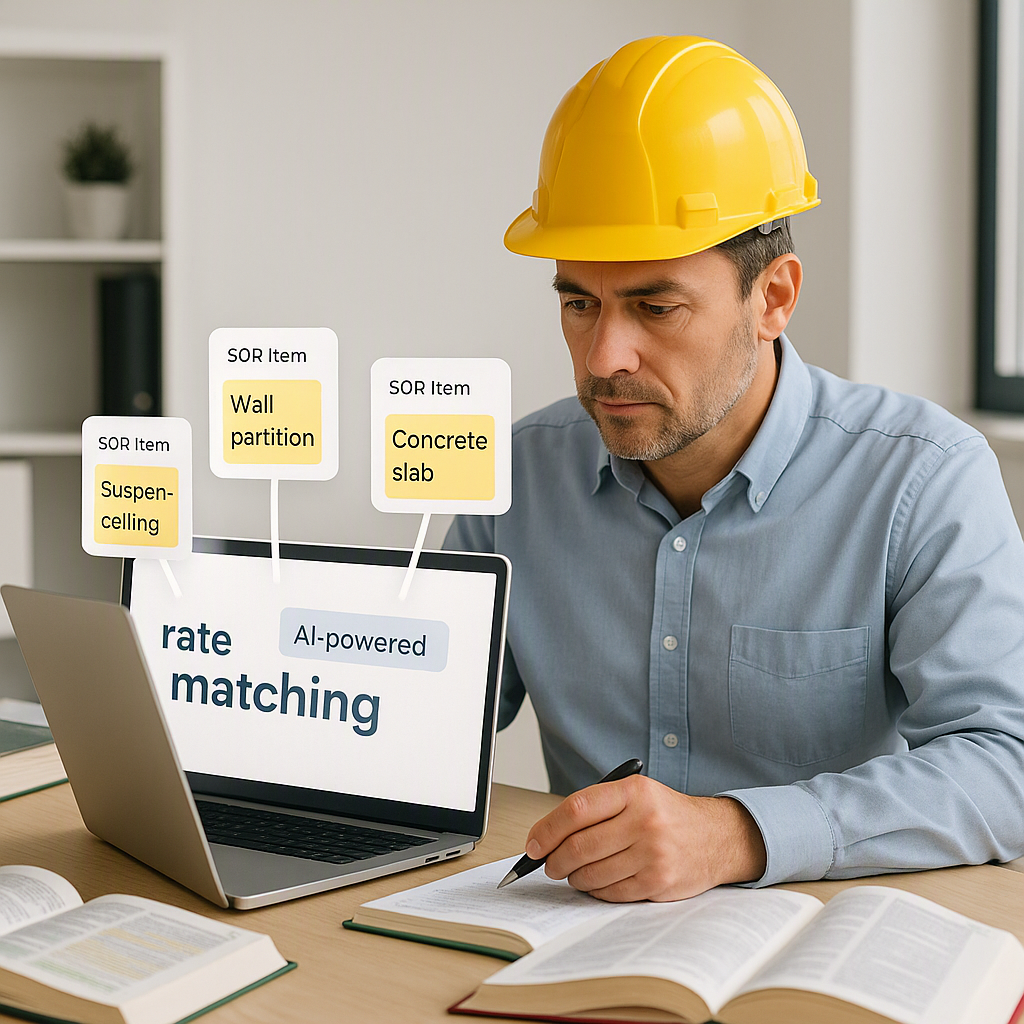
Forget manually flipping through PDFs. With AI, you simply type what you’re looking for, and the system understands context, synonyms, and variations in phrasing.
Example: Searching for “pre-stressed concrete girders” will pull up all relevant rates, even if they’re listed under slightly different terms like "prestressed beams" or "reinforced girders."
2. Feedback Loops
The system learns from your corrections. If you pick a rate and adjust it, the AI remembers your preferences for future projects. By your third or fourth project, it’s tailoring suggestions based on your historical decisions.
Stat: Users of EstimateNext report a 20-30% improvement in accuracy by their third project.
3. Multi-Catalog Integration
Whether you rely on RSMeans, CPWD DSR, or a regional SOR, the AI integrates all catalogs into one searchable database. No more toggling between books or PDFs.
4. Custom Rates
Have unique project requirements? You can upload your own rate catalog, and the AI will incorporate it seamlessly for future use.
Tip: This feature is particularly useful for contractors working on niche projects like green buildings or high-tech facilities where standard rates don’t apply.
Real-World Impact
Let’s talk about the tangible benefits of ditching manual rate matching for AI-powered tools:
Case Study: Mid-Sized Contractor
A mid-sized contractor bidding on a 20-story high-rise project transitioned to AI for rate matching and takeoffs. Here’s what they achieved:
- Time Saved: 120 hours over a two-month period.
- Cost Savings: Approximately $6,000 in labor costs (based on $50/hour for estimating staff).
- Increased Capacity: With the time saved, the team was able to pursue two additional bids that quarter, one of which they won.
- Improved Accuracy: An 80% reduction in takeoff discrepancies, ensuring tighter budget control and fewer surprises during execution.
Data Point: Industry-Wide Savings
According to McKinsey, adopting AI in preconstruction processes can reduce overall project costs by 5-10%. For a $50 million project, that’s a potential savings of $2.5 to $5 million.
Objections: “But AI Doesn’t Understand Nuance”
It’s true—AI doesn’t understand the unique challenges of your project or the nuances of subcontractor negotiations. But that’s not its job. Its role is to handle the repetitive, error-prone tasks so you can focus on strategic decision-making.
Think of AI as a power tool. It won’t replace your expertise, but it will amplify your efficiency.
How to Get Started
Ready to ditch the inefficiencies? Here’s how to make the transition to AI-powered rate matching:
- Start Small: Test AI tools on a smaller project to evaluate their accuracy and ease of use.
- Integrate Gradually: Most AI platforms, like EstimateNext, integrate with tools you’re already using, such as Bluebeam, Procore, or Excel.
- Train Your Team: Invest time in training your team. Most platforms offer user-friendly onboarding and training sessions, typically completed in under two weeks.
Decision Framework: Manual vs. AI Rate Matching
| Feature | Manual Rate Matching | AI-Powered Rate Matching |
|---|---|---|
| Speed | 12+ hours per BOQ | Seconds per rate |
| Accuracy | Prone to human error | High, with feedback loops |
| Scalability | Limited | Unlimited |
| Integration | None | Seamless with existing tools |
| Learning Curve | Repetitive, no knowledge base | Builds knowledge over time |
| Cost Efficiency | High labor costs | Lower labor costs |
The Bottom Line
Manual rate matching isn’t just inefficient—it’s outdated. AI-powered tools like EstimateNext are changing the game by making rate lookup faster, smarter, and more accurate. If you’re tired of wasting hours flipping through rate books, it’s time to make the switch.