Stop Wasting Hours Flipping Through Rate Books
If you've ever priced a bid, you know the drill. You're staring at a 2,000-page rate book, hunting for the cost of a specific item. It's tedious, error-prone, and eats up hours. Worse, if you're working on a tight deadline (which is basically every bid), mistakes creep in. Miss a critical rate adjustment, and suddenly your bid is off by thousands—or even millions—of dollars.
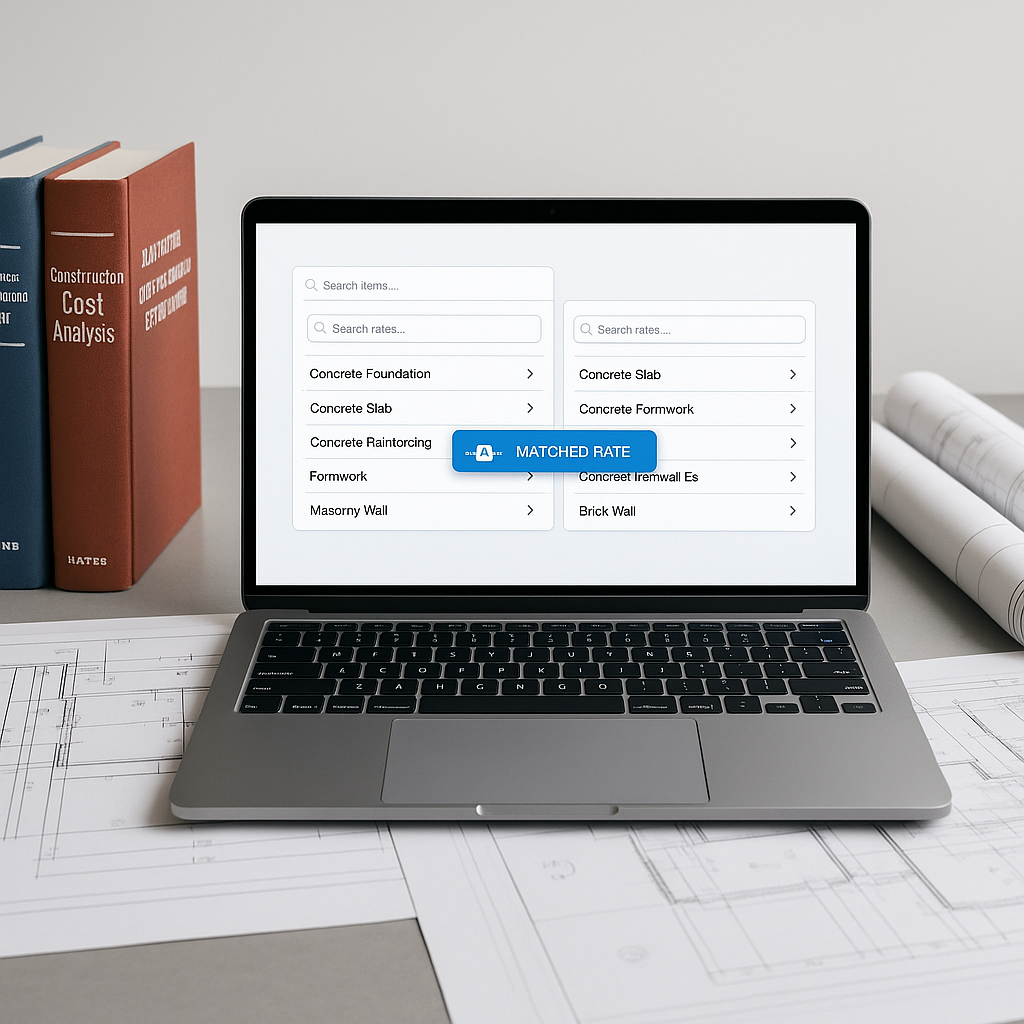
Does it have to be this painful? Nope. AI-powered rate matching changes everything. Platforms like EstimateNext can pull rates from 78,000+ items across multiple catalogs in seconds. Need the labor cost for pre-stressed concrete girders? Type it in. Done.
Let’s talk specifics.
The Hidden ROI of AI Rate Matching
Let’s put a number on this. Flipping through rate books eats up an average of 12 hours per estimate, according to a 2023 McKinsey report. For a general contractor handling five GMP pursuits a year, that’s 60 hours gone. Multiply that by $130/hour (the average loaded cost of an estimator in the U.S.), and you're looking at $7,800 wasted annually—just on rate lookups.
Now let’s add complexity. What if you’re a subcontractor juggling 30 bids a year? That’s 360 hours or $46,800 wasted. And that’s before we even talk about the opportunity cost of missed bids.
With AI tools like EstimateNext, rate lookup time drops to seconds. That’s a 1,440X speed improvement. Instead of wasting time digging through PDFs, your team can focus on higher-value tasks—like refining bid strategies or negotiating with subs.
Actionable Step: Calculate Your Own ROI
Want to know how much time and money you’re wasting? Track your rate lookup time for just one project. Multiply that by the number of bids you handle annually, and then multiply again by your hourly loaded rate. Seeing the number in black and white can be the wake-up call your team needs.
How AI-Powered Rate Matching Works
Here’s the magic:
-
Semantic Search: Instead of manually flipping through pages, AI uses natural language processing to match your query with the most relevant rate in the database. It’s like having Google for construction costs. For example, type "labor cost for rebar installation" into the platform, and you’ll see rates from multiple catalogs instantly.
-
Custom Catalog Integration: Got your own rates? No problem. AI tools let you upload custom catalogs. For example, if you’re pricing a high-end office fit-out, you can integrate your FF&E rates seamlessly.
-
Self-Learning Algorithms: The system gets smarter with use. Accept or reject matches, and the tool adjusts. By the third project, accuracy improves significantly—users report up to 99% precision by then.
-
Multi-Market Adaptability: Different projects, different rules. Whether it’s CPWD in India, RSMeans in the U.S., or AECOM in the UAE, AI systems like EstimateNext handle regional variations effortlessly.
Comparison Table: Manual Rate Matching vs AI-Powered Rate Matching
| Feature | Manual Rate Matching | AI-Powered Rate Matching |
|---|---|---|
| Time per lookup | 5–15 minutes | Seconds |
| Error rate | High (human fatigue) | Low (99% accuracy) |
| Custom catalog upload | Not possible | Fully supported |
| Regional compliance | Manual effort | Automated |
| Scalability | Limited | Unlimited |
Real-World Example: A $1B Rail Project
Here’s a case study to ground this. A general contractor bidding on a $1 billion rail project in the U.S. had to pull rates for hundreds of items—from structural steel to rail ties. Normally, this would take a senior estimator 56 hours, spread over several days. With EstimateNext, it took 10 minutes. That’s not just time saved—it’s a stress reduction for the entire team.
The GC didn’t just meet the bid deadline; they submitted early. That extra time was spent refining their bid, double-checking subcontractor quotes, and improving their presentations to the client. Ultimately, they won the project, securing millions in revenue.
Actionable Step: Test AI on a Smaller Project First
If you’re hesitant, start by using AI tools on a less complex project—maybe a $1M interior fit-out or a small public works bid. Measure the time savings and accuracy improvements. Once you see results, scaling to larger projects becomes a no-brainer.
The Obvious Objection: “But AI Can’t Think Like an Estimator”
I hear this a lot. “Sure, AI is fast, but it doesn’t understand the nuances of construction.”
You’re right—it doesn’t. But here’s the thing: AI doesn’t replace your expertise; it amplifies it. You’re still the one making judgment calls, negotiating with subs, and deciding on markup. The AI just handles the grunt work—like rate lookups and what-if recalculations.
Think of it this way: You wouldn’t manually calculate structural loads when software like STAAD exists, right? So why are you still doing manual rate matching?
Comparison: Human Expertise vs AI
| Task | Human Expertise Needed | AI Efficiency |
|---|---|---|
| Rate lookup | Minimal | Maximum (seconds) |
| Adjusting for project scope | Essential | Assists with automation |
| Negotiation with subs | Critical | No role |
| Judgment on contingencies | Critical | No role |
Who Benefits the Most?
-
General Contractors (GCs): If you’re managing multiple GMP pursuits, AI tools free up senior estimators for high-value tasks. ROI? Huge. One GC director we worked with saved 40 hours per estimate—worth $5,200 per bid.
-
MEP Subcontractors: Speed is everything. AI rate matching lets you respond to more bids in less time. If you’re turning around quotes in 4 hours instead of 3 days, you’re ahead of 90% of your competition.
-
India Regional Contractors: Forget flipping through 2,000-page CPWD rate books. AI tools like EstimateNext let you search 78,000+ SOR items instantly. At INR 1,999/month, it’s a no-brainer.
-
Interior Fit-Out Specialists: Need to price a Cat-A fit-out with custom finishes? AI tools let you upload your own catalogs and back-solve $/SF instantly.
The Bigger Picture: Why AI Matters in Preconstruction
Preconstruction is 40% of the work but still 100% manual for most teams. That’s insane in 2024. AI tools like EstimateNext are finally changing that. They don’t just save time—they make bids more accurate, more competitive, and ultimately more profitable.
The question isn’t whether you’ll adopt AI in preconstruction. It’s when. Because the GCs and subs who do will dominate the next decade.


