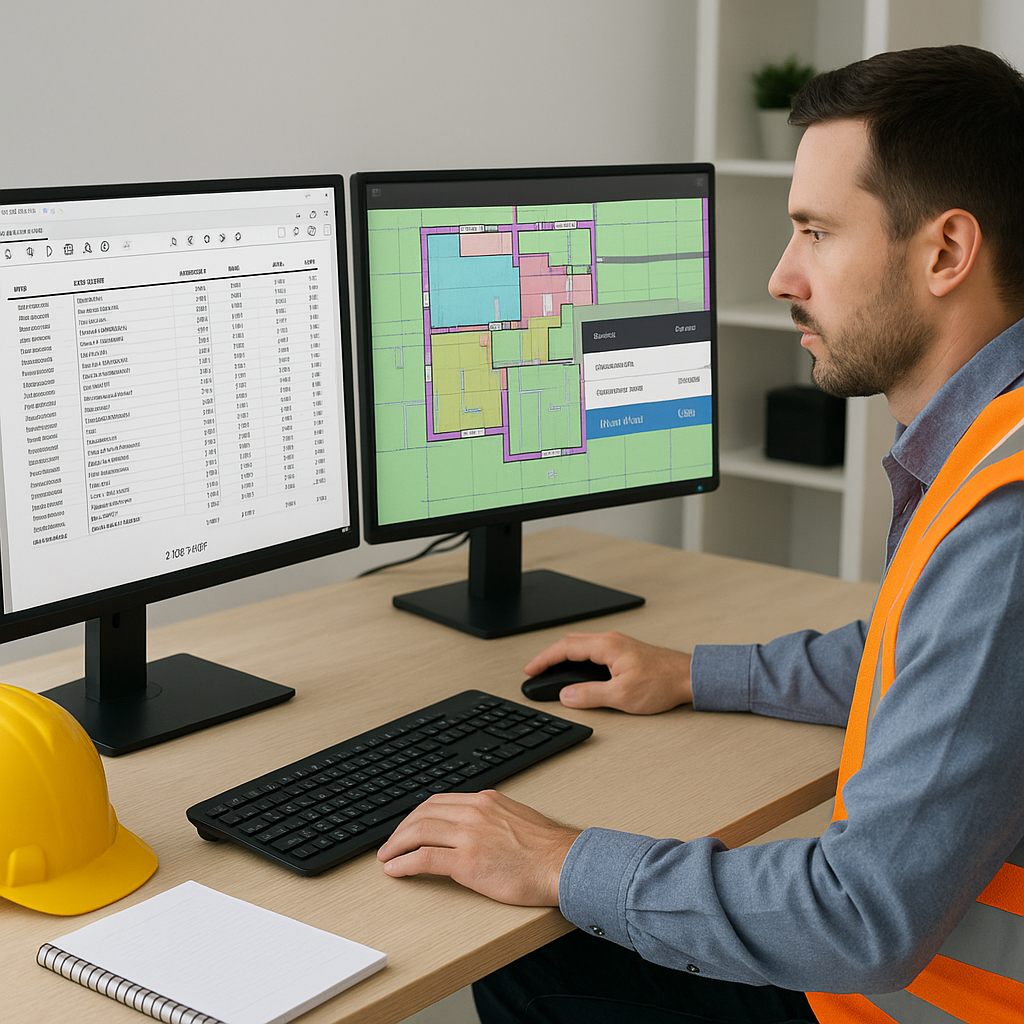
Flipping Pages or Flipping Bids?
Let’s be brutally honest—manual rate lookup is a nightmare. Ever tried finding the exact labor rate for installing a custom finish in a 2,000-page CPWD DSR or RSMeans catalog? Multiply that by 30 line items in a BOQ. That’s 12 hours gone. And for what? A fragile estimate that could miss the mark entirely if you pick the wrong rates.
That’s why AI-powered rate matching isn’t just a nice-to-have. It’s a game-changer (yeah, I said it). Tools like EstimateNext can plow through 78,000+ SOR items in seconds. Not minutes. Seconds.
But speed isn’t the only benefit. Let’s talk accuracy.
Why Manual Rate Matching Fails
Manual processes are riddled with human error. It’s not because estimators aren’t skilled. It’s because flipping between catalogs, spreadsheets, and drawings invites mistakes. A missed rate. A wrong unit. Or maybe you just grabbed the wrong year’s catalog.
One real-world example: a contractor lost a $2M bid because their estimator used 2021 rates instead of 2023’s inflated numbers. Inflation had increased material costs by 18% in two years, but that mismatch wasn’t caught until post-submission. And don’t even get me started on regional variations—what’s true for Delhi isn’t true for Bangalore.
AI tools solve this by cross-referencing rates with location, inflation, and catalog year in real time. No second-guessing.
For example, a contractor I worked with saved $342,000 on a multi-story build simply by avoiding rate mismatches. They used AI to validate every rate—materials, labor, equipment. No surprises.
What Makes AI Rate Matching Different?
It’s simple: context. A good AI tool doesn’t just spit out numbers. It understands your project. Here’s how:
- Semantic Search – You don’t need to know the exact catalog phrase for “pre-stressed concrete girders.” Just type “concrete beam installation,” and the AI does the rest. For instance, a contractor used EstimateNext to search "thermal insulation for HVAC systems" and found the exact match across three catalogs in seconds.
- Custom Catalog Integration – Got your own rates? AI tools let you upload them. They’ll even learn to prioritize your entries over default ones. A regional contractor in Texas uploaded their proprietary rates for oilfield construction and integrated them seamlessly into their bids.
- Smart Inflation Adjustments – A 2020 rate for steel in New York isn’t the same in 2024. AI tools auto-suggest CPI adjustments, saving hours of manual recalculation. The U.S. Bureau of Labor Statistics reported steel inflation rates of 15% between 2020 and 2022—AI tools account for such shifts automatically.
- Audit Trails – Every matched rate comes with a breakdown: material, labor, equipment, overhead. If something looks off, you can trace it back instantly.
These aren’t just features. They’re lifesavers when you’re chasing a $200M GMP bid.
The Skeptic’s Take: “AI Can’t Think Like Me”
I hear this a lot. “AI doesn’t understand the nuances.”
Here’s the truth: AI isn’t replacing your expertise. It’s amplifying it. You’re still the one deciding on markup, negotiating with subs, and making judgment calls. The AI just handles the grunt work—rate matching, inflation adjustments, and catalog lookups.
Think of it like hiring a junior estimator who never sleeps, doesn’t make typos, and learns from every project. Would you say no to that?
Real-World Proof: A Major Contractor’s Rail Bridge Bid
Take a major contractor’s large rail bridge project. They needed DOT-approved rates for everything from rail ties to structural steel. Normally, that would mean days of flipping through PDFs and Excel files. With AI, it took minutes. They uploaded the BOQ, matched rates in seconds, and had a complete estimate ready for review within an hour.
A similar success story comes from a mid-sized contractor bidding on a hospital renovation project. They used AI tools to cross-reference rates for specialized medical-grade flooring and saved $120,000 by catching a discrepancy in vendor pricing. Their preconstruction director told me, “It’s not just about saving time. It’s about submitting bids we know are competitive.”
How to Get the Most Out of AI Rate Matching
- Start Small – Test AI tools on a mid-sized project. Don’t jump straight into a $500M bid. Get comfortable with the workflow first.
- Use Feedback Loops – Most AI systems improve with use. Reject incorrect matches, add custom rates, and watch the tool get smarter. For example, one contractor’s AI system improved its accuracy by 15% after three projects.
- Combine with Manual Oversight – AI is accurate, but it’s not perfect. Always review critical rates before finalizing an estimate. Think of it as a safety net, not a replacement for your expertise.
- Integrate with Your Workflow – Look for tools that export to Procore, Bluebeam, or Excel. The best AI tools don’t disrupt—they complement.
Decision Framework: Manual vs. AI Rate Matching
| Criteria | Manual Rate Matching | AI-Powered Rate Matching |
|---|---|---|
| Speed | Hours to days | Seconds to minutes |
| Accuracy | Prone to human error | 99% accurate with feedback loops |
| Regional Adjustments | Requires manual input | Auto-adjusts for location and inflation |
| Catalog Integration | Limited to published rates | Custom catalogs and cross-referencing |
| Scalability | Time-intensive for large BOQs | Scales seamlessly across thousands of items |
| Cost Savings | Lost opportunities due to mismatches | Saves thousands in optimized estimates |


