The Bottleneck No One Talks About
Let’s be honest: rate lookup is a time-sink. If you’re an estimator, you’ve probably spent hours flipping through rate books like RSMeans or CPWD DSR. It’s tedious, error-prone, and wildly inefficient. Yet, it’s a critical step. A single missed rate or incorrect item can tank your bid.
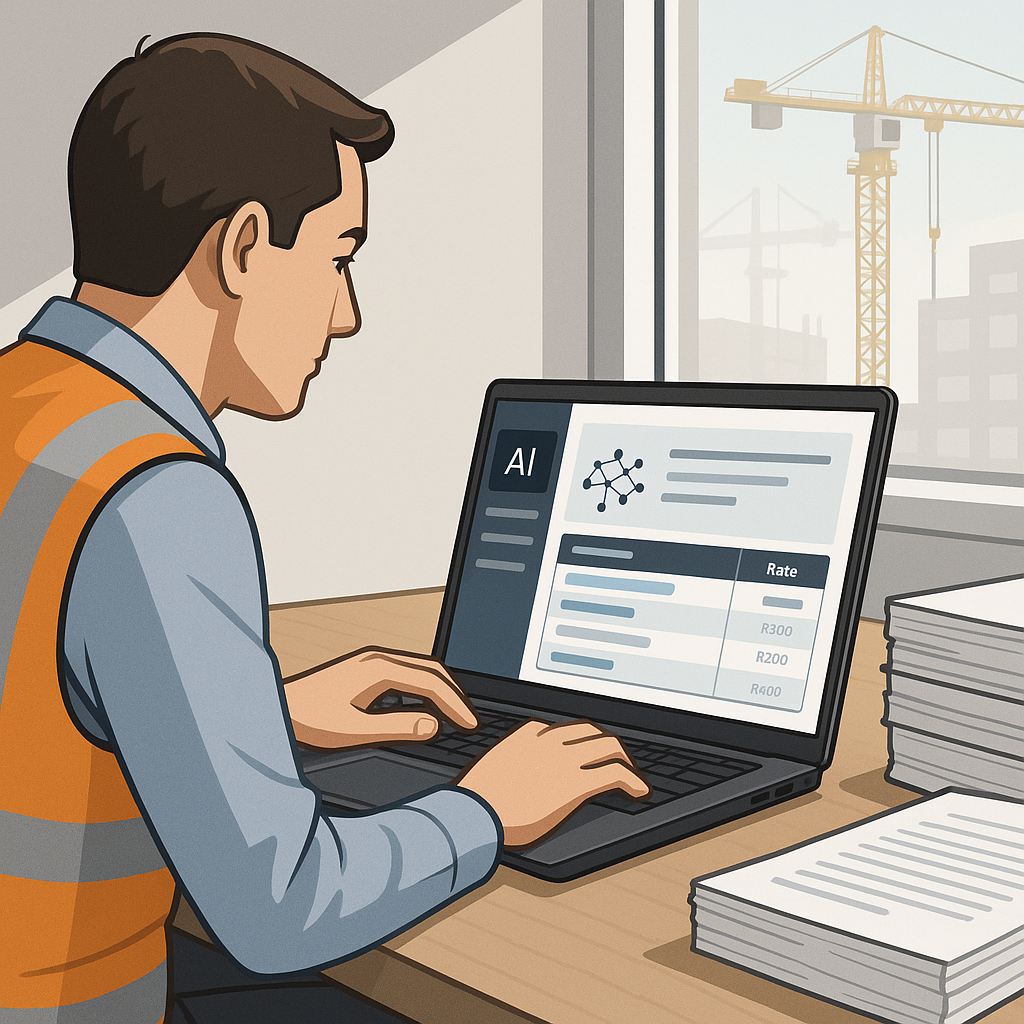
Now imagine this: instead of flipping through 2,000-page PDFs or endless Excel sheets, you type in what you need. In seconds, you get an accurate, AI-matched rate. No guesswork. No manual cross-checking. That’s what tools like EstimateNext bring to the table.
Why Manual Rate Lookup Is Broken
Traditional rate lookup methods have three major problems:
-
Time Sink: On average, estimators spend 12 hours per estimate just finding rates. That’s a day and a half gone before you’ve even started pricing. According to Deloitte’s 2022 Construction Insights Report, labor inefficiencies like rate lookups cost the industry billions annually.
-
Human Error: Ever misread a line in a rate book? Or worse, used a rate from the wrong region? It happens all the time, especially with tight deadlines. A missed rate can lead to a low bid, eating into profitability, or a high bid, costing you the job.
-
Non-Scalable: Bigger projects mean more rates to match. A $500,000 residential project might need 100 unique rates, but a $200 million commercial project can require 10,000. The more complex the bid, the more likely mistakes creep in.
These inefficiencies aren’t just annoying—they’re costly. A 2023 McKinsey report found that 88% of construction projects experience cost overruns, often linked to early estimation errors. Rate lookup might seem small, but it’s a domino that can topple the entire process.
Real-World Example: A Missed Rate Gone Wrong
In 2019, a U.S.-based general contractor won a $25 million healthcare project but forgot to adjust steel rates for a regional supplier. By the time the error surfaced, steel costs had increased 8%, cutting $400,000 from the project’s already tight profit margin. Worse, the contractor needed additional approvals to revise the budget, delaying the project by six weeks. The lesson? Even minor rate-matching errors can snowball into major financial and reputational damages.
How AI Rate Matching Works
Here’s the magic of AI-powered rate matching: it uses semantic search. Instead of keywords, it understands context. Need the labor rate for installing pre-stressed concrete girders? Just type it. The AI scans 78,000+ SOR items across catalogs like CPWD DSR, RSMeans, and more. Seconds later, you’ve got your match.
The beauty lies in its adaptability. For example, EstimateNext lets you upload your own custom rate catalogs. Got a unique material or finish? Add it once, and the system integrates it for future estimates. By the third project, users report significant accuracy improvements. The AI learns as you go.
Actionable Steps to Implement AI Rate Matching
- Start Small: Pick a single project and test the AI tool alongside your manual process. Compare results for accuracy and time savings.
- Upload Custom Rates: If you use proprietary materials or regional suppliers, upload your custom catalogs to train the AI.
- Iterate and Improve: Use the feedback loop. Correct mismatches, and the system will improve with every project.
- Monitor Confidence Scores: Many tools, like EstimateNext, provide confidence scores for rate matches. Focus on low-confidence matches for manual review.
Real-World Example: A $1B Rail Project
Let’s take a real-world case: a $1 billion rail bridge project. The contractor needed rates for everything from rail ties to structural steel. Flipping through DOT-approved catalogs manually would’ve taken days. With AI, this was done in under 10 minutes. That’s not just faster—it’s smarter. The AI also flagged potential mismatches, ensuring no scope gaps.
In their own words: “It’s like hiring another estimator, but one that works 24/7 and never makes a typo.”
Comparison Table: Manual vs. AI Rate Lookup
| Feature | Manual Lookup | AI-Powered Lookup |
|---|---|---|
| Time Required | 10-12 hours per estimate | 10 minutes per estimate |
| Error Rate | 5-10% | <1% with feedback |
| Scalability | Limited by human effort | Unlimited |
| Learning from Corrections | None | Continuous improvement |
| Cost | High labor cost | Subscription-based |
Objection: “Can AI Really Be Trusted?”
You might be thinking, “Sure, AI is fast, but can it handle the nuances of construction?” Fair question. Here’s the reality: AI isn’t perfect, but it doesn’t need to be. It’s a tool, not a replacement. You’re still in control. With features like confidence scoring and manual overrides, AI gives you the final say. Think of it as a second pair of (very fast) eyes.
Case Study: A Mid-Sized Subcontractor
A 30-person MEP subcontractor faced constant delays during the bidding process. After integrating EstimateNext, their quote turnaround dropped from 3 days to 4 hours. The team estimated a 50% increase in bids submitted annually, resulting in a 15% revenue bump. “We didn’t lose control—we gained bandwidth,” their senior estimator said.
The ROI of AI Rate Matching
Let’s talk numbers. If you’re saving 12 hours per estimate, and your team works on 50 estimates a year, that’s 600 hours saved annually. At $130/hour for a senior estimator, that’s $78,000 back in your budget.
For smaller teams, the ROI scales even faster. A mid-sized MEP subcontractor using EstimateNext saw a 4-hour quote turnaround compared to their usual 3-day cycle. That meant 50% more bids responded to—and more wins.
Key Metrics to Track ROI
- Time Saved per Estimate: Use time logs to calculate pre- and post-AI implementation.
- Bid Volume Increase: Track how many additional estimates your team can handle.
- Win Rate: Monitor if faster bids improve your win percentage.
What If My Rates Are Custom?
No problem. AI systems like EstimateNext let you define custom rates for specific items. This flexibility ensures you’re not locked into generic databases. And because the system learns from your adjustments, it gets better with every project.
Why This Matters Now
With construction costs skyrocketing—thanks to inflation, labor shortages, and supply chain issues—there’s no room for inefficiency. AI isn’t just a tech trend; it’s a necessity. Early adopters in construction are already seeing 10-20% cost savings per project, according to McKinsey. The longer you wait, the harder it gets to compete.
Call to Action
If you’re tired of wasting hours on manual rate lookups, it’s time to try AI. EstimateNext slashes that time to seconds, giving you accurate, reliable rates without the hassle. Get started free →


