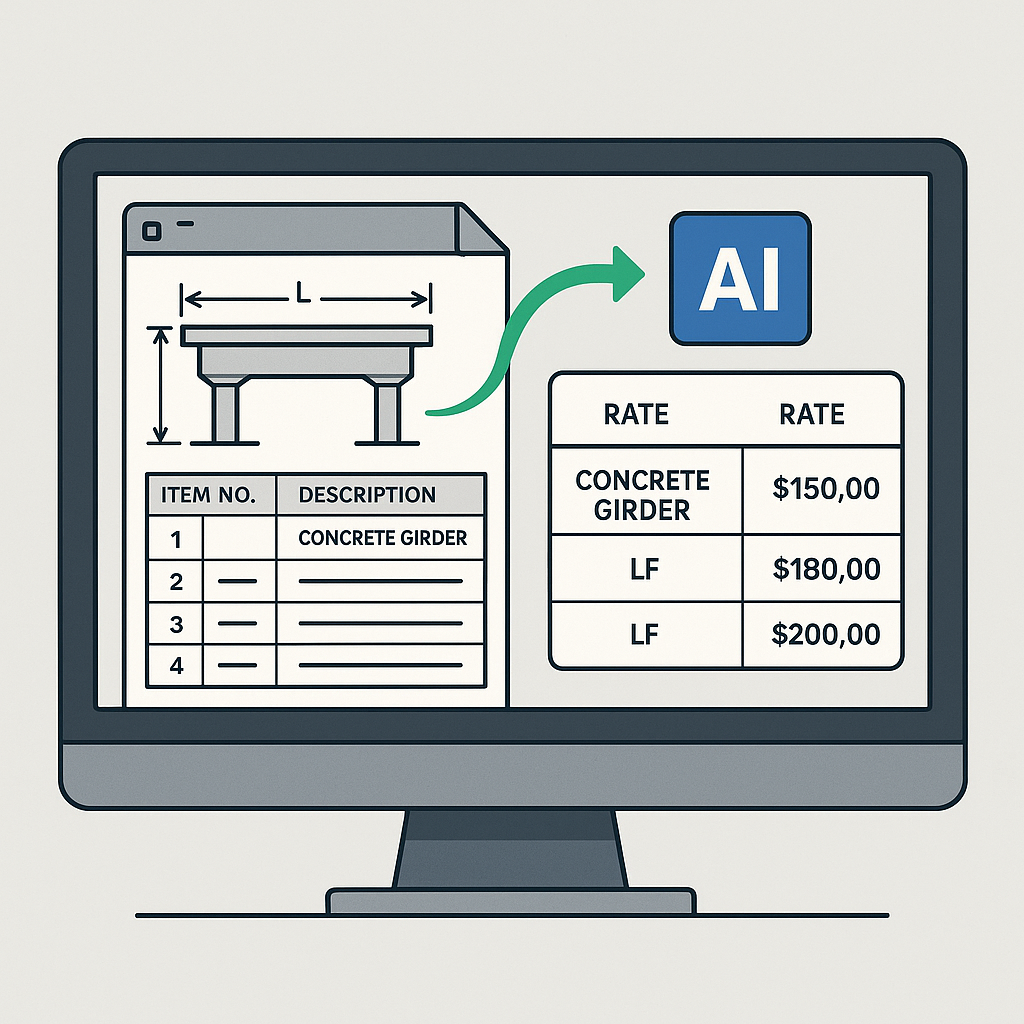
The Problem: Why Rate Matching Feels Like a Black Hole
Ever watched an estimator flip through a 2,000-page rate book for hours just to price one BOQ (Bill of Quantities) line? It’s painful. And it’s not just small contractors—I've seen Top-100 US general contractors (GCs) stuck in the same time sink. Rate lookups are tedious, error-prone, and they bleed time you don’t have during bid season.
Here’s the kicker: every mistake costs you. Misinterpreted rates inflate bids or leave money on the table. Either way, you're losing. For example, a missed rate adjustment on a subcontractor's bid could lead to underpricing services by 15%, cutting already-thin margins. On the flip side, overpricing by even 5% could result in losing a $5 million project to a competitor.
It doesn’t have to be this way. AI-powered rate matching tools like EstimateNext can process over 78,000 SOR (Schedule of Rates) items in seconds. That’s not hype—it’s math. If you’re spending 12 hours manually hunting rates, AI can cut that to 10 minutes.
A Real Example: A Major GC’s $1B Rail Bridge
Picture this: a massive rail project with rates for everything from concrete girders to structural steel. Traditionally, the manual method would involve flipping through DOT-approved catalogs for each labor, material, and equipment rate. This is an exhausting, weeks-long process prone to human error.
Instead, the contractor’s team used AI to match rates instantly. The result? Faster pricing, fewer errors, and more time to focus on value engineering. According to a published case study, a project like this can shave roughly two weeks off the preconstruction timeline and improve accuracy meaningfully. For a $1 billion project, even a 1% improvement in cost accuracy translates to $10 million in potential savings. That’s the kind of ROI you can’t ignore.
Want a smaller-scale example? A regional subcontractor bidding on a $5 million hospital wing project reduced their rate-matching process from three days to three hours using EstimateNext. The difference? They submitted their bid two days earlier than competitors and won the job.
How AI Rate Matching Works
Here’s how AI transforms rate matching from a black hole into a quick, reliable process:
1. Semantic Search
AI doesn’t just match keywords; it understands context. For example, if you type “install pre-stressed concrete girders,” it pulls the labor, material, and equipment rates instantly—even if the exact wording in the rate book is different. No flipping through PDFs or second-guessing obscure terminology.
2. Custom Catalogs
Got unique, project-specific rates? AI lets you upload and integrate them. For example, if your client requires a custom finish for a high-rise, you can input their specifications and have them ready for future bids. This feature is particularly useful for contractors working with specialized materials or regional variations in pricing.
3. Feedback Loops
AI tools improve with use. Adjust rates once, and the system remembers. By your third project, most users report near-perfect matches. For instance, after uploading three past projects, a general contractor bidding on municipal infrastructure projects saw the AI correctly predict 96% of the required rate matches without manual intervention.
4. Multi-Currency and Localization
For international contractors, AI can handle multi-currency rate catalogs and region-specific labor rules. Whether you're flipping between USD, AED, or EUR, the system seamlessly adjusts.
The Obvious Objection: “AI Can’t Think Like an Estimator”
You might be thinking, “Sure, AI is fast, but it doesn’t understand the nuances of construction.” That’s partially true—but it’s missing the point. AI doesn’t replace your expertise; it amplifies it. You’re still the one making judgment calls, negotiating with subs, and deciding on markup. The AI just handles the grunt work.
Think of it like a power drill. You wouldn’t drill hundreds of holes manually when a tool exists to do it faster and with greater precision. AI is the same for rate matching—it speeds up the tedious parts, so you can focus on strategy and decision-making.
ROI: Why Speed Matters
Let’s break down the numbers:
- Manual Rate Matching: If your team spends 12 hours per estimate at $130/hour, that’s $1,560 per bid.
- AI Rate Matching: AI cuts that time to 10 minutes. Across five GMP (Guaranteed Maximum Price) pursuits a year, you’re saving $7,800 just on rate matching.
Now, let’s scale this for subcontractors responding to 60 bid packages annually:
- Manual: 60 x $1,560 = $93,600/year
- AI-powered: 60 x $21 (10 minutes @ $130/hour) = $1,260/year
- Savings: $92,340/year
Faster quotes mean more bids submitted—and more wins. For example, an MEP contractor who used AI to respond to 20% more bids annually reported a 15% increase in awarded projects.
Edge Cases: What If My Rates Are Custom?
Good question. AI tools like EstimateNext let you upload custom rate catalogs, solving one of the biggest hurdles for contractors. Whether it’s tenant-specific finishes, niche materials, or unique labor agreements, the system integrates seamlessly.
Examples of Edge Cases Solved by AI:
- Government Contracts: Indian contractors working with CPWD (Central Public Works Department) rate books can upload the 2,000-page PDFs into the system and let AI handle the rest.
- Multi-Country Rates: GCC firms (operating in UAE, Saudi Arabia, Qatar, etc.) often juggle multi-country projects with rates in AED, SAR, and QAR. AI automatically adjusts for currency and local labor rules.
- Custom Materials: A high-end residential builder in New York uploaded a bespoke catalog for luxury finishes, ensuring accurate pricing for marble flooring, custom cabinetry, and other premium items.
Why You Need AI Now
Manual rate matching isn’t just slow—it’s risky. Every missed rate or overlooked item undermines your bids. AI eliminates those risks by delivering accurate matches in seconds. And it’s not just about speed; it’s about trust. When your subs see consistent, transparent pricing, they’re more likely to work with you.
Additionally, consider the competitive advantage. If you can submit bids faster and with higher accuracy than your competitors, you’re not just saving money—you’re winning more work. Speed and precision aren’t optional in today’s construction landscape; they’re mandatory.
Comparison Table: Manual vs. AI-Powered Rate Matching
| Feature | Manual Process | AI-Powered Process |
|---|---|---|
| Time Per BOQ Line | 10-15 minutes | Instant |
| Error Rate | 5-10% | 1-3% |
| Custom Rate Integration | Manual updates required | Automatic |
| Scalability | Limited by staff time | Unlimited |
| Cost Efficiency | High labor cost | Low operational cost |
| Learning Curve | None | 1-2 weeks |
Call to Action
If you’re tired of wasting hours on rate lookups, EstimateNext can help. Upload your BOQ and get priced estimates in minutes. Don’t let outdated processes hold you back. Get started free →


