Why Manual Rate Matching is a Time Sink
Let’s face it: flipping through 2,000-page rate books is a nightmare. Whether it’s RSMeans, CPWD DSR, or your custom catalog, finding the right rates eats up hours. For most estimators, rate matching is like solving a puzzle blindfolded. You waste time re-checking numbers, confirming compliance, and double-checking scope just to avoid costly mistakes. It’s tedious. Worse, it’s expensive.
The Cost of Manual Rate Matching
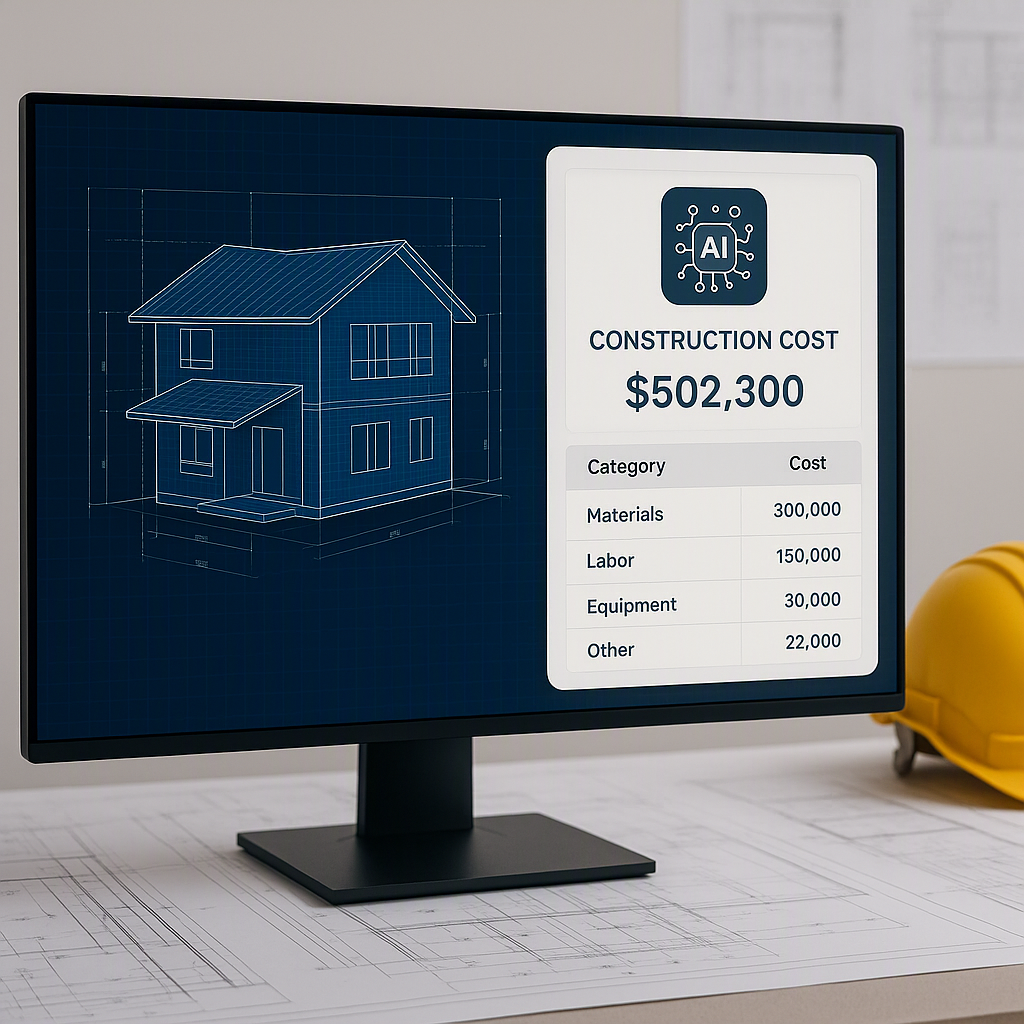
How expensive? Let’s break it down. Say it takes 12 hours to match rates for one bid. At $130/hour (the average estimator cost), that’s $1,560 per estimate. Multiply that by five GMP (Guaranteed Maximum Price) pursuits a year, and you’re burning nearly $8,000 annually per estimator—just flipping pages. For a 10-person estimating team, that’s $80,000 a year spent on what is essentially data entry.
This doesn’t even consider the added costs of mistakes. According to a 2019 Navigant Construction Forum report, manual data entry errors account for 2–5% of project costs. On a $10M project, a 3% error rate could mean $300,000 in budget overruns. Suddenly, that $8,000 per estimator seems like the least of your worries.
AI Rate Matching: A Smarter Solution
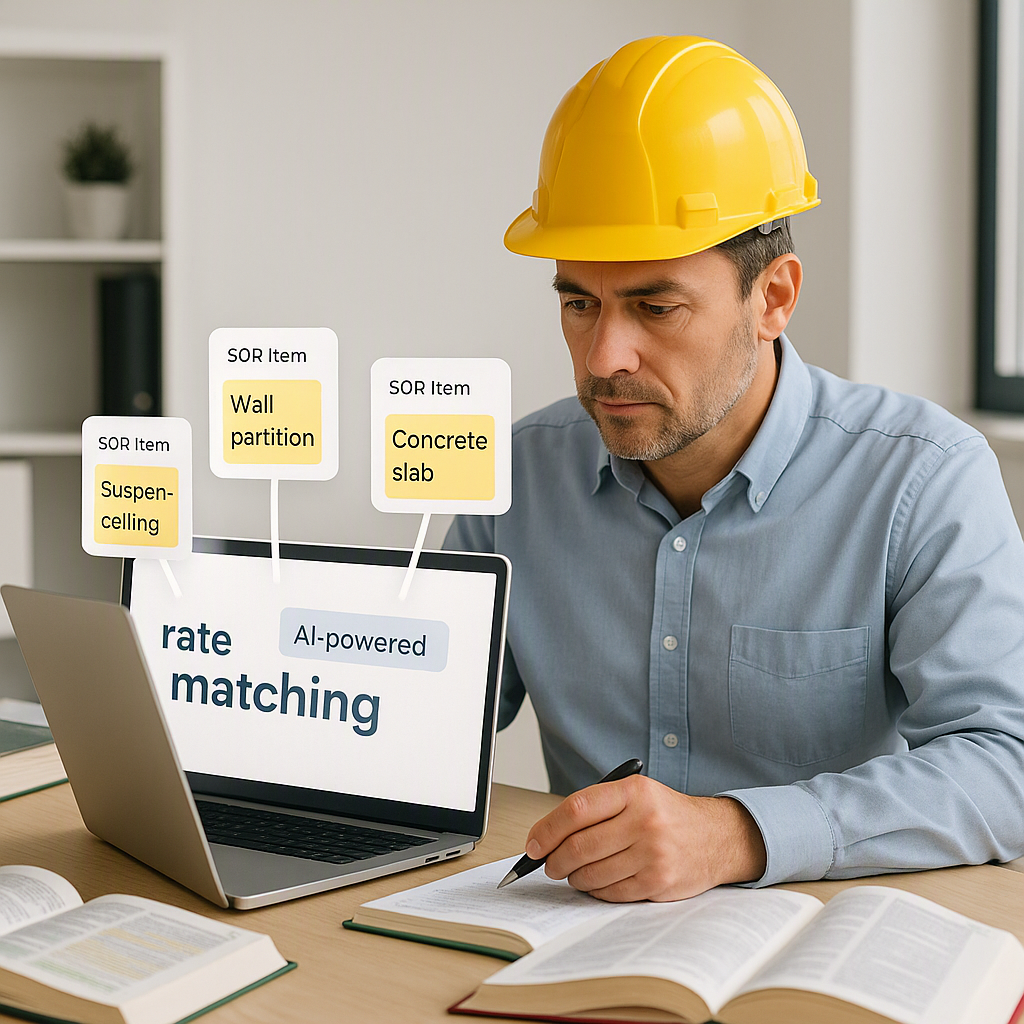
This is where AI-powered tools like EstimateNext come in. Instead of manually searching rate books, EstimateNext uses semantic search across 78,000+ Standard Operating Rates (SOR) items. Need labor rates for installing pre-stressed concrete girders? Type it in, and the system finds matches in seconds. Done.
Real-World Example: Saving Time and Reducing Errors
Here’s a real-world example: A general contractor (GC) team bidding on a $120M rail project recently used EstimateNext’s AI rate matching. With thousands of rates to pull from DOT-approved catalogs, the team saved 12 hours per estimate. That’s a full day of labor avoided—not to mention the reduced risk of errors. Their own case study notes that AI tools eliminate up to 80% of discrepancies, meaning fewer change orders post-award.
Step-by-Step: How AI Rate Matching Works
- Upload Your Catalogs: Whether you’re using RSMeans, CPWD DSR, or a custom catalog, upload your data into the tool.
- Search Intuitively: Use natural language to search. For example, type, "labor cost for HVAC duct installation," and the system will fetch relevant rates.
- Review and Adjust: AI tools like EstimateNext provide confidence scoring, so you can quickly review high-probability matches.
- Export and Integrate: Once rates are matched, export the estimates directly into your preferred software like Procore or Excel.
The Hidden ROI
You might be thinking, “Sure, it’s faster—but does it really save money?” Absolutely. According to a 2023 McKinsey report, early adopters of AI estimation tools see average cost savings of 10–20% per project. For a $100M bid, that’s $10–20M in potential savings.
Example ROI Calculation
Let’s revisit the earlier example. Assume AI tools save 12 hours per estimate, and your team produces five bids per year. At $130/hour, that’s $7,800 in saved labor costs annually per estimator. Now factor in the reduced change orders and errors—if AI eliminates just 50% of a typical 3% error rate on a $100M project, that’s $1.5M in savings. The numbers add up quickly.
Cost Comparison: AI vs. Manual
| Method | Cost per Year (10 Estimators) | Error Risk | Efficiency |
|---|---|---|---|
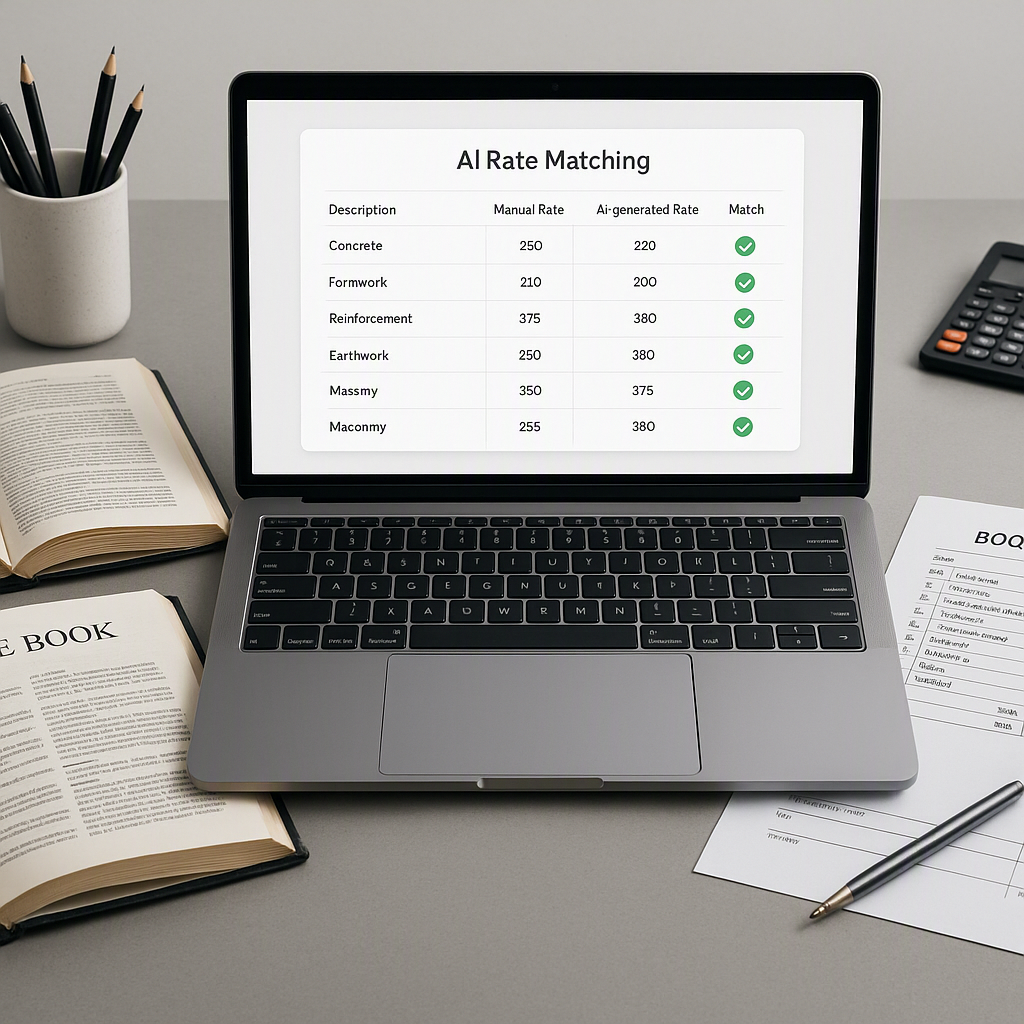
| Manual Matching | $80,000 | High (2–5% project cost) | Slow (12+ hrs per estimate) |
| AI-Powered Matching | $12,000 (EstimateNext) | Low (<1% with oversight) | Fast (seconds per estimate) |
What About Custom Rates?
You might be thinking, “But my projects use custom materials and finishes. Can AI handle that?” Good question. EstimateNext lets you upload custom catalogs and integrates them seamlessly for future use. The system gets smarter with feedback loops—most users report significant accuracy improvements by their third project.
Real-World Success: MEP Subcontractor Case Study
For example, an MEP (Mechanical, Electrical, Plumbing) subcontractor used EstimateNext to upload custom labor rates for a high-rise HVAC installation. The AI matched their custom rates in seconds without compromising accuracy. They shaved three days off their quote turnaround and responded to 50% more bids that quarter. With an average bid win rate of 20%, that’s potentially 1–2 more projects won per quarter.
The Obvious Objection: “AI Can’t Think Like an Estimator”
I get this pushback all the time. You might be thinking, “Sure, AI is fast, but it doesn’t understand the nuances of construction.” That’s partially true—but it’s also missing the point. AI doesn’t replace your expertise; it amplifies it. You’re still the one making judgment calls, negotiating with subs, and deciding on markup. The AI just handles the grunt work.
How AI Amplifies Human Expertise
- Time Savings: Spend more time on strategic decisions instead of repetitive tasks.
- Error Reduction: Use confidence scoring and feedback loops to ensure accuracy.
- Scalability: Bid on more projects without increasing headcount.
In my view, that’s the real value. By automating the repetitive stuff, you free up time for the high-value tasks that actually move the needle. More bids, better subcontractor coordination, smarter risk analysis—it’s about working smarter, not harder.
Practical Takeaways
- Test Small First: Start with a smaller project to test accuracy. Most tools, including EstimateNext, scale easily once you’re confident.
- Upload Custom Rates Early: Don’t let unique materials or labor costs derail adoption. Custom catalogs solve this.
- Train Junior Estimators: Pair less experienced staff with AI tools to free up senior team members for strategy.
- Set Feedback Loops: Use manual overrides and feedback to improve AI accuracy over time.
- Monitor ROI: Track time savings and error reductions to measure the tool’s impact.
Call to Action
If you’re tired of wasting hours on manual rate matching, EstimateNext can help. Get started free →