The Real Problem with Preconstruction Estimation
If you're still flipping through 2,000-page rate books for every bid, you're not alone. Estimators have been stuck in this manual grind for decades. Need a labor rate for installing pre-stressed concrete girders? You pull out the RSMeans or CPWD DSR catalog, search for the item, manually check for inflation adjustments, and hope you didn't miss anything. It's tedious, error-prone, and just plain slow.
Anecdotally, I’ve seen senior estimators spend half a workday just cross-referencing rates for one section of a BOQ. Multiply that across a full estimate, and you're looking at 12 hours lost—per project. And if you're managing multiple bids a month, this inefficiency adds up to real dollars wasted. A study by Dodge Data & Analytics found that 35% of construction professionals cite poor estimation workflows as their biggest bottleneck, leading to missed deadlines and inflated costs.
The Hidden Costs of Sticking to Manual Processes
Let’s break it down further. Manual estimation isn’t just about lost time—it introduces avoidable risks, such as:
- Human Errors: Forgetting to adjust for inflation or regional cost multipliers can result in underestimated bids, which erode profit margins. A wrongly priced bid can cost a contractor anywhere from 5-15% of the project value, according to a Construction Industry Institute report.
- Missed Opportunities: Spending days on one bid means you don’t have bandwidth to bid on others. A survey by JBKnowledge revealed that 48% of contractors bid on fewer projects than they’d like due to time constraints.
- Team Burnout: Repeating tedious tasks demoralizes senior estimators, pushing them toward early retirement or other industries.
Clearly, something needs to change. Enter AI-powered estimation tools.
AI Rate Matching: A Better Way
This is where AI-powered tools like EstimateNext change the game. Instead of flipping through PDFs, semantic search lets you type in the item you need—say, “pre-stressed concrete girder labor rate”—and get an accurate match in seconds. It’s not just faster; it’s smarter.
Real-World Example: EstimateNext in Action
Imagine you’re bidding on a new hospital project. You need rates for:
- Labor and materials for concrete slabs
- HVAC duct installation
- Electrical wiring for operating rooms
With traditional methods, finding these rates across catalogs could take hours. But with EstimateNext, you can:
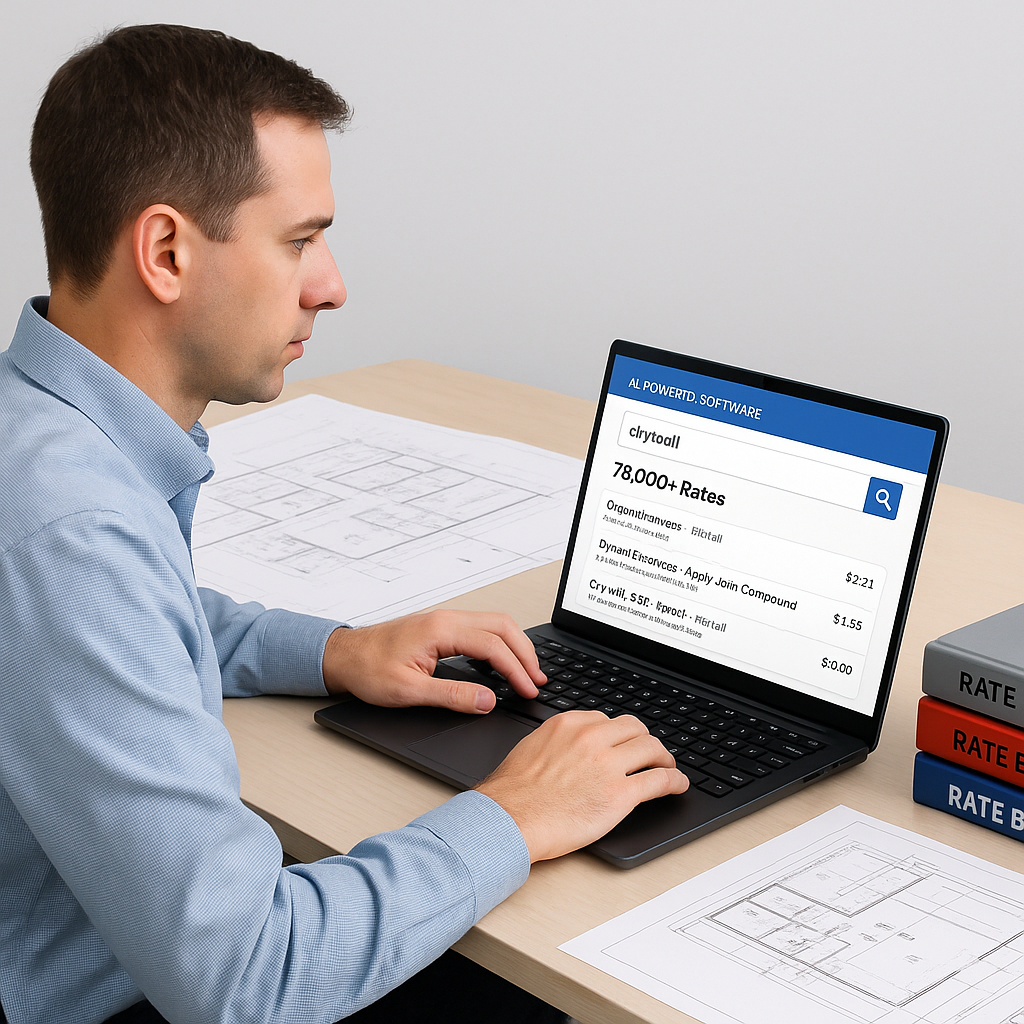
- Search for Items: The AI pulls from a database of 78,000+ SOR items across 135 catalogs.
- Apply Adjustments: The tool factors in tenant history, user-defined catalogs, inflation rates, and regional cost multipliers.
- Match Accurately: Even if an item isn’t listed verbatim, the AI uses semantic understanding to suggest the closest match.
For example, when working on a large GC’s rail bridge project, where DOT-approved rates for rail ties and structural steel were non-negotiable, AI rate matching can ensure compliance while saving the team roughly 30 hours of rate-matching work.
Why Accuracy Matters
Here’s the kicker: speed is useless without accuracy. AI tools don’t just spit out the first rate they find. They consider inflation adjustments, labor percentages, equipment costs, and even tax regimes. You get a full material + labor + equipment breakdown with all audit trails intact.
Case Study: Mid-Sized GC Saves 120 Hours
A mid-sized general contractor bidding on a $50M high-rise used EstimateNext to streamline their process. Key outcomes included:
- Time Saved: 120 hours saved on rate matching alone.
- Accuracy Boost: 99% rate-matching accuracy by the third project.
- Cost Savings: Reduced bid preparation costs by $15,000.
These results aren’t unique. McKinsey reports that early adopters of AI in construction save 10-20% per project, underscoring the transformative potential of these tools.
Building Trust with AI
I know what you're thinking: "But AI can't think like an estimator." That’s partially true, and it’s a fair objection. AI doesn’t replace your expertise; it amplifies it. You’re still the one making judgment calls, negotiating with subs, and deciding on markup. The AI handles the grunt work—like rate matching and recalculating what-ifs.
Think of AI as Your Assistant
AI is like an assistant who never sleeps or makes careless mistakes. Here’s what it does:
- Handles Repetitive Tasks: Rate matching, inflation adjustments, and catalog lookups.
- Provides Insights: Suggests alternative materials or methods when budgets are tight.
- Improves Over Time: Learns your preferences and historical decisions to make better recommendations.
The result? More bids submitted, fewer errors, and less time wasted.
Practical Steps to Get Started
Ready to ditch the rate books? Here’s how to test AI rate matching on your next project:
- Upload Your BOQ: Use a platform like EstimateNext to parse your BOQ file (Excel/CSV). The tool will auto-detect merged cells, section headers, and hierarchies.
- Search for Rates: Type in your items directly or upload your own custom catalogs. Let the AI match them in seconds.
- Review and Adjust: Use the audit trail to verify labor, material, and equipment breakdowns. Apply inflation uplifts or regional cost factors as needed.
- Export Your Estimate: Generate professional reports in formats like CSI MasterFormat, NRM2, or CPWD DSR. Share them directly with your team or integrate with existing tools like Procore.
Decision Framework: Is AI Right for You?
| Criteria | Manual Estimation | AI-Powered Estimation |
|---|---|---|
| Time Required | Days per project | Hours per project |
| Accuracy | Prone to human error | 95-99% accuracy |
| Scalability | Limited to team size | Scalable to multiple bids |
| Upfront Investment | None | Subscription cost or licensing |
| Learning Curve | None | Minimal (1-2 weeks) |
Call to Action
If you're tired of wasting hours on manual rate lookups, EstimateNext’s AI-powered tools can help. Get started free →


