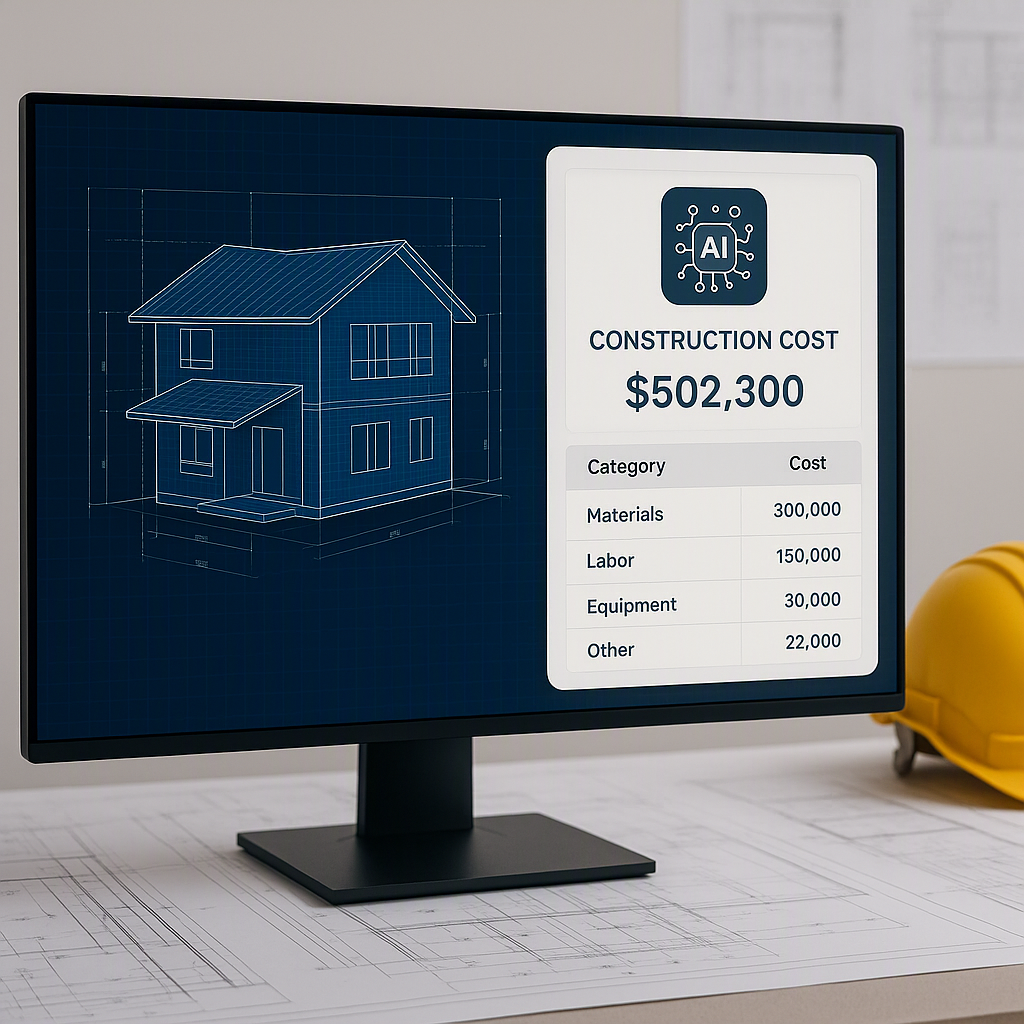
78,000 Rates in Seconds: Why AI is Changing Construction Estimation Forever
Imagine this: You’re pricing a $20M high-rise project. The Bill of Quantities (BOQ) lands on your desk, and you’re tasked with assigning rates to 500+ line items. What’s your first move? Most estimators grab their trusted rate book—whether that’s RSMeans, CPWD DSR, or a custom Excel sheet—and start flipping. Hours melt away as you cross-reference materials, labor, and equipment costs. Sound familiar?
It’s a broken process, and it’s costing you time, accuracy, and money.
AI-powered tools like EstimateNext are rewriting this script. Instead of spending 12 hours manually hunting through rate books, semantic search algorithms can surface matches in seconds. Yes, seconds. And that’s not just marketing fluff—it’s backed by real numbers and real workflows.
The Manual Rate Lookup Problem
Let’s get specific. Rate lookup for preconstruction estimation has three major pain points:
1. Volume Overload
A single rate catalog can run 2,000+ pages. For example:
- CPWD DSR (India’s Standard Rate Book): Includes 19 categories across 78,000+ items.
- RSMeans (US): Covers thousands of line items for materials, labor, and equipment.
Flipping through these manually isn’t just tedious—it’s error-prone. You might miss critical details or misinterpret rates, leading to costly mistakes during bidding.
2. Customization Gaps
What happens when your project requires non-standard materials or finishes? Traditional methods force you to manually derive rates or guesstimate costs. For instance:
- A contractor working on a luxury residential project might need to price imported Italian marble—something not listed in standard catalogs.
- Or, in regions with unique environmental requirements (e.g., hurricane-resistant materials in Florida), traditional rate books often fall short.
These gaps introduce inconsistencies, risking both overbidding and underbidding.
3. Time Drain
A mid-sized general contractor typically spends 12-15 hours on rate lookup per bid. Multiply that by 5-8 Guaranteed Maximum Price (GMP) pursuits a year, and you’re looking at over 100 hours wasted annually—per estimator.
In an industry where margins are razor-thin, those inefficiencies add up fast. For companies bidding on multiple projects simultaneously, this bottleneck can mean missed deadlines or rushed, error-prone submissions.
How AI Rate Matching Works
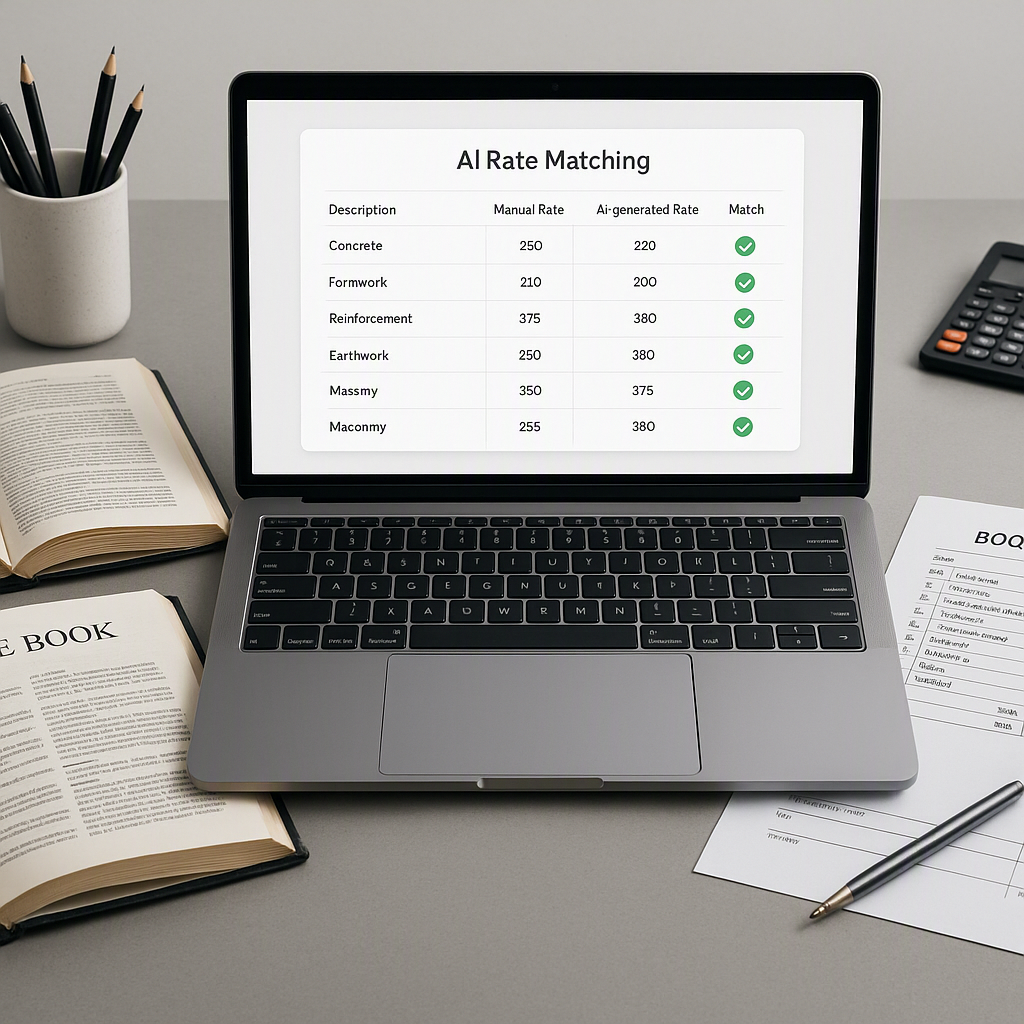
AI tools like EstimateNext solve this problem by automating rate matching. Here’s how it works step-by-step:
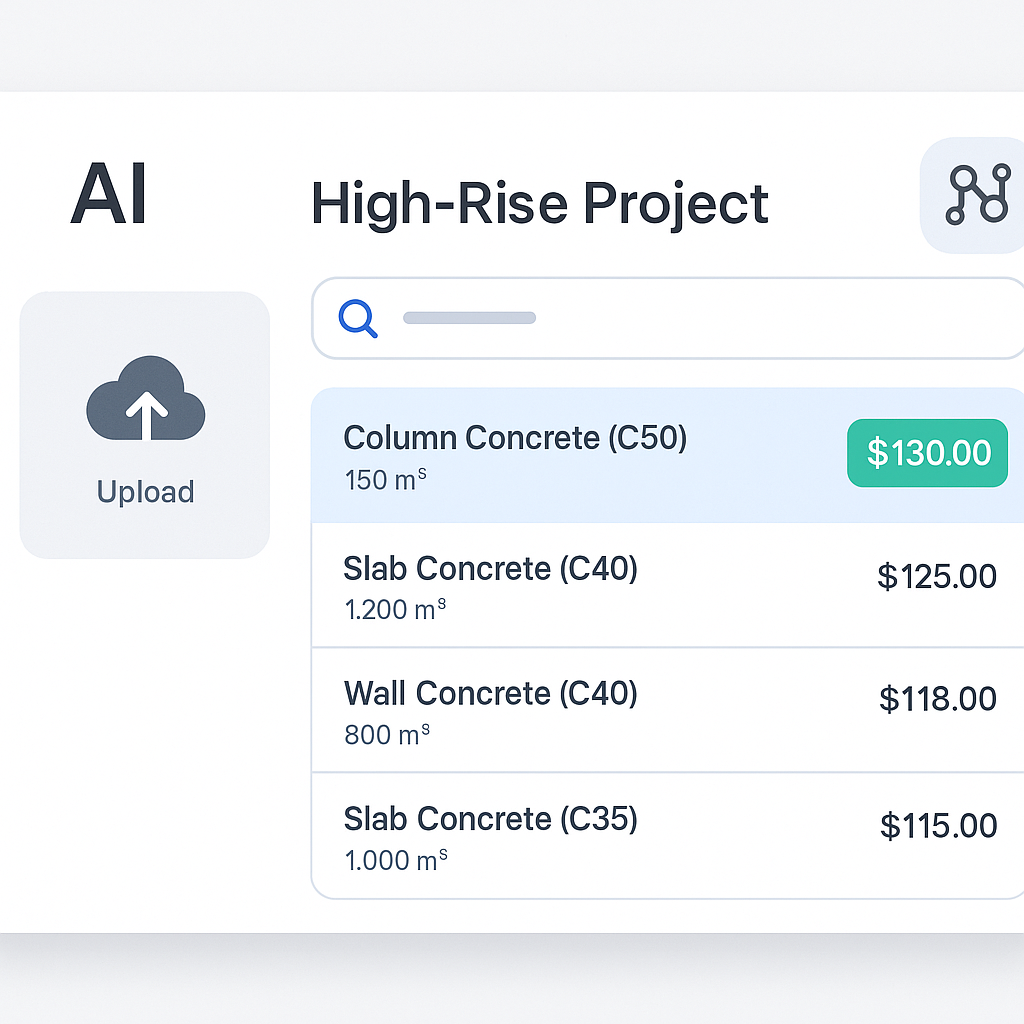
1. BOQ Upload
Start by uploading your BOQ in Excel, CSV, or even ODS format. AI algorithms:
- Auto-detect merged cells and section headers.
- Maintain hierarchy levels.
- Eliminate the need for tedious reformatting.
For example, a subcontractor bidding on a $50M hospital project uploaded a BOQ with irregular formatting. The AI parsed it seamlessly, saving hours of manual cleanup.
2. Semantic Search
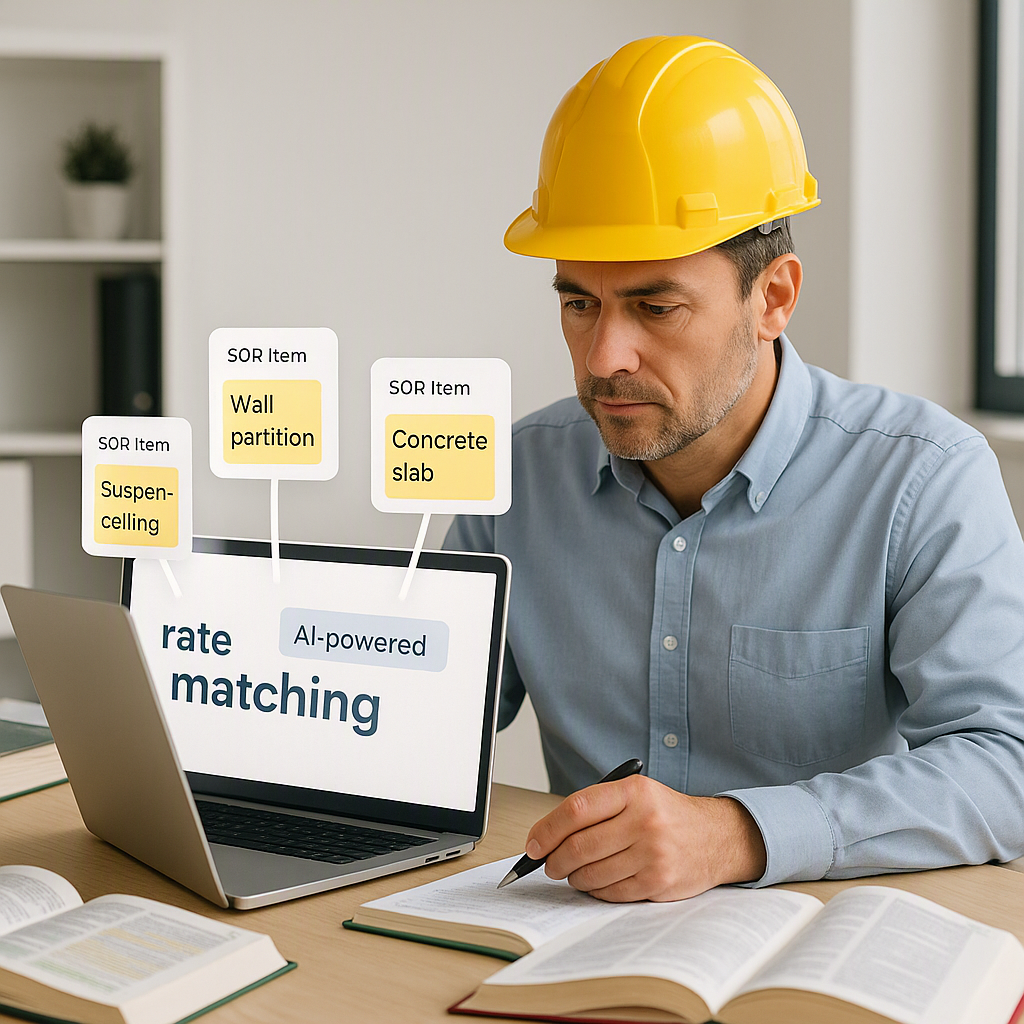
Instead of flipping through PDFs, you simply type in plain English. Need the labor rate for installing pre-stressed concrete girders? The AI can scan 78,000+ items across 135 catalogs and return the top matches in seconds.
Here’s a real-world comparison:
| Task | Manual Process | AI-Powered Process |
|---|---|---|
| Search for rates | 10-15 minutes per item | < 5 seconds per item |
| Cross-referencing | Requires multiple catalogs | Consolidated into one tool |
| Error risk | High (manual entry errors) | Low (automated validation) |
3. Custom Catalogs
Got unique rates? No problem. You can upload your own catalog, and the AI integrates it seamlessly.
- Example: A Florida-based GC added custom hurricane-resistant material rates to their database, saving hours of manual entry for every bid cycle.
- Another Example: A high-end residential firm added specific finishes like Venetian plaster and Brazilian hardwoods to their custom catalog for ultra-luxury bids.
4. Audit Trail
Every rate match includes a breakdown of materials, labor, and equipment costs. Need to justify a rate to a client? The audit trail has you covered. This transparency builds trust with clients and reduces disputes over estimates.
Real-World Impact
Let’s talk results. AI-driven rate matching isn’t just a theoretical advantage—it’s delivering measurable outcomes for contractors worldwide.
Case Study 1: High-Rise Project
- Company: Mid-sized general contractor.
- Challenge: Estimating a $20M high-rise project with 500+ BOQ line items.
- Results: By automating rate lookup and quantity takeoff, the company saved 120 hours—equivalent to two full weeks of labor costs. They still met the bid deadline without cutting corners.
(Source)
Case Study 2: $1B Rail Project
- Company: Civil contractor bidding on a billion-dollar rail project.
- Challenge: Pricing structural steel, rail ties, and concrete decks.
- Results: Using AI-powered rate matching, they shaved 56 hours off their preconstruction timeline—a 99% reduction in rate lookup time.
(Source)
Case Study 3: Small Subcontractor
- Company: Specialty subcontractor focused on drywall and interior finishes.
- Challenge: Bidding on a $2M tenant improvement project with highly specific material requirements.
- Results: The AI tool helped them identify exact matches for niche materials, reducing guesswork and ensuring a competitive yet profitable bid.
The Obvious Objection
“But AI doesn’t understand my project’s nuances.”
I hear this a lot. And it’s partially true—AI isn’t perfect. It doesn’t replace your expertise; it amplifies it. You’re still the one making judgment calls, negotiating with subs, and deciding on markups.
The AI just handles the grunt work, like rate lookup and what-if recalculations. Plus, most tools include manual override options. If the AI suggests a rate that doesn’t feel right, you can adjust it and save the changes for future projects. The system gets smarter with every feedback loop.
Why Now?
If you’re still on the fence about adopting AI, here’s why now is the time:
-
Labor Shortages: The construction industry lost 500,000 workers during the pandemic, according to the Bureau of Labor Statistics. Preconstruction directors are being asked to do more with fewer people. AI tools act like hiring extra estimators without the payroll hit.
-
Cost Pressures: Inflation has pushed material costs up by 20-30% since 2020, per Reuters. Accurate rate lookup is more critical than ever to avoid underbidding.
-
Competitor Adoption: A 2023 McKinsey report found that early adopters of AI in construction see average cost savings of 10-20% per project. If your competitors are using these tools, you risk falling behind.
Call to Action
If you’re tired of wasting hours on manual rate lookup, it’s time to try AI. EstimateNext can cut your preconstruction workload by 80%—and it’s free to get started. Get started free →