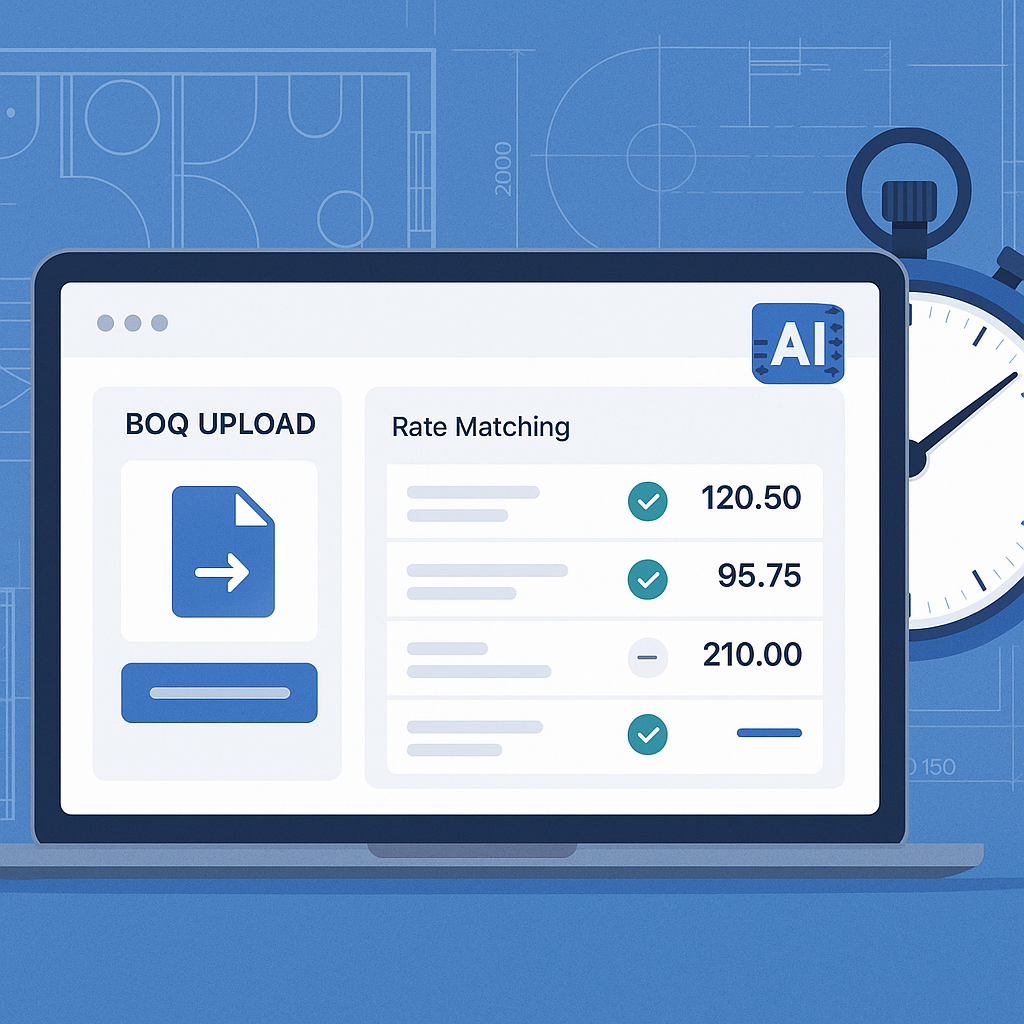
The Silent Time Killer in Estimation: Rate Lookups
Let’s talk about something every estimator despises but can’t escape: rate lookups. You’ve got your BOQ (Bill of Quantities) in hand, and now you’re flipping through a 2,000-page CPWD DSR PDF or scrolling through RSMeans for hours, hunting for the right labor or material rate. Sound familiar? It’s brutal.
On average, this process eats up 12 hours per estimate. Multiply that by 4-8 GMP pursuits a year for a mid-sized General Contractor (GC) team, and you’ve lost weeks of productivity. For subcontractors juggling dozens of bids annually, the time drain is even worse.
But here’s the kicker: it’s not just about time. Manual lookups mean errors. You miss a rate, or worse, use one that’s outdated or mismatched to the scope. That’s not just embarrassing—it can cost you the bid or, if you win, tank your margins.
So why are we still doing it this way?
How AI-Powered Rate Matching Fixes This
AI tools like EstimateNext are flipping this old process on its head. Instead of manually searching, you upload your BOQ, and the AI does the rest. Think Google Search, but for construction rates.
How It Works
-
Semantic Search
- Type in “install pre-stressed concrete girders,” and the system scans 78,000+ SOR items to find the exact match. No flipping, no guessing.
- Example: A project manager working on a road project in India can search “bituminous macadam” and instantly find the corresponding CPWD DSR rate, instead of combing through hundreds of pages.
-
Custom Catalogs
- Use proprietary rates? No problem. Upload them, and the AI integrates these into its matching process. This feature is a game-changer for firms using niche materials or region-specific labor rates.
- Example: A GC specializing in healthcare projects can upload their custom rate book for medical-grade finishes and get precise matches tailored to their scope.
-
AI Fallback
- Can’t find a direct match? The system suggests the closest alternatives, ranked by relevance. You decide from there.
- Example: If you're searching for a specific HVAC component that isn’t listed, the AI provides the next-best options with cost differentials clearly outlined.
The Results
What used to take 12 hours now takes seconds. And because the AI learns from each project, it gets better over time. By your third estimate, you’re saving even more time.
Real-World Wins
Let’s move beyond theory and look at actual results.
Case Study 1: General Contractor on a $1B Rail Project
A GC working on a $1 billion rail project used EstimateNext for their rate matching. Instead of spending weeks on manual lookups, their team finalized the BOQ in just two days. That’s a 56-hour time savings on one bid.
Case Study 2: MEP Subcontractor Handling 30+ Bids Annually
MEP subcontractors responding to 30+ bid packages a year have cut their quote turnaround time from 3 days to 4 hours. That’s a 50% increase in bids responded to annually, directly translating to more wins.
Small Contractors in India
For contractors in India relying on CPWD DSR or state-specific schedules, AI tools have reduced rate lookup times by 90%. For instance, a small road contractor quoted, “We saved over 200 hours annually, allowing us to focus on expanding our portfolio.”
The Obvious Objection: “AI Can’t Handle My Custom Rates”
This is a common pushback I hear: “Sure, AI is fine for general rates, but my projects use custom materials or labor rates. How can it keep up with that?”
Here’s the answer:
- AI tools like EstimateNext let you upload your own catalogs. Whether it’s tenant-specific finishes, custom materials, or regional labor adjustments, the system integrates your data seamlessly.
- Once uploaded, these rates are prioritized in every future match. It’s like having a personalized rate book that never gets outdated.
Example: Regional Adjustments
A contractor in Texas uploaded regional labor rates to account for higher wages in urban areas. The AI automatically applied these rates to relevant line items, ensuring accurate estimates without any manual intervention.
Why This Matters More Than Ever
The construction industry isn’t getting any simpler. Inflation, labor shortages, and multi-market complexity are squeezing margins everywhere. A 2023 McKinsey report found that early adopters of AI in construction are seeing 10-20% cost savings per project. That’s not fluff—it’s survival.
If you’re still clinging to Excel, paper PDFs, and manual processes, you’re bleeding time and money. Worse, you’re falling behind competitors who’ve already shifted to AI-powered tools.
What’s the ROI?
Let’s break it down:
| Role | Savings | ROI |
|---|---|---|
| GC Directors | Saving 40 hours per estimate at $130/hour = $5,200 saved per GMP pursuit. | 52X ROI on a $100/month tool. |
| MEP Subs | Responding to 15 additional bid packages a year at a 30% win rate = $900K incremental revenue. | Massive revenue growth. |
| India Contractors | Cutting CPWD DSR lookups by 90% = Over 200 hours saved annually. | INR 1,999/month tool pays for itself. |
What Happens If You Don’t Change?
You might think, “We’ve been doing fine without AI.” But have you? What’s the opportunity cost of sticking to manual methods? Here’s the reality:
- Missed bids: Slow processes mean you’re responding to fewer RFPs.
- Lower margins: Errors in your rate book can kill your profits.
- Burned-out staff: Spending nights and weekends on tedious lookups leads to churn.
In my view, AI in preconstruction isn’t a luxury anymore—it’s table stakes. The firms adopting it aren’t just saving time; they’re building a competitive moat. The longer you wait, the harder it’ll be to catch up.
Call to Action
If you’re tired of wasting hours on manual rate lookups, EstimateNext can help. Upload your first BOQ and get a priced estimate in minutes. Get started free →


