Why Manual Rate Lookups Are Breaking Construction Estimation
Let’s talk about the pain of flipping through massive rate books. If you’ve ever had to match BOQ items to rates manually, you know what I mean. It’s tedious, error-prone, and slow. On average, estimators spend 12 hours per bid just finding the right rates — whether they’re working with CPWD DSR in India or RSMeans in the US. Miss one rate, and your entire bid could be off by thousands. Worse, manual errors can cost you the trust of clients and subs.
In fact, a McKinsey report found that early adopters of AI estimation tools save 10-20% in project costs simply by eliminating these inefficiencies. That’s huge.
Real-World Example: Manual Errors and Their Cost
Take the example of an infrastructure contractor bidding for a large roadway project. Their team accidentally miscalculated the cost of asphalt due to a manual error during rate lookup. The mistake wasn’t caught until after the bid was submitted. The result? They had to absorb a $250,000 loss due to unexpected material costs. This scenario underscores the risk of relying on manual rate lookups — one small mistake can snowball into significant financial pain.
How AI Rate Matching Solves This Problem
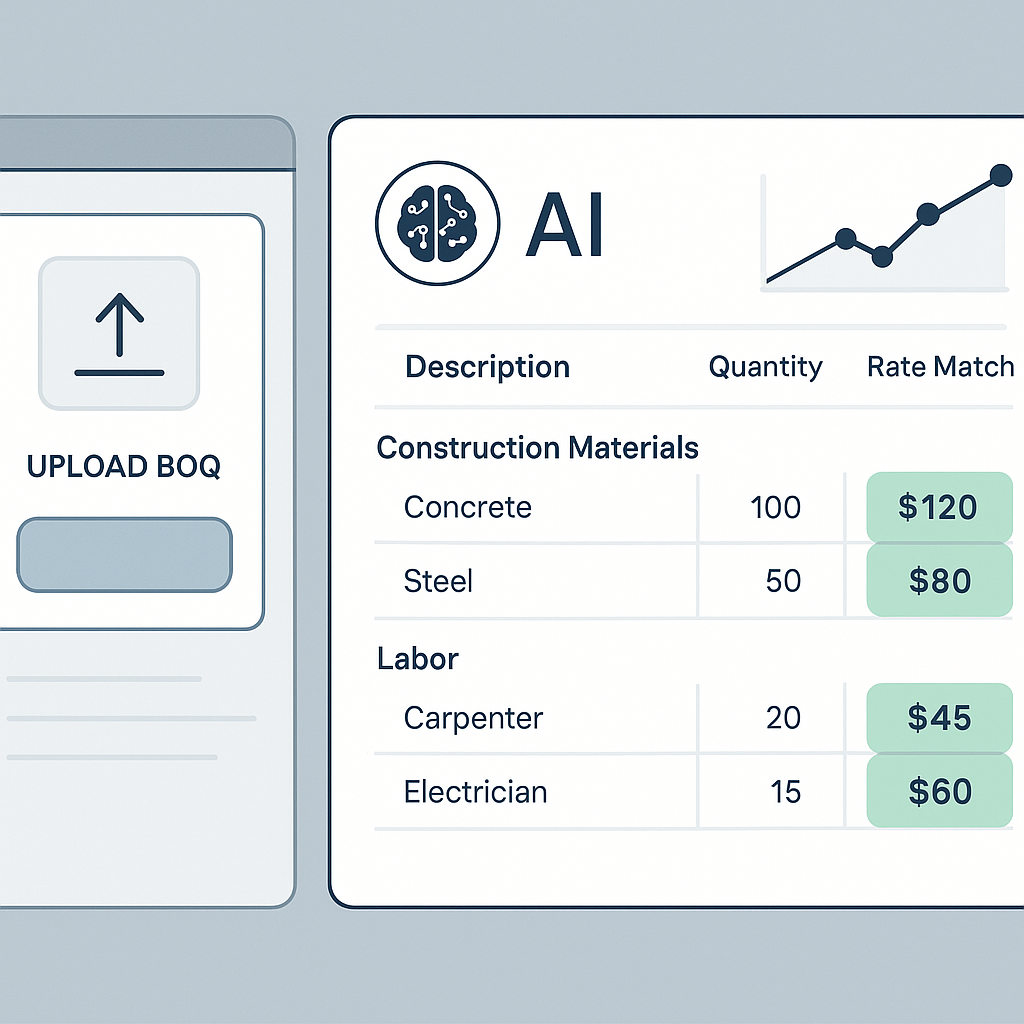
This is where AI-powered rate matching changes the game. Instead of flipping through PDFs or Excel sheets, platforms like EstimateNext use semantic search to match BOQ items to rates instantly. Need the labor rate for installing pre-stressed concrete girders? Type it in, and the AI pulls the most relevant match from 78,000+ SOR items — across catalogs like CPWD DSR, RSMeans, and AECOM Middle East.
Actionable Steps to Implement AI Rate Matching
- Upload Your BOQ: Start by uploading your bill of quantities to an AI-powered estimation tool.
- Define Your Rate Sources: Choose the catalogs relevant to your project — whether it’s RSMeans, CPWD DSR, or a custom rate book.
- Review Matches: The AI will instantly match items to rates. Review flagged items where confidence is below 100%.
- Export Final Estimate: Once reviewed, export the final estimate to integrate with your bidding process.
Case Study: High-Rise Construction Project
A mid-sized contractor working on a $20M high-rise project saved two weeks of labor by using EstimateNext’s rate-matching tool. They uploaded their BOQ, and the AI matched rates in seconds. No human errors, no back-and-forth corrections. Just clean, accurate pricing. The time saved allowed the contractor to focus on refining their bid strategy, ultimately securing the project.
The Obvious Objection: “AI Can’t Think Like an Estimator”
You’ve probably heard it before: “AI doesn’t understand construction like we do.” And to some extent, that’s true. AI isn’t replacing your expertise; it’s amplifying it. You’re still the one making judgment calls, negotiating with subs, and deciding on markup. The AI just handles the grunt work — like rate matching and recalculating what-if scenarios.
Comparing AI and Human Input
| Aspect | AI Tools (EstimateNext) | Human Estimators |
|---|---|---|
| Speed | Matches rates in seconds | Requires hours of manual lookup |
| Accuracy | 99% with feedback loops | Prone to human error |
| Contextual Judgments | Limited to semantic matching | Comprehensive understanding of project |
| Scalability | Handles large catalogs easily | Slows down with project complexity |
Hybrid Workflows: Best of Both Worlds
This hybrid approach is why AI tools like EstimateNext include features like manual override and confidence scoring. If the AI isn’t 100% sure about a match, it flags it for review. You get speed without sacrificing precision.
Why Trust Matters in Estimation
In my view, trust is the backbone of preconstruction estimation. If clients or subcontractors don’t trust your numbers, you’ll lose bids or get squeezed on margins. That’s why accurate rate matching is such a critical feature. Platforms like EstimateNext don’t just match rates; they also provide full audit trails for every estimate. You can show exactly where a rate came from, whether it’s a catalog item, a historical project, or a custom adjustment.
Case Study: Winning a $108M Water Project
A regional GC bidding on a $108M water project used EstimateNext to match rates directly from DOT-approved catalogs. The AI pulled labor, material, and equipment costs that aligned perfectly with their RFP requirements. The result? A winning bid with zero scope conflicts and increased trust from the client.
The ROI of AI Rate Matching
Let’s break down the numbers. If you save 12 hours per estimate on rate lookup, and your team prices 50 projects a year, that’s 600 hours saved annually. At $130/hour for senior estimators, you’re looking at $78,000 in labor cost savings. Add in the reduced risk of errors and improved bid accuracy, and the ROI becomes undeniable.
Small Contractor Example
It’s not just about big firms. Consider a fit-out QS specializing in office interiors. They might spend hours recalculating rates for every $/SF adjustment. AI tools like EstimateNext back-solve these adjustments instantly, cutting iteration times from 45 minutes to seconds. This allows smaller firms to compete with larger players by improving efficiency without increasing overhead.
Call to Action
If you're tired of wasting hours on manual rate lookups, EstimateNext can help. Its AI-powered rate matching across 78,000+ items saves time, reduces errors, and builds trust in your estimates. Get started free →


