The Rate Book Bottleneck Expanded
Let’s be real: flipping through rate books like RSMeans or CPWD DSR is painfully slow. A single BOQ might need hundreds of rates pulled from a 2,000-page manual. Ever tried finding the installation rate for pre-stressed concrete girders or HVAC ductwork in a rush? It’s like searching for a needle in a haystack while the clock is ticking.
For most estimators, this process eats up 12 hours per bid. And that’s if you’re lucky. Errors creep in when rates are misapplied or overlooked—leading to underpricing and blown margins. One mistake can cost tens of thousands, especially on large projects. For example, a contractor on a $10M office fit-out project miscalculated the rate for polished concrete flooring, leading to a $25,000 underbid. They absorbed the cost, cutting into their profit margin.
The Problem: Manual Rate Lookup
Why is manual rate lookup so inefficient? Rate books are designed for reference, not speed. You flip through pages, cross-reference sections, and manually input rates into your BOQ. If you’re working on large infrastructure projects or high-spec builds, the complexity multiplies. Rates for specialty items like fire-resistant coatings or custom millwork are often buried in obscure sections.
Case in point: a mid-sized contractor bidding for a $5M retail project spent 15 hours manually pulling rates for glass partitions, HVAC systems, and custom lighting installations. They later found they’d missed several small items, forcing them to revise their bid during negotiation.
Enter AI Rate Matching
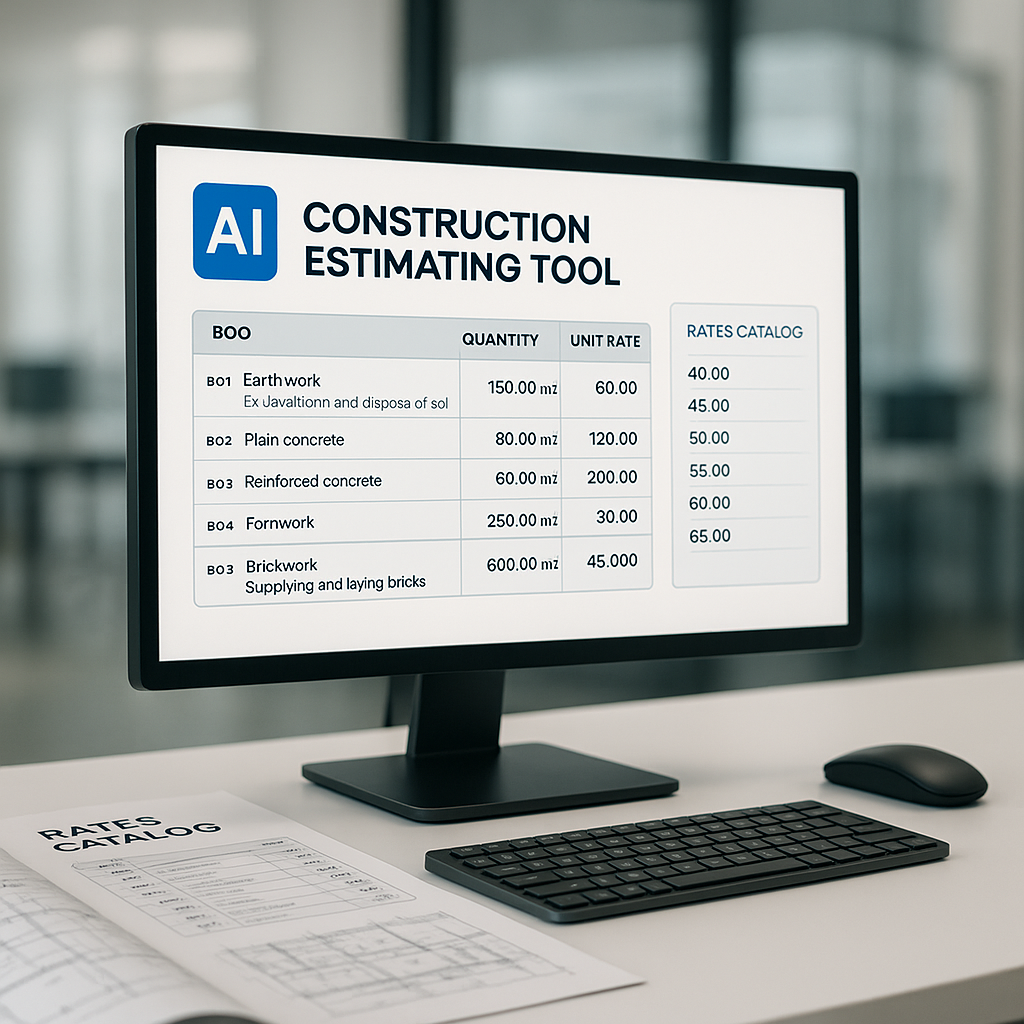
AI-powered tools like EstimateNext are flipping the script. Instead of manually paging through rate books, you upload your BOQ and let the software do the heavy lifting. Semantic search across 78,000+ SOR items instantly pulls the exact rates you need.
Take a real-world example: a $1B rail project recently used AI to price the labor and material costs for structural steel, rail ties, and concrete decks. Instead of 12 hours, it took seconds. That’s not just faster—it’s more accurate, too. AI flags missing data and suggests fallback rates from similar projects.
Actionable Steps to Implement AI Rate Matching
- Evaluate Your Current Process: Track how long it takes your team to complete rate lookup for a typical bid. Identify bottlenecks.
- Choose the Right Tool: Platforms like EstimateNext offer free trials. Test their semantic search capabilities with one of your BOQs.
- Upload Custom Rate Catalogs: If you use proprietary rates or regional adjustments, ensure the AI tool allows custom uploads.
- Train Your Team: Schedule a short onboarding session to familiarize your estimators with the platform’s features.
- Track ROI: Measure time savings and error reduction after your first few projects.
Why It Works
AI doesn’t just match rates—it learns. With every adjustment or feedback, the system gets smarter. By the third project, users report a significant boost in accuracy, often hitting 99% reliability. That’s because the AI adapts to custom materials, inflation factors, and even regional labor costs.
In one case study, a mid-sized contractor added proprietary finishes to their catalog. The AI integrated these seamlessly, applying them across future bids. No more wondering if you forgot to include a specialty item.
How AI Learns Over Time
- Feedback Loops: Every manual override or adjustment is logged, helping the system refine its matches.
- Project-Specific Insights: AI adapts to recurring items in your BOQs, like custom fixtures or niche materials.
- Regional Adjustments: It incorporates local labor rates and material costs for greater accuracy.
What About Edge Cases?
You might be skeptical. What if your BOQ has custom items or non-standard rates? AI tools like EstimateNext let you upload your own catalogs, ensuring your estimates reflect reality. And if the AI doesn’t find an exact match, it flags the item for manual review—saving time without sacrificing control.
For example, a contractor working on a boutique hotel project uploaded a catalog of specialty interior finishes. The AI flagged two items for manual review: Venetian plaster and reclaimed wood paneling. After approval, these rates were seamlessly applied in future bids.
ROI: The Numbers Don’t Lie
Is AI rate matching worth it? Let’s do the math. A general contractor running 5 GMP pursuits a year could save 60 hours annually just on rate lookup. At $130/hour for senior estimators, that’s $7,800 saved. For MEP subs handling 50 bids a year, the ROI multiplies—faster quotes mean more opportunities to win.
McKinsey estimates that early adopters of AI in construction see cost savings of 10-20% per project. On a $200K bid, that’s up to $40K saved. Multiply that across 30 bids, and the benefits are obvious.
Comparison Table: AI vs. Manual Rate Lookup
| Feature | Manual Lookup | AI Rate Matching |
|---|---|---|
| Time Per Bid | 12-15 hours | Seconds |
| Error Rate | High (human oversight) | Low (99% accuracy) |
| Scalability | Limited by manpower | Unlimited |
| Learning Curve | None | 1-2 weeks |
| Cost | High (labor intensive) | Low ($39/month) |
Common Objections
“You might be thinking, ‘AI can’t replace my experience.’” And you’re right—it doesn’t. AI amplifies your expertise. You still decide on markup, negotiate with subs, and finalize bids. The AI just eliminates the grunt work, giving you more time for strategic decisions.
“What about learning curves?” Modern platforms are built for ease of use. Most teams get up to speed in under two weeks. And once you’re trained, it’s like adding an extra estimator to your team—without the payroll hit.
Final Thoughts
Manual rate lookup is outdated—and frankly, costly. AI-powered rate matching doesn’t just save time; it saves money and reduces errors. If your team is still flipping through PDF books, it’s time to rethink your process.
If you're dealing with rate lookup bottlenecks, EstimateNext can help. Get started free →


