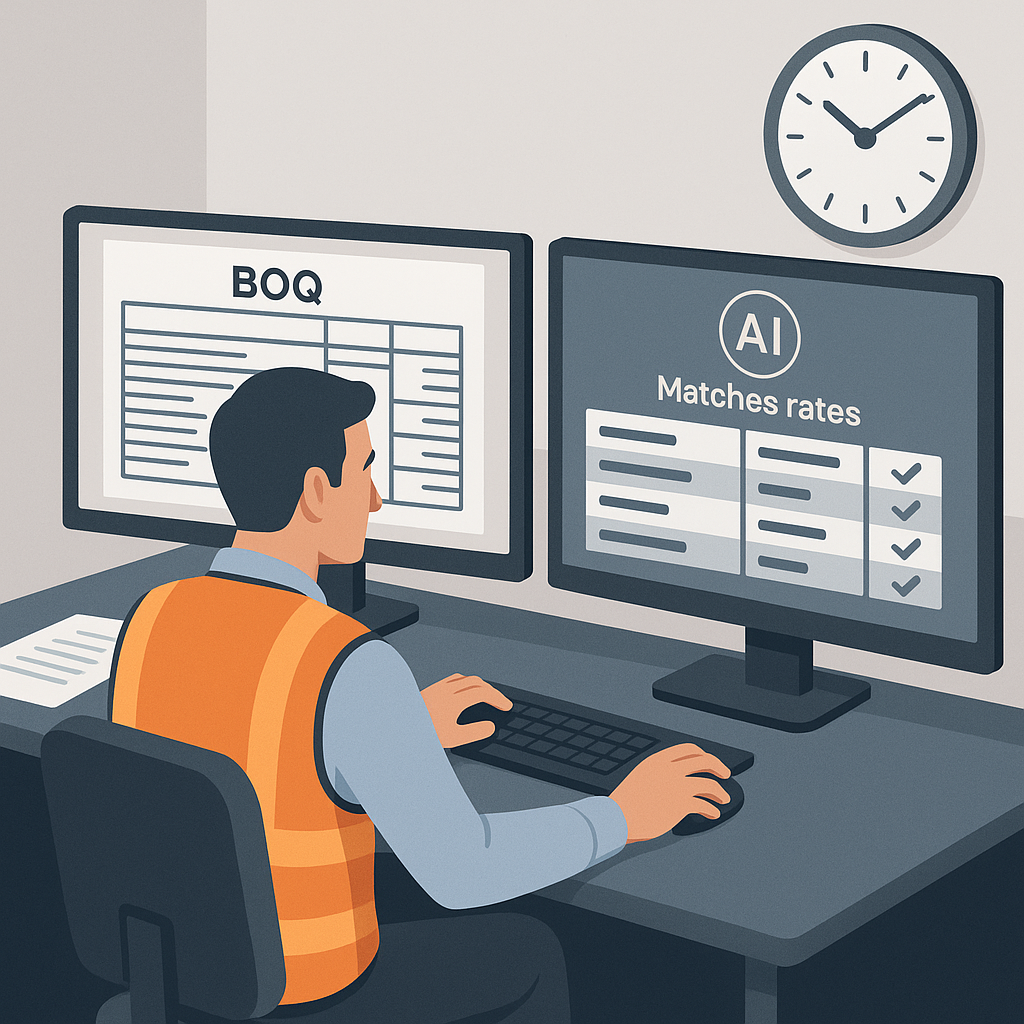
Why Manual Rate Matching Is Killing Your Productivity
Let’s talk about rate matching. If you’ve ever flipped through a 2,000-page CPWD DSR or RSMeans book, you know the pain. It’s not just tedious—it’s a productivity killer. Estimators waste hours looking up rates, cross-checking line items, and hoping they didn’t miss anything. Multiply that by the number of bids your team handles, and you’re easily losing weeks of valuable time per year.
Here’s a typical scenario: You’re pricing a mid-sized commercial project. The BOQ lists 300+ line items, and you need accurate rates for everything from reinforced concrete to HVAC ductwork. If you’re searching manually, that’s about 12 hours of work per estimate. For a team of four estimators handling five bids a month, that’s 240 hours—essentially one person’s full-time job.
Let’s break it down further:
| Variable | Value |
|---|---|
| Average BOQ line items | 300 |
| Manual rate-matching time/item | 2.4 minutes |
| Time per estimate | ~12 hours |
| Estimates handled/month | 20 (team of 4 estimators) |
| Total team hours lost/month | ~240 hours |
| Total team hours lost/year | ~2,880 hours (120 days!) |
This inefficiency isn’t just frustrating—it’s expensive. If your average estimator’s hourly rate is $50, that’s $144,000 a year spent on manual rate matching alone. And that doesn’t even factor in the opportunity cost of missing submissions or rushing through bids.
Clearly, the old way is not ideal.
The AI Shortcut: 78,000 Rates Matched in Seconds
Now imagine this: You upload that same BOQ into an AI-powered tool like EstimateNext. In less than a minute, the system scans your line items, searches across 78,000+ SOR items, and returns matches. It even accounts for regional variations and inflation adjustments. Need the labor rate for installing pre-stressed concrete girders? Type it in, and you’re done.
The time savings are staggering. What used to take 12 hours now takes under a minute. That’s not just faster—it’s transformational. Your estimators can focus on higher-value tasks like negotiating with subs or refining bid strategies instead of drowning in rate books.
| Task | Manual Effort | With AI |
|---|---|---|
| Rate matching (300 items) | ~12 hours | ~1 minute |
| Team hours/month | ~240 hours | ~20 minutes |
| Annual cost (at $50/hr) | $144,000 | ~$200 |
Key takeaway: AI tools don’t just save time—they transform how you allocate resources.
Built-In Intelligence: How It Works
Here’s why AI rate matching is a game-changer:
-
Semantic Search: Unlike traditional keyword searches, AI understands context. For example, if you search for “gypsum board,” it knows to include variations like “drywall” or “plasterboard.” This eliminates the guesswork and ensures accurate matches.
-
Custom Catalog Integration: Have your own rate list? No problem. Upload it, and the AI will prioritize your rates over default databases. It even learns from your adjustments, so it gets smarter with every project. For example, if you frequently adjust labor rates for urban projects, the system will preemptively apply those adjustments the next time you upload a similar BOQ.
-
Audit Trails: Accuracy matters, especially when you’re dealing with projects worth millions. Every rate match comes with a breakdown—material, labor, equipment—plus a confidence score. If the AI isn’t 100% sure about a match, it flags it for your review. Essentially, it acts like a junior estimator that improves with feedback.
-
Regional Adaptability: Construction costs vary widely by region. AI tools like EstimateNext adjust rates based on regional indices, ensuring your estimates remain competitive whether you’re bidding in Mumbai or Miami.
-
Historical Learning: AI tools don’t just work in isolation. They analyze past estimates, win/loss data, and your manual overrides to refine their algorithms. The result? Better matches and fewer corrections over time.
Real-World Impact: A Case Study
Let’s make this concrete (pun intended). A mid-sized general contractor recently used EstimateNext for a $50 million office project. Their BOQ had 450 line items. By automating rate matching, they saved 16 hours per estimate. Over the course of five bids, that’s 80 hours saved—two full workweeks.
But the real impact wasn’t just time saved. Faster rate matching meant faster bids. That contractor submitted three extra proposals in a quarter, securing one additional win worth $9.5 million. The ROI? Off the charts.
Here’s another example: A small HVAC subcontractor used AI tools to handle bids for a series of hospital projects. By reducing the time spent on rate matching, they were able to submit bids 30% faster, securing three jobs in a competitive market. The cost of the AI tool? Less than $1,000 a year. The value of the secured projects? Over $1.2 million.
Common Objections (And Why They Don’t Hold Up)
“AI Can’t Handle My Custom Rates”
Sure it can. Tools like EstimateNext let you upload custom catalogs and even define project-specific rates. Once uploaded, the system prioritizes your data over its default database. Plus, the system learns from your adjustments, meaning it gets better over time.
“What If It Matches the Wrong Rate?”
That’s why there’s a confidence score and manual override feature. If the AI isn’t 100% certain, it flags the line item for your review. Think of it as a junior estimator that improves with guidance.
“Isn’t This Just for Big Projects?”
Not at all. AI scales beautifully. Whether you’re pricing a $1 million renovation or a $1 billion infrastructure project, the system adapts. Smaller firms benefit just as much because time savings and accuracy improvements are universal.
“Does AI Replace Estimators?”
No. AI tools like EstimateNext are designed to augment your team, not replace it. By automating repetitive tasks, your estimators can focus on strategic and creative aspects of bidding.
FAQ
Q: How accurate are AI-powered rate matches?
AI tools like EstimateNext report up to 99% accuracy by the third project, thanks to self-learning algorithms and feedback loops. The more you use it, the better it gets.
Q: Can I use this with my existing tools?
Yes. EstimateNext integrates seamlessly with platforms like Procore, Autodesk Build, and Excel. You can export estimates directly into your current workflows, reducing the need for redundant data entry.
Q: What if I only need this for a few projects?
That’s fine. AI tools are subscription-based, so you can scale usage up or down depending on your workload. Many platforms offer pay-as-you-go models, making them accessible for firms of any size.
Q: How long does it take to implement?
Not long. Most users report getting up to speed within two weeks. The interface is intuitive, and training materials are included. Plus, dedicated support teams can help with onboarding.
Q: Is it worth the investment for small firms?
Absolutely. Time savings and accuracy improvements benefit firms of all sizes. For smaller teams, the automation can free up valuable hours that can be redirected toward client relationships or business development.
Decision Framework: Is AI Rate Matching Right for You?
| Question | If Yes... |
|---|---|
| Do you handle more than 5 bids a month? | Automate rate matching—it’ll save hundreds of hours per year. |
| Do you use custom rate catalogs? | AI tools can integrate and prioritize your unique data. |
| Are you losing bids due to slow submissions? | Faster rate matching means faster proposals and increased competitiveness. |
| Struggling to train new estimators? | AI can act as a training tool, guiding new hires with confidence scores. |
| Concerned about accuracy in estimates? | Audit trails and manual overrides ensure no detail is missed. |
Why Now Is the Time to Switch
The construction industry isn’t getting any easier. Labor shortages, inflation, and tighter deadlines mean teams are stretched thinner than ever. The old way—manual lookups, Excel sheets, gut-feel decisions—just doesn’t cut it anymore.
AI tools like EstimateNext don’t replace your expertise. They amplify it. By automating grunt work like rate matching, you and your team can focus on what really matters: winning more bids and delivering projects profitably.
Ready to Stop Wasting Hours? Get started with EstimateNext today →


