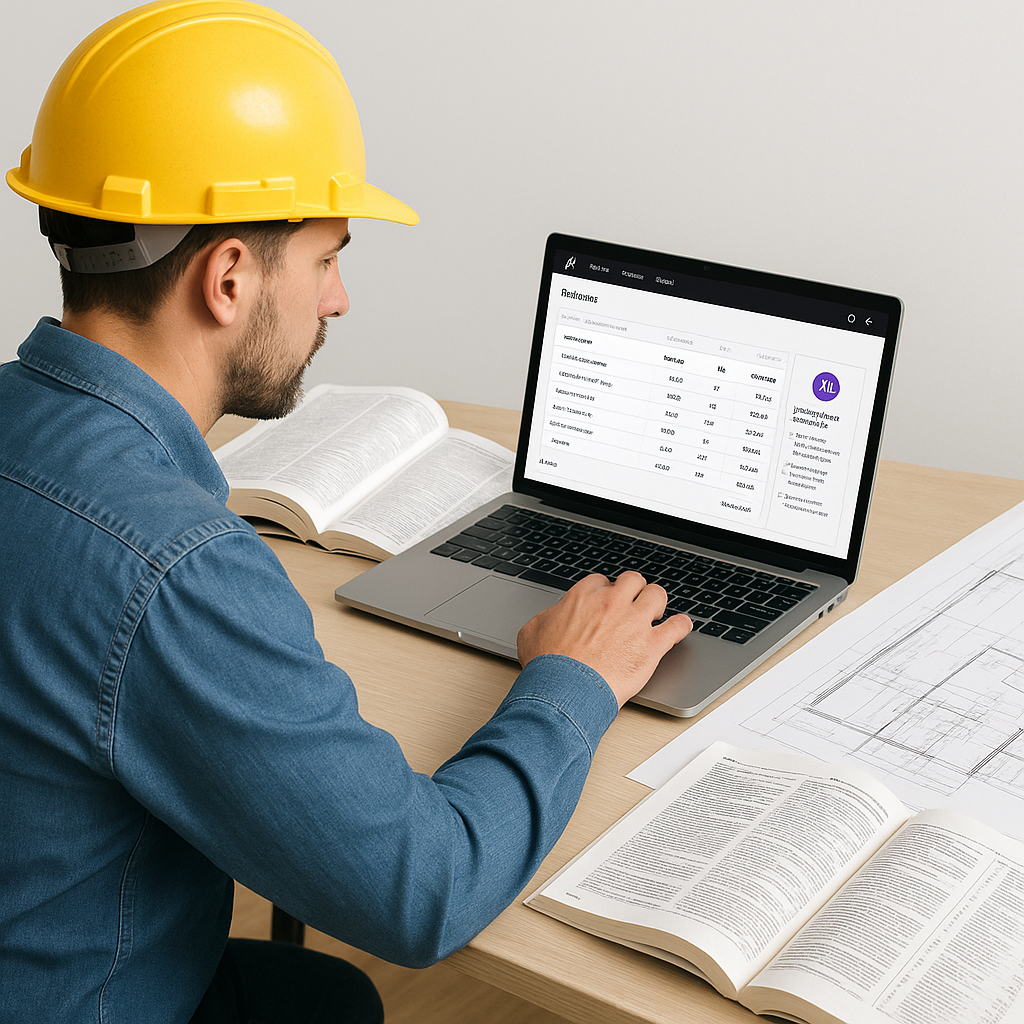
Stop Flipping Through Rate Books: AI Can Do It Better
Every estimator has been there. You're on a deadline, flipping through a massive rate book like RSMeans or CPWD DSR, trying to find the exact labor or material rate that fits your scope. It's tedious. It's frustrating. And let's face it—it's prone to mistakes.
Now imagine typing a query—"labor cost for installing pre-stressed concrete girders"—and getting an accurate rate match in seconds. That’s what AI-powered rate matching brings to the table. Tools like EstimateNext are transforming construction estimation by turning hours of manual lookup into a task that takes less time than ordering a coffee.
Why Manual Rate Matching Is Broken
The traditional rate-matching process is painfully slow. Here's the typical workflow:
- Identify the task or material in your BOQ.
- Open a 2,000-page rate book (physical or PDF).
- Manually search for the matching item.
- Cross-reference the details to make sure it's the right fit.
- Repeat this for dozens—or even hundreds—of line items.
It's not just time-consuming; it's error-prone. Miss a page or misread a rate, and your entire estimate could be off. On a $50M project, even a 1% error equals a $500,000 mistake. Can your margins afford that?
Concrete Example: The $150,000 Error
A mid-sized contractor working on a commercial project once misread a labor rate in their CPWD DSR manual. The error wasn’t caught until the project was underway, and the discrepancy resulted in a $150,000 increase in labor costs. This is not uncommon—many contractors face similar challenges when relying on manual processes.
Actionable Steps to Avoid Errors Manually
- Use bookmarks in digital rate books for frequently used categories.
- Cross-check rates with peers or supervisors before finalizing.
- Allocate extra time for rate validation on critical line items.
These steps can help, but they won’t eliminate errors entirely. That’s why AI is gaining traction.
How AI Rate Matching Fixes This
AI-powered tools like EstimateNext use semantic search to replace manual lookup entirely. Here's how it works:
- Upload Your BOQ: Drag and drop your Excel or PDF file. The system parses it automatically.
- Search Across 78,000+ Items: The AI scans rate catalogs—RSMeans, CPWD DSR, or your custom rates—and finds the closest matches instantly.
- Customizable Adjustments: Need a region-specific uplift or inflation adjustment? The AI factors that in, too.
- Audit Trail: Every match comes with a confidence score and a link to the source catalog, so you can double-check.
Case Study: Rail Project Success
Consider a mid-sized contractor bidding on a $100M rail project. They used EstimateNext to match rates for 236 BOQ items. What typically took 12 hours was completed in under 10 minutes. The AI not only saved valuable time but also reduced the likelihood of errors. Over the course of six projects, this contractor estimated they saved over $35,000 in labor costs alone.
Actionable Steps for Maximizing AI Tools
- Prepare Your Data: Ensure your BOQ is clean and well-structured before uploading.
- Customize Parameters: Use region-specific rates and inflation adjustments to tailor results.
- Audit Results: Review confidence scores and flagged items for accuracy.
The ROI of AI Rate Matching
Let’s talk numbers. A typical estimator costs $130/hour. If you’re spending 12 hours on rate lookup per estimate, that’s $1,560 in labor costs—per bid. Multiply that by 10 bids a year, and you’re looking at $15,600 wasted on something a machine can do better.
But the ROI doesn’t stop at labor savings. Accurate rate matching reduces errors, which means fewer change orders and disputes down the line. A 2023 McKinsey report found that AI in construction estimation can cut project costs by 10-20%. That’s real money staying in your pocket.
Example ROI Breakdown
| Metric | Manual Process | AI-Assisted Process |
|---|---|---|
| Labor Cost (per bid) | $1,560 | $130 |
| Time Spent (per bid) | 12 hours | 10 minutes |
| Errors (per year) | 3 major | 1 minor |
| Cost Impact (errors/year) | $50,000 | $5,000 |
The Obvious Objection: “Can AI Handle My Custom Rates?”
Short answer: Yes. Long answer: Most AI tools, including EstimateNext, let you upload your own rate catalogs. Whether you're dealing with a unique material or a specialized labor task, the system integrates your data seamlessly. It even learns from your adjustments to improve future matches.
Still skeptical? You can always override the AI's suggestions. Think of it as a smart assistant—it handles the grunt work, but you’re still in control.
Example: Custom Catalog Integration
A contractor specializing in green building projects uploaded their proprietary rate catalog into EstimateNext. The AI used these custom rates to match BOQ items accurately, factoring in sustainability metrics like carbon footprint reduction. The system saved them hours on every bid.
What’s the Catch?
No tool is perfect. AI rate matching works best with clean, structured data. If your BOQ is a mess of merged cells and inconsistent formats, you’ll need to clean it up first. But the good news? Many AI platforms, like EstimateNext, include smart parsers that auto-detect and fix common issues.
Also, while AI can handle 99% of rate matches, niche or highly specialized tasks might still require manual input. That’s why human oversight remains critical. AI isn’t here to replace you; it’s here to make you faster and more accurate.
Actionable Steps for Overcoming Challenges
- Use the parser tools provided by the AI platform to clean your data.
- Maintain a small team for oversight on specialized tasks.
- Regularly update custom rate catalogs for better results.


