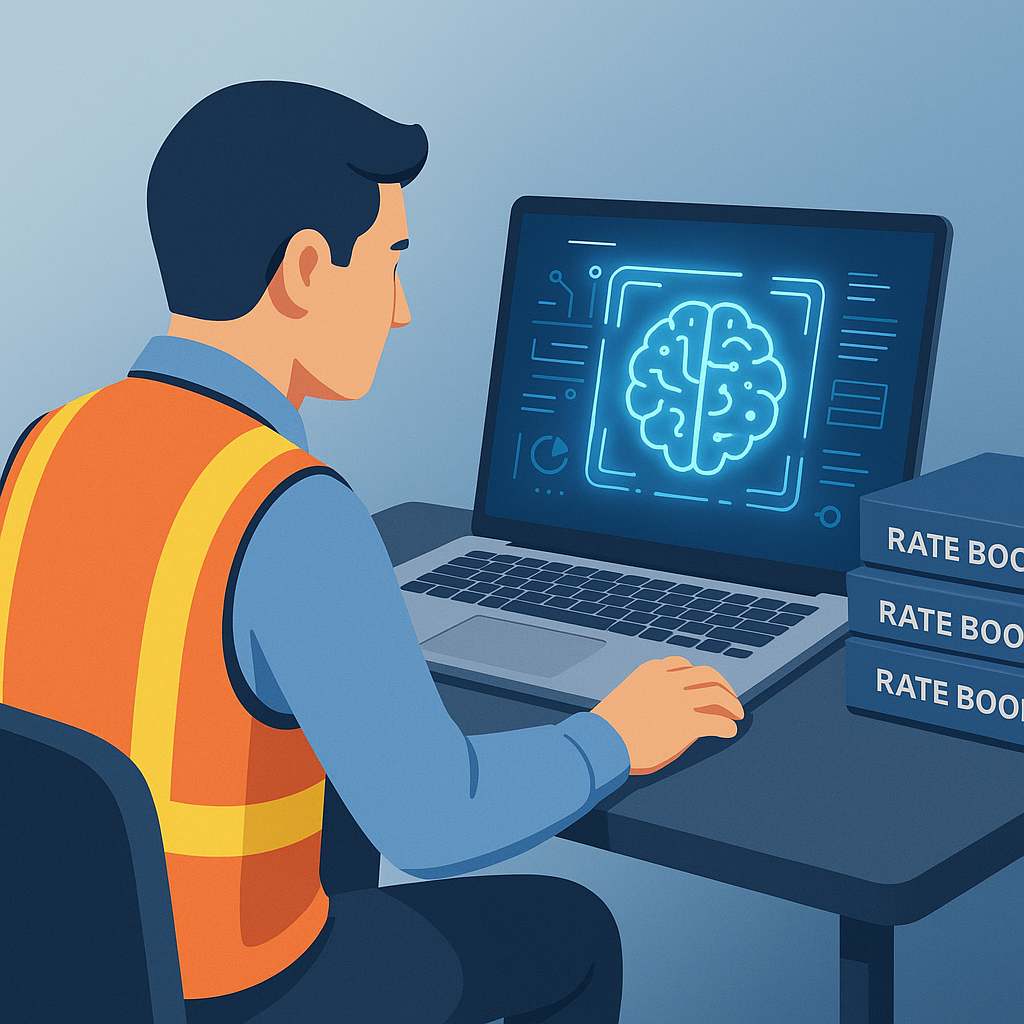
Stop Wasting Time on Rate Lookup
Imagine this: you're pricing a $100M hospital bid. Your BOQ has 2,347 line items, each needing a corresponding rate from a 2,000-page catalog like RSMeans or CPWD DSR. You could spend the next 12 hours manually flipping through PDFs—or let AI handle it in seconds.
That’s the promise of AI-powered rate matching. Tools like EstimateNext use semantic search to find exact matches for rates across 78,000+ items. You’re not scanning page after page hoping to spot the right line. You type, hit enter, and get your rate instantly. Need the labor cost for installing pre-stressed concrete girders? Done. Want to find the equipment rate for a tower crane? Seconds.
But here’s the kicker: it’s not just about speed. AI improves accuracy too. Manual lookup often leads to mistakes—choosing the wrong rate or misreading unit conversions. AI minimizes that risk by verifying matches against historical data and user feedback. Their own case study notes that users report 99% accuracy by the third project.
The Cost of Doing It the Old Way
Let’s talk dollars and cents. Every hour spent on manual rate lookup costs your team roughly $130 (assuming senior estimator wages). Multiply that by the 12 hours wasted per bid, and you’re looking at $1,560 in labor costs—just for rate matching. Now scale that across five GMP pursuits annually, and the math gets brutal.
It’s not just the direct cost either. Those wasted hours mean fewer bids submitted, slower turnaround times, and missed deadlines. In tight markets, speed wins. If your competitor prices faster, they’ll submit more bids—and they’ll win more work.
To illustrate, consider a mid-sized general contractor. They bid on an average of 10 projects per quarter, each requiring approximately 8 hours of manual rate lookup. That’s 80 hours per quarter spent searching for rates—costing the company over $10,400 in labor. Switching to AI tools cuts this time down to less than 2 hours per project, reducing the cost to about $260 per quarter. That’s an 80% cost reduction, which translates directly into higher profitability.
Real-World Example: A $1B Rail Project
Take a major contractor’s large rail bridge bid. On a job like that, they needed rates for everything from rail ties to structural steel. The rates had to come from DOT-approved catalogs. Normally, this would take days of manual lookup. But with AI tools like EstimateNext, the entire rate-matching process was done in minutes—accurately.
Another example is a $50M wastewater treatment plant bid submitted by an MEP contractor. The project required highly specialized rates for chemical-resistant piping and aeration blowers—items that weren’t easily found in standard catalogs. The contractor used EstimateNext’s custom catalog upload feature to integrate their supplier pricing. The result? A complete bid in under 24 hours, compared to the usual 72-hour turnaround.
The obvious objection is, “But AI can’t think like an estimator.” True, AI won’t negotiate with subs or decide on markup percentages. But that’s not its job. AI handles the grunt work so your team can focus on high-value tasks—like refining scope or improving bid strategy.
What Makes AI Rate Matching Reliable?
You might be wondering: does AI really deliver consistent results? Yes, but only if the platform is designed for it. EstimateNext, for instance, combines several layers of matching:
- Tenant History: Rates you’ve used before are prioritized.
- User Catalogs: Tailored catalogs uploaded by your team are integrated seamlessly.
- Country-Level Widen: Matches expand to national standards when local rates aren’t available.
- AI Fallback: If all else fails, semantic AI suggests the closest match with confidence scoring.
Let’s break this down further with actionable steps:
-
Step 1: Upload Your Historical Rates: If you’ve priced similar projects before, upload your previous rate sheets to the platform. This creates a baseline for AI to prioritize.
-
Step 2: Define Confidence Thresholds: Set minimum accuracy requirements for AI matches (e.g., 95%). This ensures you only see high-probability matches.
-
Step 3: Use Feedback Loops: Actively accept or reject AI-generated matches. The system learns from your input, improving accuracy over time.
And it gets smarter. Every time you accept or reject a match, the system learns. By the third project, most teams report significant accuracy improvements.
Why Speed and Accuracy Matter for Subs Too
This isn’t just a GC problem. MEP subs face the same bottleneck. A plumbing contractor pricing a hospital might need fixture rates from IPC catalogs. Waiting three days to match rates means fewer bids submitted—and fewer jobs won. AI tools fix this. EstimateNext’s trade-specific tools (like plumbing fixture unit calculators) drastically cut quote turnaround time.
Consider an HVAC subcontractor pricing a $10M office building. They traditionally spent 6–8 hours pulling rates for ductwork, air handlers, and chillers. By switching to AI, they reduced this process to under an hour. That time savings allowed them to submit two additional bids in the same week—one of which they won.
The Future of Rate Matching
In my view, manual rate lookup should’ve died years ago. It’s inefficient, prone to error, and frankly, unnecessary. With AI-powered tools like EstimateNext, contractors can price faster, submit more bids, and win more work—all while reducing overhead.
If you’re still flipping through PDFs in 2026, you’re already behind.
Comparison Table: Manual vs. AI Rate Matching
| Feature | Manual Lookup | AI-Powered Tools |
|---|---|---|
| Speed | 8–12 hours per project | Under 1 hour per project |
| Accuracy | Prone to human error | 99% accuracy with feedback |
| Scalability | Limited by team bandwidth | Scales across multiple bids |
| Cost | $130/hour labor costs | $39–$99/month subscription |
| Ease of Use | Requires catalog expertise | Intuitive search interface |
Call to Action
If manual rate lookup is holding your team back, EstimateNext can help. Match rates across 78,000+ items in seconds with AI-powered tools. Get started free →


