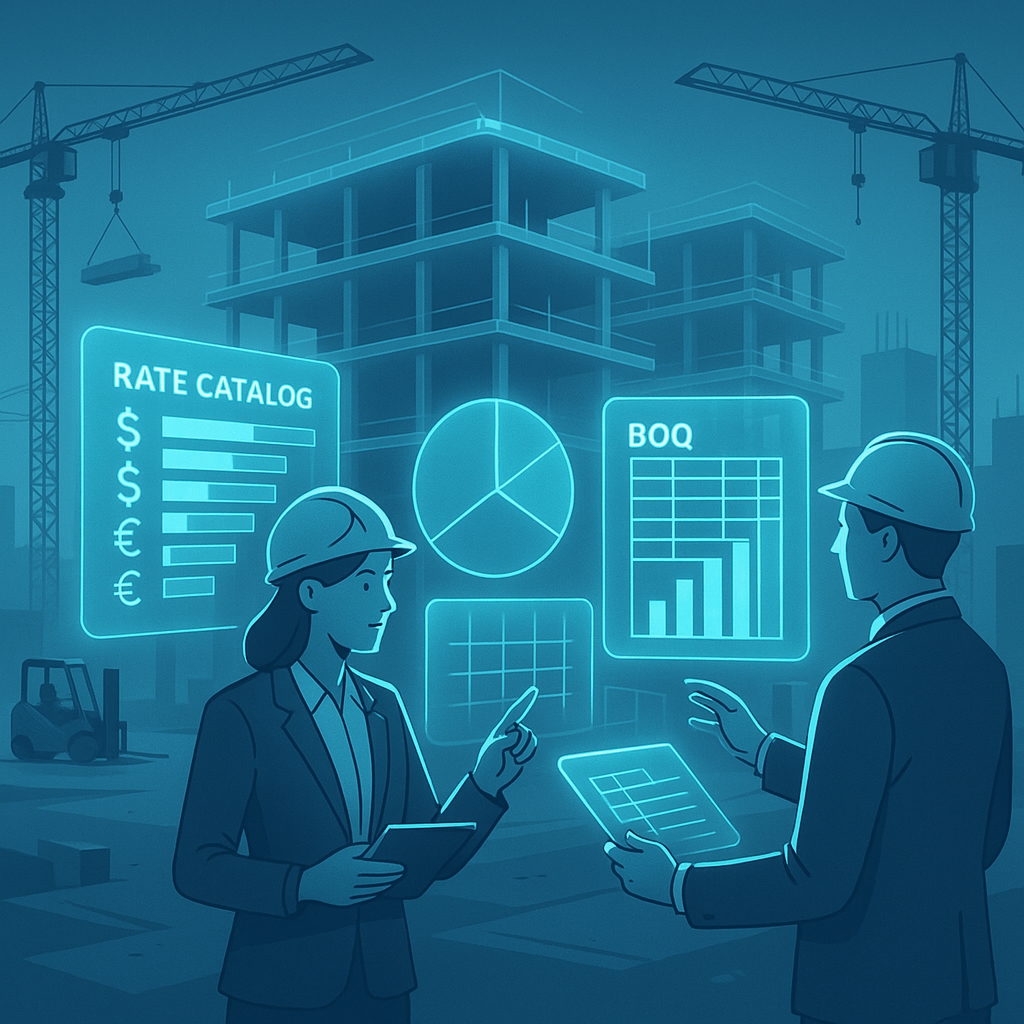
Why Rate Lookups Are Killing Your Estimation Process
If you've spent hours flipping through rate books like RSMeans or CPWD's DSR, you know the pain. It's boring, inefficient, and prone to error. One mismatched rate can throw off your entire bid. Worse, if you're pricing a large project—think $100M infrastructure—those errors compound.
Here’s the brutal math: According to McKinsey, manual rate lookups can eat up an average of 12 hours per BOQ. Even mid-sized projects require combing through hundreds of lines. That’s time you could spend analyzing subcontractor quotes or refining your margin strategy.
Why Manual Rate Lookups Hurt Profitability
Manual rate lookups don't just waste time—they erode your bottom line. Consider this scenario: a $20M commercial building project requires detailed estimates across 15 different trades. If each trade involves 200 BOQ items and your team spends an average of 5 minutes per lookup, that's 250 hours of labor. If your estimator’s hourly rate is $130, you’re spending $32,500 just to pull rates from outdated catalogs.
Now imagine you misapply a rate due to human error. A miscalculated labor rate for something as mundane as drywall installation could inflate your costs by $10,000—or worse, underprice your bid and leave you scrambling to cover losses during execution. The ripple effects of inefficiency are staggering.
How AI Matches Rates in Seconds
AI-powered tools like EstimateNext fix this bottleneck. Instead of manually searching through 2,000-page rate books, semantic search lets you type in a query—like “labor rate for installing pre-stressed concrete girders”—and get an accurate match instantly.
These tools leverage natural language processing (NLP) to understand the context behind your search. For example, it knows the difference between "standard concrete" and "lightweight concrete" rates. It also factors in regional variations, industry standards, and inflation trends to ensure your estimates reflect current market conditions.
A Practical Example
On a $1B rail project, one general contractor (GC) saved 56 hours per bid using AI-powered rate matching. Here’s how:
- Before AI: The team manually combed through RSMeans for rates, often resulting in duplicate entries or overlooked costs.
- After AI: They used EstimateNext to auto-match rates to their BOQ. The AI flagged discrepancies in unit conversions and suggested inflation adjustments based on historical data.
The result? A more accurate bid that reduced rework during execution and improved profit margins.
Actionable Steps to Transition to AI Rate Matching
-
Audit Your Current Process
- Track how much time your team spends on manual rate lookups.
- Identify error-prone tasks (e.g., incorrect unit conversions or outdated rates).
-
Select the Right AI Tool
- Look for platforms that support your region’s rate books, like RSMeans, CPWD DSR, or state-specific SORs.
- Ensure the tool offers features like confidence scoring and custom catalog uploads.
-
Pilot a Small Project
- Test the AI tool on a smaller BOQ to evaluate accuracy and ease of use.
- Collect feedback from your estimators to refine workflows.
-
Train Your Team
- Conduct workshops to familiarize estimators with AI functionality.
- Emphasize the tool’s role in complementing—not replacing—their expertise.
-
Scale Gradually
- Roll out AI rate matching across larger projects once you’ve validated its ROI.
- Monitor metrics like bid turnaround time and accuracy improvements.
The Obvious Objection: “But AI Can’t Think Like an Estimator”
You might be thinking, “Sure, AI is fast, but it doesn’t understand the nuances of construction.” That’s partially true—but it’s also missing the point. AI isn’t here to replace your expertise; it’s here to amplify it.
What AI Can’t Do:
- Negotiate with subs.
- Decide markup strategies.
- Spot potential scope risks.
What AI Does Do:
- Eliminate grunt work.
- Provide confidence scoring for rates.
- Suggest inflation uplifts based on historical data.
Think of AI as the ultimate assistant. It handles the tedious tasks so you can focus on high-value decision-making.
Why Faster Rate Matching Translates to Better Margins
Speed isn’t just a convenience—it’s a competitive advantage. Faster rate matching means:
- More bids: A mid-sized MEP subcontractor increased their bid capacity by 50% after adopting EstimateNext.
- Higher win rates: Faster responses to RFQs often lead to better client relationships.
- Improved accuracy: Avoiding errors during estimating minimizes surprises during execution.
Case Study: MEP Subcontractor
A mid-sized MEP firm used EstimateNext to reduce their average turnaround per quote from 72 hours to 4 hours. This allowed them to submit 4–8 additional bids per year, winning contracts worth $800K–$1.6M in incremental revenue.
Custom or Project-Specific Rates: A Game-Changer
Not every project fits neatly into rate book categories. Custom or project-specific rates are where AI truly shines. With tools like EstimateNext, you can:
- Upload proprietary rate sheets.
- Define project-specific rates for unique tasks.
- Integrate these seamlessly into your BOQ.
The AI also learns from your inputs. For example, if you consistently adjust steel prices upward due to supplier variability, the tool will factor this into future recommendations.
Comparison Table: Manual vs AI Rate Matching
| Feature | Manual Process | AI-Powered Tools |
|---|---|---|
| Speed | 12–15 hours per BOQ | 10–30 minutes per BOQ |
| Accuracy | Prone to human error | 99% accuracy with confidence scoring |
| Scalability | Limited by manpower | Scales to hundreds of bids |
| Custom Rate Integration | Manual entry required | Automated, learns over time |
| Cost | High labor costs | 1–3% of labor cost savings |
The ROI of AI-Powered Rate Matching
Let’s break it down:
- GC Directors: Save 40 hours per estimate (worth $5,200 in labor costs). Multiply that by 5–8 GMP pursuits per year.
- MEP Subs: Respond to 50% more bids, translating into $800K–$1.6M in additional revenue annually.
- Regional Contractors: Replace CostX at 1% of the cost, saving $5–15K/year.
Call to Action
If manual rate lookups are slowing your team down, EstimateNext can help. Its AI-powered rate matching across 78,000+ items saves time and eliminates errors. Get started free →


