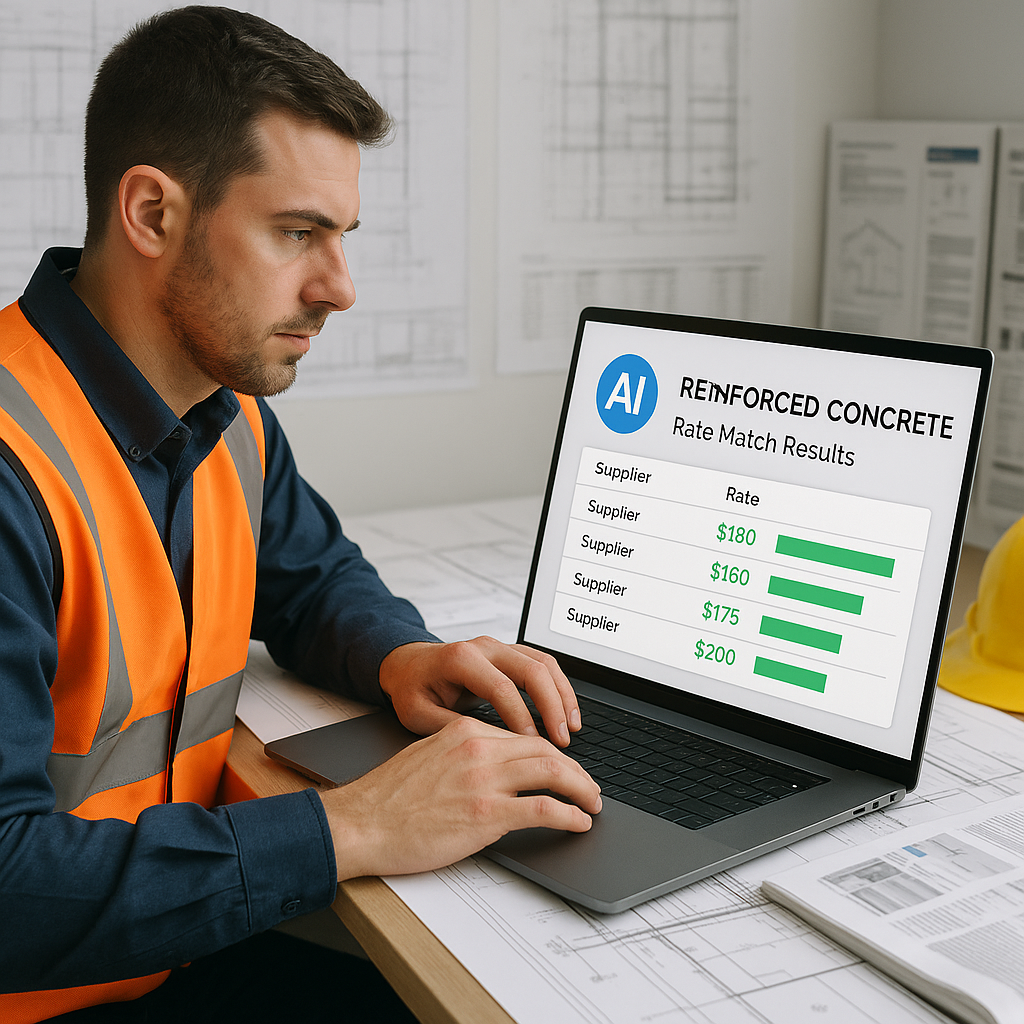
Why Rate Lookup is Every Estimator’s Nightmare
Imagine you’re pricing a $300M hospital project. You’ve got the Bill of Quantities (BOQ) ready, but the rates? They’re buried in a 2,000-page RSMeans PDF or CPWD DSR catalog. You’re flipping, CTRL+F-ing, and second-guessing if the labor rate for reinforced concrete is the right one. Hours wasted. And let’s be honest—mistakes happen. Wrong rates lead to blown margins or lost bids.
This isn’t just annoying; it’s expensive. According to a 2023 McKinsey report, early adopters of AI-powered estimation tools cut costs by 10-20% per project. Why? Rate matching is faster and more accurate.
The Real-World Cost of Manual Rate Lookup
Let’s break down the impact further. A survey by Construction Executive found that 35% of construction professionals spend more than 10 hours per week on manual administrative tasks like rate lookup. Imagine a general contractor (GC) director earning $130/hour. If they spend 12 hours per estimate only on rate lookup (a conservative figure), that’s $1,560 per bid wasted. Now multiply that by five GMP (Guaranteed Maximum Price) pursuits per year—$7,800 annually gone just to find rates.
For subcontractors, the numbers are even worse. Many MEP (Mechanical, Electrical, Plumbing) subs price 60 bid packages annually. If they could save even 8 hours per estimate, they’d recover 480 hours a year. That’s time that could be spent improving accuracy, negotiating better material prices, or chasing additional bids.
How AI Fixes Rate Lookup
AI-powered tools like EstimateNext change the game. Instead of manually flipping through catalogs, you type what you need—say, “labor rate for installing steel decking”—and the system pulls it instantly. Semantic search across 78,000+ items ensures you get the exact match, whether it’s CPWD DSR for India, RSMeans for the US, or DOT-approved catalogs for infrastructure projects. No human error, no wasted time.
Case Study: A Large Rail Bridge Project
Take a $1B rail bridge project as an example. The rates for everything—rail ties, structural steel, concrete—needed to be pulled from DOT-approved catalogs with strict compliance requirements. Using AI, a team can match rates for the entire BOQ in seconds. The result? Not only was the process faster, but it also avoided costly errors that could have jeopardized the bid. This kind of precision also strengthens a team’s competitive edge, allowing them to submit bids with confidence and meet aggressive deadlines.
Actionable Steps to Adopt AI-Powered Rate Matching
- Define your catalog requirements: Identify the rate catalogs you use most often (e.g., RSMeans, CPWD DSR, DOT, or custom supplier lists).
- Test AI tools before committing: Most tools like EstimateNext offer free trials. Test them on a small project to evaluate speed and accuracy.
- Upload custom rates: For projects with unique materials or finishes, ensure your AI tool can handle custom rate catalogs.
- Train your team: Even the best AI tools require user training. Ensure your estimators know how to leverage semantic search and confidence scoring.
What About Custom Rates?
You might be thinking, “But my projects have unique materials or finishes.” That’s fair. AI tools like EstimateNext go beyond standard catalogs by allowing you to upload custom rates. For example, if you’re pricing a luxury fit-out with bespoke marble finishes, the AI integrates your unique rates seamlessly for future use.
Example: Luxury Fit-Out Projects
Consider a high-end residential developer pricing a $10M penthouse renovation. The project involves custom brass fixtures, imported Italian marble, and hand-crafted wood paneling. Rather than relying on generic catalog rates, they upload their supplier quotes into EstimateNext. The AI not only matches rates but also flags discrepancies between similar materials and offers inflation-adjusted projections. By the third project, users report massive accuracy improvements because the system learns from their feedback loops.
Actionable Steps for Custom Rates
- Digitize your supplier quotes: Organize all custom rates into a searchable database or spreadsheet.
- Upload rates into your AI tool: Ensure the tool supports bulk uploads and can integrate inflation adjustments.
- Review AI’s learning curve: Check how the system improves rate matching over time based on your feedback.
The Obvious Objection: “AI Can’t Think Like an Estimator”
I get this pushback all the time. You might feel that AI lacks the nuance to understand construction. Here’s the truth: AI doesn’t replace your expertise; it amplifies it. You’re still the one making judgment calls, negotiating with subs, and deciding markup. The AI just handles grunt work—rate matching, takeoffs, and recalculations—so you can focus on strategy.
Comparison: Manual Rate Lookup vs. AI-Powered Estimation
| Aspect | Manual Lookup | AI-Powered Estimation |
|---|---|---|
| Time Spent | 8–12 hours per bid | Minutes |
| Error Risk | High (manual entry mistakes) | Low (automated checks) |
| Scalability | Limited to current bandwidth | Can handle 100+ bids annually |
| Accuracy | Depends on estimator | Confidence scoring built-in |
| Cost Savings | None | $7,800+ annually per GC |
Real ROI: Estimators Save Thousands per Bid
Let’s do the math again. A GC director typically spends 12 hours per estimate on rate lookup alone. At $130/hour, that’s $1,560 wasted. Multiply that across 5 GMP pursuits a year, and you’re burning $7,800 annually. AI-powered rate matching cuts this to minutes, saving thousands.
For MEP subs responding to 60 bid packages annually, the savings are even higher. Faster rate matching means they can price more bids, increasing their win rate. One HVAC contractor reported an additional $1.2M in revenue after switching to AI tools.


