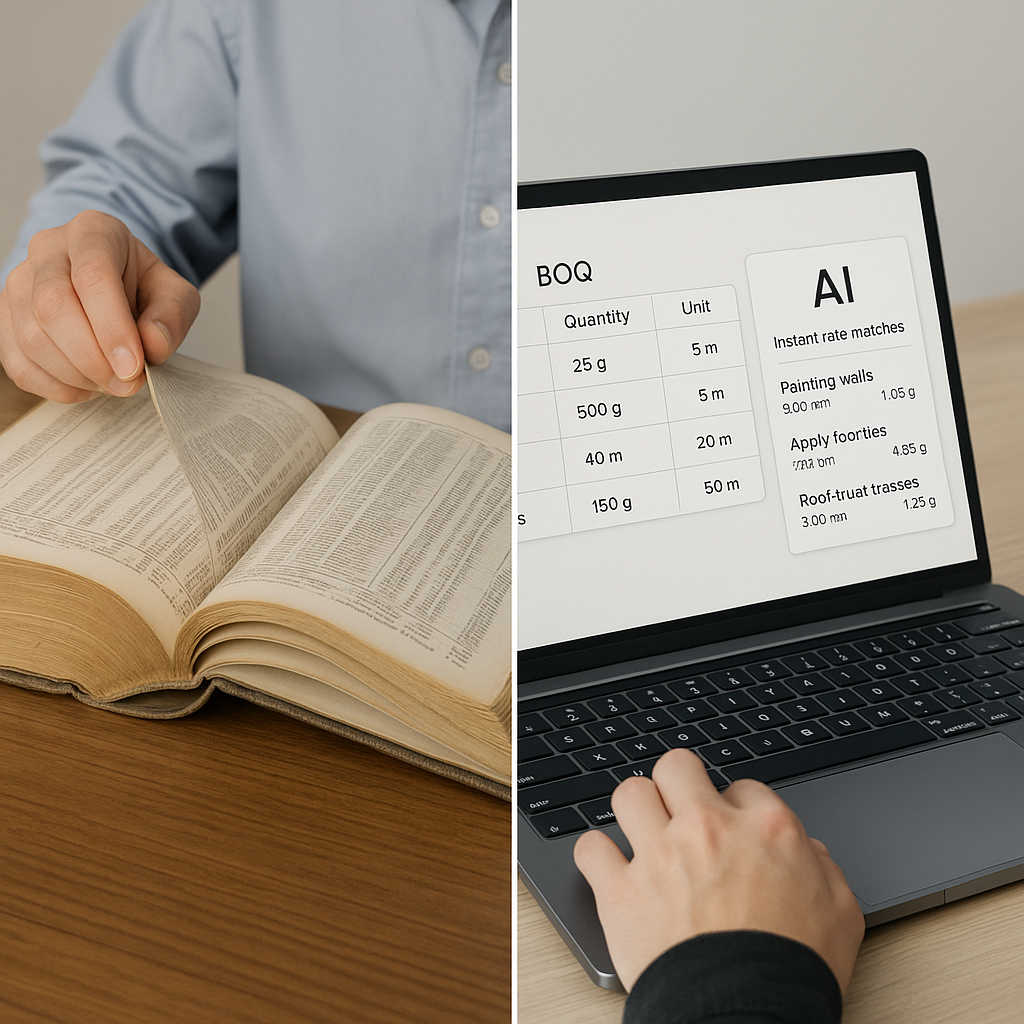
Why Manual Rate Lookup is Killing Your Productivity
Every estimator has been there. You’re knee-deep in a bid, and you need the labor rate for something specific — let’s say installing pre-stressed concrete girders. You grab the RSMeans book (or worse, the CPWD DSR PDF), and you start flipping. Page after page. Maybe it’s 20 minutes for one rate, maybe it’s an hour if you’re cross-referencing multiple sources.
Now multiply that by 200 items in your BOQ. Suddenly, you’ve lost a full day just on rate lookup. And that assumes you don’t miss a critical detail like regional adjustments or inflation factors.
In my experience, this isn’t just a time sink — it’s a risk. Manual lookup introduces human error, especially when you’re rushing to meet a bid deadline. One wrong rate can throw off your profit margins or make your bid uncompetitive.
To illustrate, a contractor bidding for a $10 million government project I consulted last year missed a regional adjustment factor while manually pulling rates. Their bid ended up 8% lower than the realistic cost, leading to significant losses on-site. This kind of error is avoidable with the right tools.
How AI Fixes This Bottleneck
AI-powered rate matching changes everything. Tools like EstimateNext use semantic search to instantly match BOQ items to the most relevant rates in a database of 78,000+ SOR items. No flipping through books. No CTRL+F guesswork in massive PDFs.
Step-by-Step Process
- Upload Your BOQ: You upload your Excel or CSV file. The system auto-detects line items, hierarchies, and merged cells that would otherwise need manual cleanup.
- Semantic Search: Type “pre-stressed concrete girder labor rate,” and the AI searches across multiple catalogs (RSMeans, CPWD DSR, AECOM, etc.) to find the closest match.
- Filters and Adjustments: Need rates specific to New York City instead of statewide averages? Or rates adjusted for 2024 inflation? The system applies these filters automatically, ensuring accuracy for your specific project.
- Audit Trail: Every rate match comes with an audit trail showing the source, adjustments, and why it was selected, so you can verify accuracy. This transparency reduces guesswork and builds confidence in the numbers.
Real-World Benefits
A case study highlighted by EstimateNext mentioned a mid-sized contractor saving 12 hours per estimate using this feature. That’s 12 hours they could spend refining bid margins or negotiating better terms with subcontractors. In competitive markets, the ability to reallocate time toward strategic tasks rather than repetitive rate lookups can make or break your bid.
Another example: A small engineering consultancy in Washington adopted EstimateNext and reported a 30% reduction in bid prep time within their first month. They found that AI-driven rate matching eliminated not only lookup inefficiencies but also discrepancies in regional adjustments.
Common Objections (and Why They Miss the Point)
“But AI can’t think like an estimator!”
I hear this a lot. And it’s true — AI won’t replace your expertise. But it doesn’t need to. Think of it as an assistant that handles the grunt work. You’re still the one making judgment calls, selecting markup percentages, and deciding how aggressive to be on pricing. AI just gets you to that point faster and with fewer errors.
“What if the AI picks the wrong rate?”
This is where human oversight comes in. Tools like EstimateNext include confidence scoring and manual override options. If something looks off, you can adjust it. Over time, the system learns from your preferences and improves matches. By the third project, most users report significant accuracy improvements.
“Isn’t it expensive?”
Not compared to the alternatives. RSMeans costs $5,000/year. CostX is $15,000. EstimateNext starts at $39/month. That’s less than the hourly rate of a single estimator. Plus, the ROI is immediate — if you’re saving even 10 hours per bid, the tool pays for itself many times over.
Real-World Example: Multi-Market Complexity
Let’s say you’re bidding on a project in Dubai, but your rate catalogs are based on U.S. labor costs. Manually converting currencies and adjusting for regional wage differences is tedious and error-prone. EstimateNext’s MarketProfile architecture handles this automatically. It pulls rates from AECOM Middle East catalogs, applies FIDIC compliance rules, and even adjusts for local tax regimes.
One UAE contractor reported cutting bid prep time by 50% using this feature. This saved them hours of unnecessary labor and unlocked additional time to focus on fine-tuning their bid competitiveness.
Decision Framework: Manual Lookup vs AI Tools
| Feature | Manual Lookup | AI-Powered Rate Matching |
|---|---|---|
| Time Investment | 1-2 hours per rate | 30 seconds per rate |
| Error Risk | High (human oversight required) | Low (audit trail provided) |
| Cost | $5,000-$15,000/year (books/software) | $39/month |
| Scalability | Limited by human capacity | Scales to large and complex BOQs |
| Learning Curve | Minimal (but slow and manual) | Moderate (AI improves over time) |
The Bottom Line
Manual rate lookup is a productivity killer. AI-powered tools like EstimateNext not only save you hours per estimate but also reduce errors, improve bid accuracy, and provide transparency. If you’re still flipping through 2,000-page rate books, it’s time to rethink your process.


