The Death of the 2,000-Page Rate Book
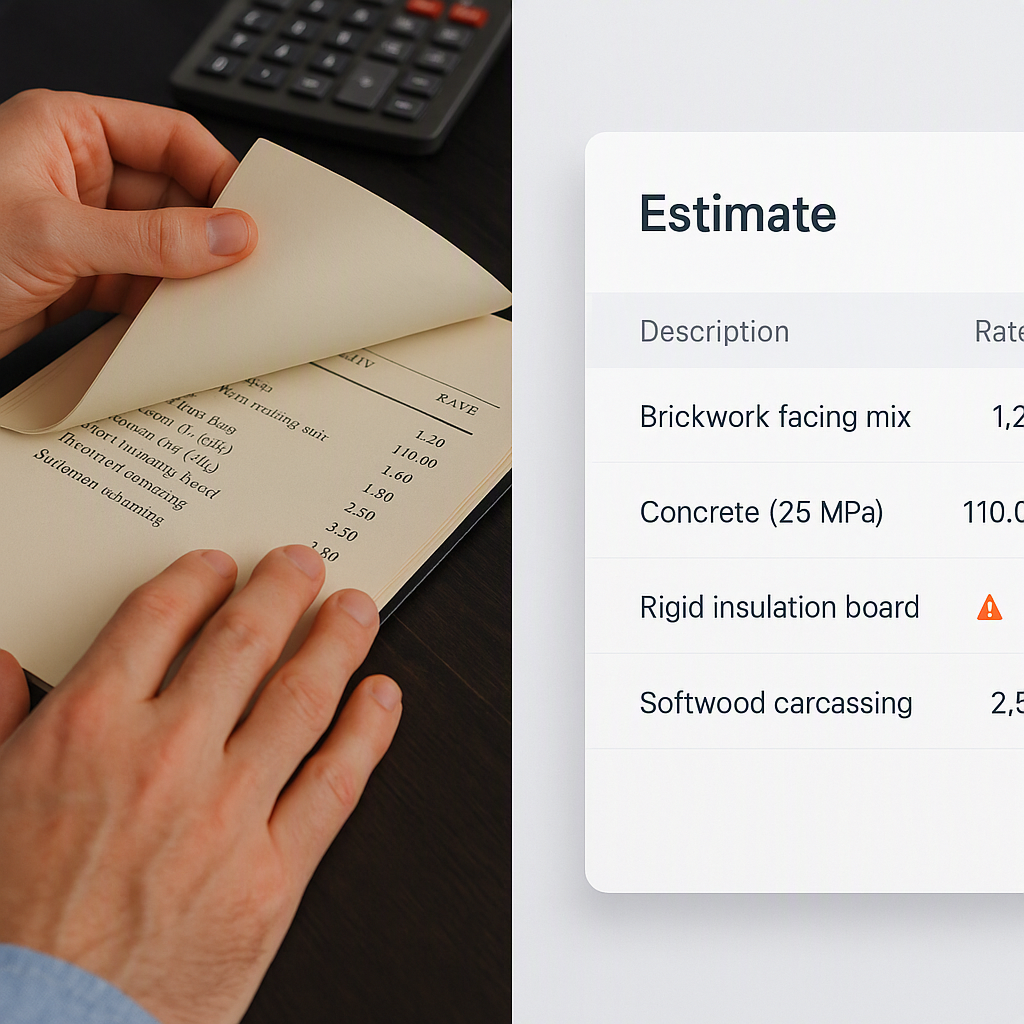
If you've ever flipped through a massive rate book like RSMeans or CPWD DSR, you know the pain. Finding the right rate for a specific item—say, pre-stressed concrete girders or high-efficiency HVAC units—can take hours. Worse, you might miss the exact match entirely because you're human, not a search engine.
This isn't just annoying; it's costly. Estimators spend an average of 12 hours per bid on rate lookups alone. Multiply that by 30 bids a year, and you're burning 360 hours annually on something a machine could do in seconds. That's a full 9 work weeks!
AI-powered tools like EstimateNext fix this. Their semantic search engine scans 78,000+ Schedule of Rates (SOR) items across 135+ catalogs in seconds. Need a labor rate for installing structural steel in Houston? Done. Pricing for drainage pipes in Delhi? No problem. It’s all there—fast and accurate.
Real-World Example: A $1B Rail Project
Let’s dive into a real-world scenario. A mid-sized contractor bidding on a $1B rail project faced the daunting task of pricing hundreds of items like rail ties, concrete decks, and structural columns. Traditionally, this would involve flipping through DOT-approved rate books, manually entering rates into Excel, and hoping nothing was missed. This was a grueling process that could take days.
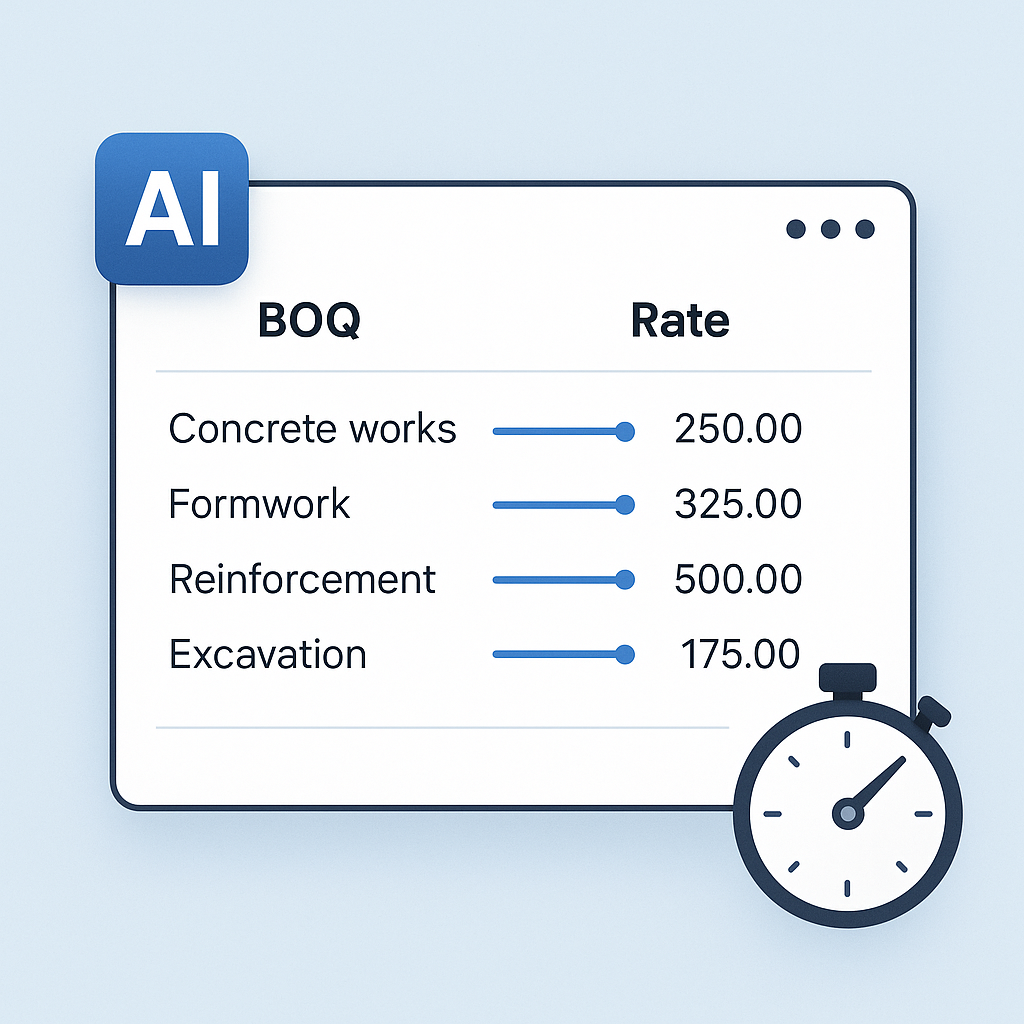
Using EstimateNext, they uploaded the Bill of Quantities (BOQ), and the AI matched 90% of the items to catalog rates within minutes. For the remaining 10%, the estimator added custom rates, which the system saved for future use. What normally took 12+ hours was done in under an hour.
The contractor not only met their bid deadline but also had time to refine their margin strategy. This extra time allowed them to identify cost-saving measures, secure competitive sub-contractor quotes, and ultimately submit a more attractive bid that won the project. This is a perfect example of how technology isn’t just about speed—it’s about enabling better decision-making.
Why Accuracy Matters
You might argue, "Sure, AI is fast, but can it be trusted?" Fair question. Accuracy is the make-or-break factor for rate matching. Let’s break down how AI tools like EstimateNext ensure precision:
-
Confidence Scoring: EstimateNext assigns a confidence score to each matched rate. If the AI isn’t 100% sure about a match, it flags the item for manual review. This ensures that human oversight is applied to edge cases, reducing the risk of errors.
Example: If the AI finds two similar rates for installing rebar—one for high-rise buildings and another for highway bridges—it will flag the discrepancy for your review to ensure the correct rate is applied.
-
Custom Catalog Integration: Got your own pricing? Upload it. The AI learns from your adjustments and gets smarter with each project. By the third bid, most users report near-perfect matches.
Case Study: A commercial contractor specializing in green building materials uploaded their custom solar panel installation rates. After a few projects, the tool could accurately apply their unique rates to any BOQ containing renewable energy components.
-
Audit Trail: Every matched rate comes with a breakdown of material, labor, and equipment costs. This transparency allows you to verify calculations and defend your estimates if questioned by clients or auditors.
Pro Tip: Use the audit trail feature to quickly respond to client RFIs (Requests for Information), which often ask for detailed cost justifications.
The ROI Is Hard to Ignore
Let’s do some quick math to highlight the return on investment (ROI). Say you’re a General Contractor (GC) Preconstruction Director managing 5 Guaranteed Maximum Price (GMP) pursuits annually. Each pursuit involves 40 hours of manual rate lookups. That’s 200 hours per year dedicated to repetitive tasks.
At an average labor cost of $130/hour, this translates to $26,000 annually. Switch to EstimateNext, and those 200 hours drop to just 10. That’s a 95% time savings. Even if the tool costs $1,200/year (the top-tier plan), you’re looking at a 20X ROI—if not more.
And that calculation doesn’t even factor in the potential for:
- Reduced errors that could result in costly bid revisions.
- Faster bid submissions, which can help you meet tight deadlines and secure more projects.
- Improved team morale by eliminating tedious, low-value tasks.
What About Edge Cases?
You might be thinking, "What if my project uses custom materials or niche finishes not in any catalog?" This is a common concern, but AI tools have a solution:
-
Custom Rates: You can define custom rates for unique materials or labor. These custom entries are saved for future BOQs, so you only have to input them once.
Example: A contractor pricing a custom glass façade for a luxury hotel manually added their supplier’s rate for tempered glass and installation. The system saved this rate, applying it automatically to future projects with similar façade specifications.
-
Outdated Catalogs: Construction costs fluctuate, and outdated rate books can lead to inaccurate estimates. EstimateNext addresses this by:
- Applying annual inflation adjustments.
- Integrating live data feeds like HUD Davis-Bacon rates in the U.S. and CPWD updates in India.
Case Study: A contractor working in a high-inflation market used real-time material cost updates to adjust their bid for a government housing project. This ensured their bid remained competitive without sacrificing profitability.
Why Aren’t More Estimators Using This?
Honestly? Habit. Many estimators are seasoned pros who trust their spreadsheets and rate books because they’ve used them for decades. Change is hard, especially in industries like construction, where relationships and experience play a significant role.
But here’s the thing: technology doesn’t replace your expertise; it amplifies it. When you free yourself from manual grunt work, you can focus on what really matters—negotiating with subcontractors, refining your bid strategy, and spotting opportunities to add value for your clients.
The Bottom Line
If rate lookups are eating into your team’s productivity, it’s time to rethink your process. AI-powered tools like EstimateNext don’t just save time; they improve accuracy, reduce errors, and give you a competitive edge.
Why spend 12 hours doing what a machine can handle in seconds? Your team’s expertise is too valuable for that.
Comparison Table: Manual Rate Lookups vs. AI Tools
| Feature | Manual Process | AI-Powered Tools (e.g., EstimateNext) |
|---|---|---|
| Time to Find Rates | 12+ hours per bid | Under 1 hour |
| Accuracy | Prone to human error | High confidence with audit trails |
| Custom Rate Integration | Manual entry for every project | Automatic application after one-time input |
| Cost Adjustments | Requires manual updates | Includes live data feeds |
| Scalability | Time-consuming for large BOQs | Scans 100,000+ items in seconds |
Ready to Stop Wasting Time on Rate Lookups?
If you’re dealing with the inefficiencies of manual estimation, EstimateNext can help. Get started free and see the difference for yourself.