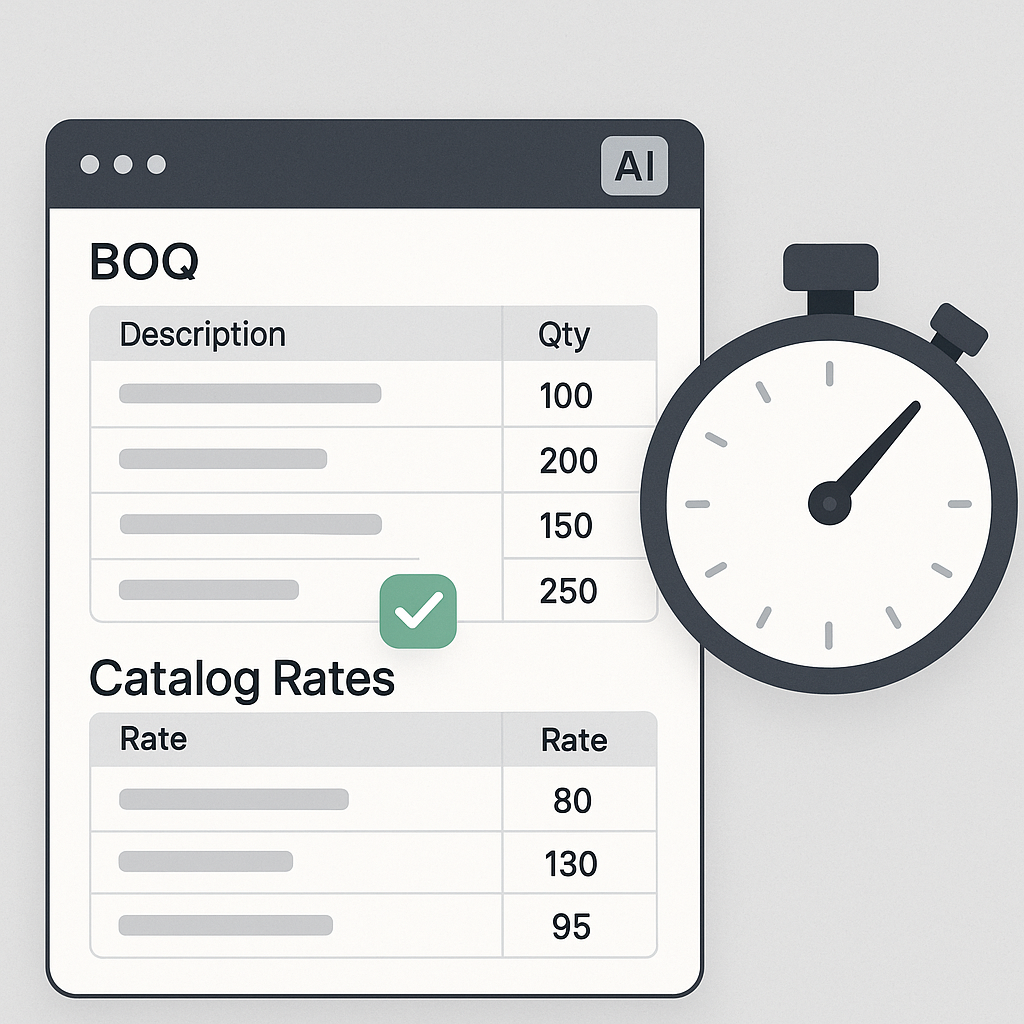
Why Manual Rate Lookup is Killing Productivity
Picture this: you're an estimator working on a $200M project. The BOQ (Bill of Quantities) is 600 lines long, and your job is to price it accurately. That means flipping through a 2,000-page rate book or digging into outdated PDFs to match material, labor, and equipment costs across hundreds of items. Sound familiar? It should. This process eats up 12-15 hours per bid, minimum.
And guess what? Those hours aren’t just wasted—they’re risky. Every manual lookup introduces the possibility of human error. A missed rate or outdated cost can sink a bid. Worse, if you’re under the gun to hit a deadline, you’re more likely to cut corners. Not ideal.
But what if you didn’t have to waste time or take those risks? That’s where AI-powered rate matching comes in.
AI Rate Matching: Seconds, Not Hours
Here’s the magic of tools like EstimateNext: instead of manually searching rates, you upload your BOQ, and the AI does the heavy lifting. In seconds, it matches your items to a database of 78,000+ Standard Operating Rates (SORs) from catalogs like CPWD DSR, RSMeans, and AECOM Middle East. Need a labor rate for precast concrete? Done. What about material costs for HVAC ductwork? Handled.
Speed Comparison
Let’s break it down:
- Manual lookup: 12-15 hours per bid, depending on complexity.
- AI rate matching: Under 2 minutes. The system scans, analyzes, and matches your BOQ items automatically. No flipping through PDFs. No Ctrl+F.
Accuracy Matters
Speed is only part of the story. AI also improves accuracy. Every match comes with a confidence score, so you know exactly where to double-check. If an item doesn’t have a perfect match, the AI suggests close alternatives or flags it for manual review. That’s peace of mind you don’t get with manual methods.
Real-World Example: $1B Rail Project
Let’s look at a real case. A top-tier general contractor bidding on a $1B rail bridge project used EstimateNext to handle their rate matching. Normally, pulling rates for concrete columns, beams, and rail decks would take over 50 hours. Using AI, they got it done in under 10 minutes. That’s a 99% time reduction.
The Result
- Bid submitted ahead of schedule: This gave them a competitive edge.
- Improved accuracy: The AI flagged discrepancies in their rate library, issues they would’ve missed manually.
- Cost savings: Reducing manual effort freed up the team to focus on value engineering and negotiations.
Other examples abound:
- A subcontractor pricing a $5M plumbing job saved 10+ hours using AI and discovered outdated material costs they hadn’t accounted for.
- A civil contractor working on a 30-km highway project used AI to update their rates mid-bid when fuel prices spiked, avoiding a costly underestimation.
Why This Matters More Than You Think
You might be thinking, “Okay, speed is great, but I’ve been doing this manually for years. Why change now?” Here’s why: the stakes are higher than ever.
Shrinking Margins
Profit margins in construction are notoriously thin—often in the 2-6% range. A single pricing error can wipe out your profit on an entire job.
Inflation & Market Volatility
Inflation is driving up material costs. For example, steel prices surged by over 25% in 2021 alone. Without real-time updates, you’re at risk of underbidding and eating the difference.
Labor Shortages
The global construction industry faces a labor shortage. Estimators are stretched thin, and every hour you save on estimation is an hour you can spend refining your bid strategy, negotiating with subs, or running what-if scenarios to optimize costs.
Amplify Expertise, Don’t Replace It
AI isn’t replacing your expertise—it’s amplifying it. By handling the repetitive, error-prone task of rate matching, AI frees up estimators to focus on higher-value activities like analyzing bid strategies or improving project workflows.
What About Custom Rates?
A common objection we hear is, “But my projects use custom materials and unique specs. AI can’t handle that.”
The Reality
- Tools like EstimateNext allow you to upload custom catalogs, so your rates are always reflected accurately.
- The system learns from your adjustments. By your third project, it’s already smarter, delivering better matches every time.
- You can even integrate live feeds from suppliers for real-time cost updates, ensuring your custom rates are always current.
The ROI is Undeniable
Let’s do the math:
- Saving 12 hours per bid across 8 bids per year equals 96 hours saved annually.
- At an average estimator rate of $130/hour, that’s $12,480 in labor savings.
- Factor in reduced errors and better accuracy, which can save tens (or hundreds) of thousands on large projects, and the cost-benefit becomes even clearer.
- Compare this to the cost of an AI tool like EstimateNext, which starts at $39/month for trade subcontractors or $99/month for general contractors. That’s less than $1,200 per year for most companies—a fraction of the potential savings.
Decision Framework: Manual vs. AI Rate Matching
| Feature | Manual Rate Lookup | AI Rate Matching |
|---|---|---|
| Time per bid | 12-15 hours | Under 2 minutes |
| Human error risk | High | Low (with confidence scores) |
| Custom catalogs | Manually integrated | Automatically updated |
| Learning curve | None, but slow process | 1-2 projects to optimize |
| Cost | Labor-intensive, high | Low subscription cost |
Actionable Steps to Get Started
- Audit Your Current Process: Track how much time your team spends on manual rate matching per bid. Identify bottlenecks.
- Test AI Tools: Start with a free trial of tools like EstimateNext or similar platforms.
- Integrate Custom Data: Upload your custom rate catalogs and adjust the AI’s suggestions to train it for your specific needs.
- Measure ROI: Track time saved, errors reduced, and overall bid accuracy improvements after implementing AI.


