Why Rate Matching is Killing Your Estimation Team
Let’s start with the obvious: rate lookup is a disaster. If you’ve ever spent hours flipping through a 2,000-page CPWD DSR or RSMeans PDF, you know the pain. Manual rate matching isn’t just slow—it’s error-prone. Miss one rate, and your bid could be off by thousands. The worst part? You’re not even solving the real problem.
In my experience, estimators waste more time on rate matching than almost any other task. A BOQ (Bill of Quantities) with 1,847 line items might take someone days to price manually. Why? Because every rate lookup involves hunting for labor costs, material breakdowns, and equipment schedules—often across multiple catalogs. And if your rates are custom? Good luck.
The AI Fix: Semantic Rate Matching
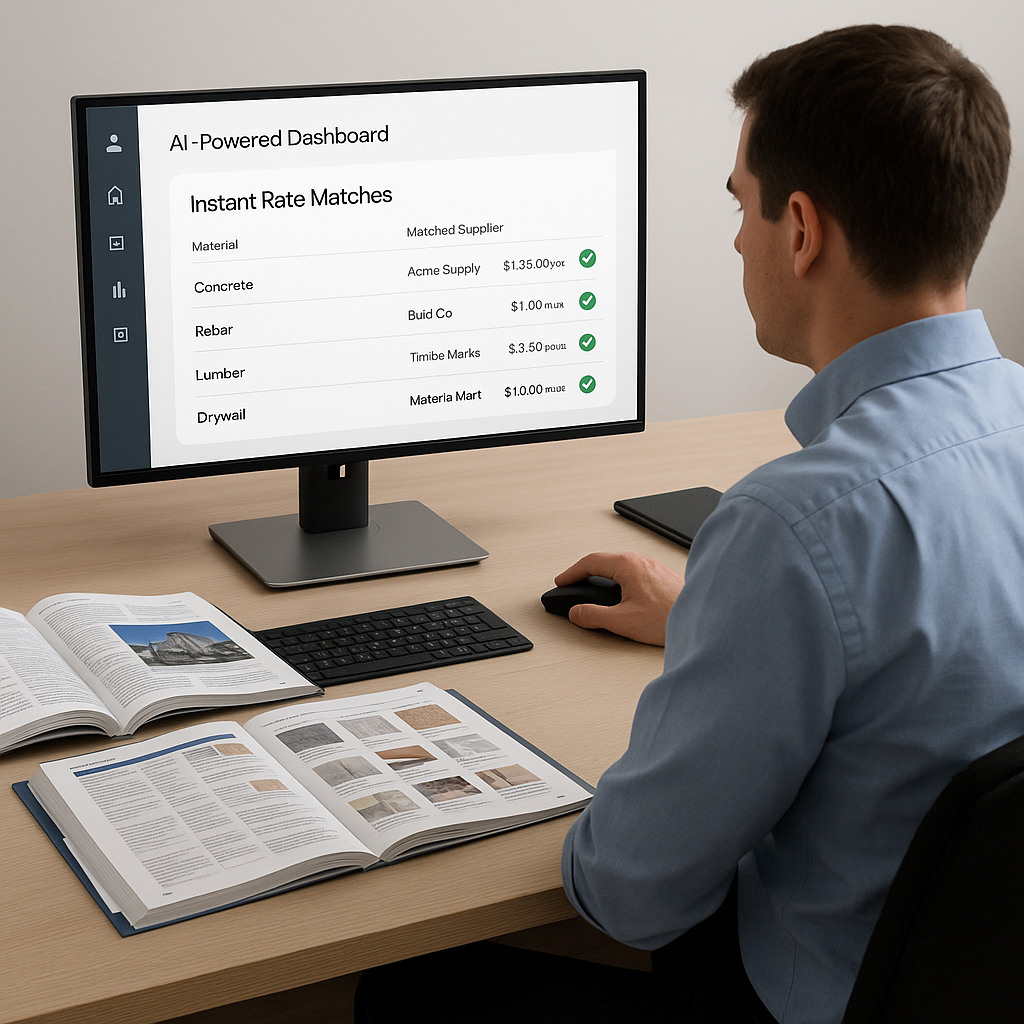
AI changes everything. Tools like EstimateNext use semantic search to match BOQ items to 78,000+ preloaded rates across 135 catalogs. Need the labor rate for pre-stressed concrete girders? Type in the description, and the AI finds it instantly. Done.
Here’s a real-world example: a subcontractor pricing a $1B rail project used EstimateNext to match rates for concrete columns, beams, and rail decks. What would’ve taken weeks to price manually was done in under 10 minutes. The kicker? The AI didn’t just pull rates—it broke them down into material, labor, and equipment costs with full audit trails. No guessing.
But let’s expand on this. Imagine you’re bidding on a multi-story commercial building project. Your BOQ includes everything from structural steel to HVAC ductwork. Manual rate matching would require flipping through catalogs for each item, cross-referencing rates, and manually calculating totals. With AI, you can upload the BOQ, let the system match rates automatically, and focus on refining the bid strategy. This isn’t just faster—it reduces the risk of costly errors.
How Does It Work?
It’s simpler than you think. The system applies a 4-step matching process:
- Tenant History: It checks your previous matches first, leveraging historical data from your prior projects.
- User Catalogs: If you’ve uploaded custom rates, it prioritizes them to ensure accuracy.
- Country-Level Widen: Expands to local catalogs when matches aren’t found in your immediate dataset.
- AI Fallback: Uses semantic matching across global datasets, identifying the closest matches based on item descriptions.
For example, let’s say you’re pricing construction in Dubai but working with a team based in India. The AI automatically adjusts for regional standards like CPWD, CESMM3, or CSI, ensuring the rates align with local labor costs and material pricing. This eliminates the need for manual reconciliation between catalogs.
This isn’t about replacing your expertise—it’s about saving you from grunt work. You still control the final rates, but the AI gets you to a starting point faster.
What’s the ROI?
Let’s talk numbers. A general contractor (GC) team using EstimateNext reported saving 40 hours per bid. Multiply that by $130/hour (average estimator salary), and you’re looking at $5,200 saved per pursuit. For teams handling 5-8 GMP pursuits annually, that’s $26K-$41K saved each year—just on rate matching.
For subcontractors, the ROI is even higher. Faster bids mean responding to more packages. A mid-sized MEP (Mechanical, Electrical, Plumbing) firm added 4 wins in one year by cutting their quote turnaround from 72 hours to 4 hours. Those wins translated to $800K in incremental revenue.
And it’s not just large firms. A small concrete contractor in Chicago used AI rate matching to bid on smaller municipal projects. By cutting bid prep time in half, they landed 3 additional contracts worth $250K in total.
The Obvious Objection: “AI Can’t Think Like an Estimator”
I hear this all the time—“Sure, AI is fast, but it doesn’t understand construction.” Fair point. AI doesn’t know why you picked a 12% markup instead of 10%, or why you negotiated harder with Sub B over Sub A. But that’s missing the point.
AI isn’t here to replace your judgment. It’s here to handle the grunt work so you can focus on high-value tasks. With rate matching, the AI gets you 99% of the way there. You’re still the one making the final call.
Edge Cases: What If My Rates Are Custom?
This is a common concern. AI tools like EstimateNext let you upload your own rate catalogs or define custom rates for specific items. For example, if you’ve negotiated special pricing on imported steel, the system integrates those rates seamlessly. And the more you use it, the smarter it gets—learning from every adjustment you make.
Take the example of a civil contractor in Singapore working on a custom pedestrian bridge. They uploaded their negotiated rates for imported aluminum, and the AI matched those rates to relevant BOQ items automatically. What would’ve required manual overrides in traditional software was handled seamlessly.
What About Multi-Market Complexity?
If you’re working across multiple countries, you know how messy rate lookup can get. Different standards (CSI/NRM2/CPWD/CESMM3), currencies, and labor rules make manual matching a nightmare. AI fixes that too. EstimateNext’s MarketProfile architecture handles these variations automatically, applying the correct measurement standard and local rates.
For example, a contractor pricing projects in both the US and India can rely on the AI to account for regional discrepancies in labor laws, material pricing, and unit conversions. This ensures bids are accurate regardless of geography.
Comparison Table: Manual Rate Matching vs. AI Rate Matching
| Feature | Manual Rate Matching | AI Rate Matching |
|---|---|---|
| Speed | Days per BOQ | Minutes per BOQ |
| Accuracy | Prone to human error | 99% reliable |
| Multi-market compatibility | Time-consuming adjustments | Automatic regional adapts |
| Integration with software | Limited | Seamless |
| Cost | High labor costs | Affordable monthly plans |
Call to Action
If you’re wasting hours on manual rate lookups, EstimateNext can help. It matches rates in seconds and saves you thousands per bid. Get started free →


