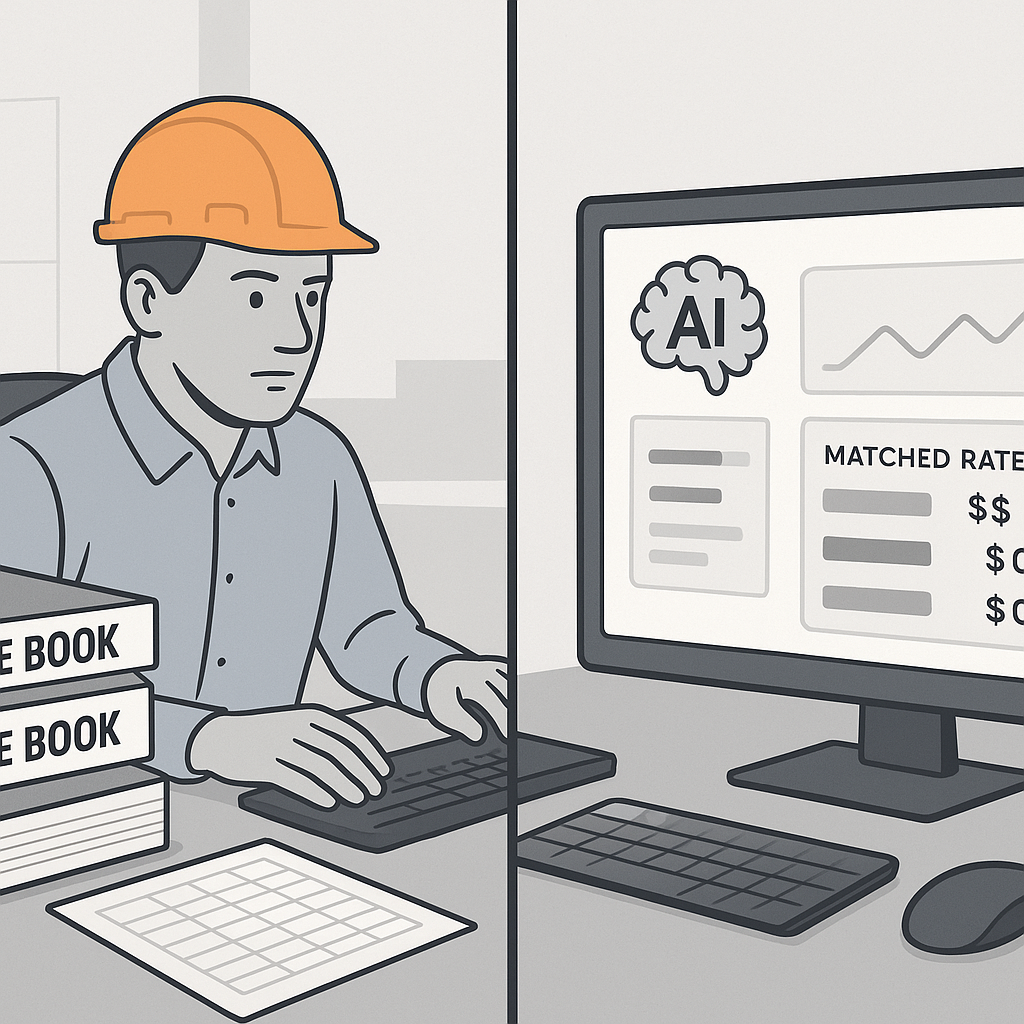
Why Rate Matching is Killing Your Preconstruction ROI
If you’ve ever flipped through a 2,000-page RSMeans or CPWD DSR rate book, you know the pain. Matching rates manually takes hours—sometimes days. Multiply that across multiple projects, and you’ve just burned a week chasing numbers. For construction professionals, time isn’t just money—it’s opportunity. Every minute spent on manual tasks is a minute you’re not strategizing, negotiating, or locking in new business.
It’s not just the time. Mistakes happen. What if you misread a column or forget to factor in inflation adjustments? Those errors snowball, and suddenly you’re underbidding—or worse, overbidding—a job. The consequences can be catastrophic: unprofitable projects, strained client relationships, and even reputational damage.
AI fixes this. Tools like EstimateNext use semantic search to match rates in seconds. Type “pre-stressed concrete girder installation labor rate,” and boom—you’ve got the match. No manual lookup. No human error. Just results.
How AI Rate Matching Works
AI-powered rate matching isn’t magic—it’s a combination of advanced technology and industry-specific intelligence. Let’s break it down:
1. Semantic Search
Traditional rate books require you to flip through thousands of pages, cross-referencing columns and rows. AI tools eliminate this drudgery. They use semantic search to understand the intent behind your query. For instance, if you search for “pre-stressed concrete girder installation labor rate,” the system doesn’t just look for exact matches; it understands synonyms and context. This means it can pull the exact rate you need from a database of 78,000+ Schedule of Rates (SOR) items in seconds.
2. Custom Catalog Integration
Not all projects are standard. Many contractors deal with unique materials, proprietary techniques, or specialized labor. AI tools allow you to upload your own rate catalogs, ensuring the system reflects your specific needs. Over time, the AI learns your preferences, making future estimates even faster and more accurate.
3. Inflation Adjustments
Construction rates aren’t static. A rate from a 2018 catalog isn’t valid in 2023. AI automatically applies inflation adjustments, factoring in compound growth rates based on the catalog year. This ensures that your estimates are not only accurate but also competitive in today’s market.
Real-World Examples
General Contractor Streamlines a $10M Project
A mid-sized general contractor recently used EstimateNext for a $10 million school renovation project. Previously, their estimators spent 36 hours manually matching rates for a similar project. With AI, they completed the task in less than 4 hours. At an average estimator rate of $130/hour, that’s a labor cost savings of $4,680 on a single project.
But the benefits didn’t stop there. By reducing time spent on rate matching, the team was able to focus on refining their bid strategy, resulting in a more competitive proposal. They won the project and delivered it on budget, thanks in part to the accuracy of their AI-generated estimates.
Subcontractor Increases Bid Volume by 50%
An MEP subcontractor handling HVAC installations saw a 50% increase in their bid volume after adopting AI-powered rate matching. By reducing quote turnaround times from 72 hours to just 4, they could respond to more opportunities without adding staff. Over the course of a year, this translated to an additional $1.2 million in revenue from new contracts.
Addressing Common Objections
Objection: “AI Can’t Think Like Me”
You’re absolutely right—AI doesn’t replace your expertise. It can’t negotiate with suppliers, identify hidden risks, or build client relationships. What it does is amplify your capabilities by handling the tedious, error-prone tasks. Think of it like hiring an assistant who never gets tired, never forgets, and never makes arithmetic mistakes.
Objection: “What About Niche or Custom Rates?”
Some contractors worry that their unique requirements are too specific for AI. But tools like EstimateNext are designed for flexibility. You can upload custom rate catalogs and even input project-specific adjustments. Over time, the AI learns from your feedback, becoming more tailored to your needs.
Objection: “Won’t AI Take My Job?”
This is a common fear, but the reality is far different. AI doesn’t replace estimators; it empowers them. By automating repetitive tasks, estimators can focus on higher-value activities like cost optimization, risk assessment, and client communication. Companies that adopt AI often find they can take on more projects without overburdening their teams.
Why Speed Matters
In the competitive world of construction, speed isn’t just a luxury—it’s a necessity. Missing a bid deadline can cost you millions in lost opportunities. AI-powered rate matching ensures you never fall behind.
Time-Saving Scenarios
- General Contractors: For a GC managing multiple $10M+ projects, AI can save 40 hours per estimate. Over 10 bids, that’s 400 hours—or 10 full workweeks.
- Subcontractors: MEP contractors handling 30-60 bid packages annually can cut their quote turnaround time by 80%, freeing up resources to pursue additional opportunities.
Competitive Advantage
Speed doesn’t just help you meet deadlines; it gives you a competitive edge. Faster estimates mean you can respond to more RFPs, negotiate better terms, and secure projects before your competitors even submit their bids.
Decision Framework: Manual vs. AI-Powered Rate Matching
| Criteria | Manual Rate Matching | AI-Powered Rate Matching |
|---|---|---|
| Time Required | 30-40 hours per project | 2-4 hours per project |
| Accuracy | Prone to human error | 99% accuracy with feedback loops |
| Scalability | Limited by human resources | Scales effortlessly across projects |
| Custom Rate Handling | Manual input and tracking | Seamless integration and learning |
| Cost | High labor costs | Low subscription fee; high ROI |
| Competitive Advantage | Slower response times; fewer bids submitted | Faster estimates; more opportunities |
Call to Action
If rate matching is eating into your time and profits, EstimateNext can help. Stop wasting hours flipping through rate books or second-guessing inflation adjustments. Try it free today—no credit card required—and discover how AI can transform your preconstruction process.


