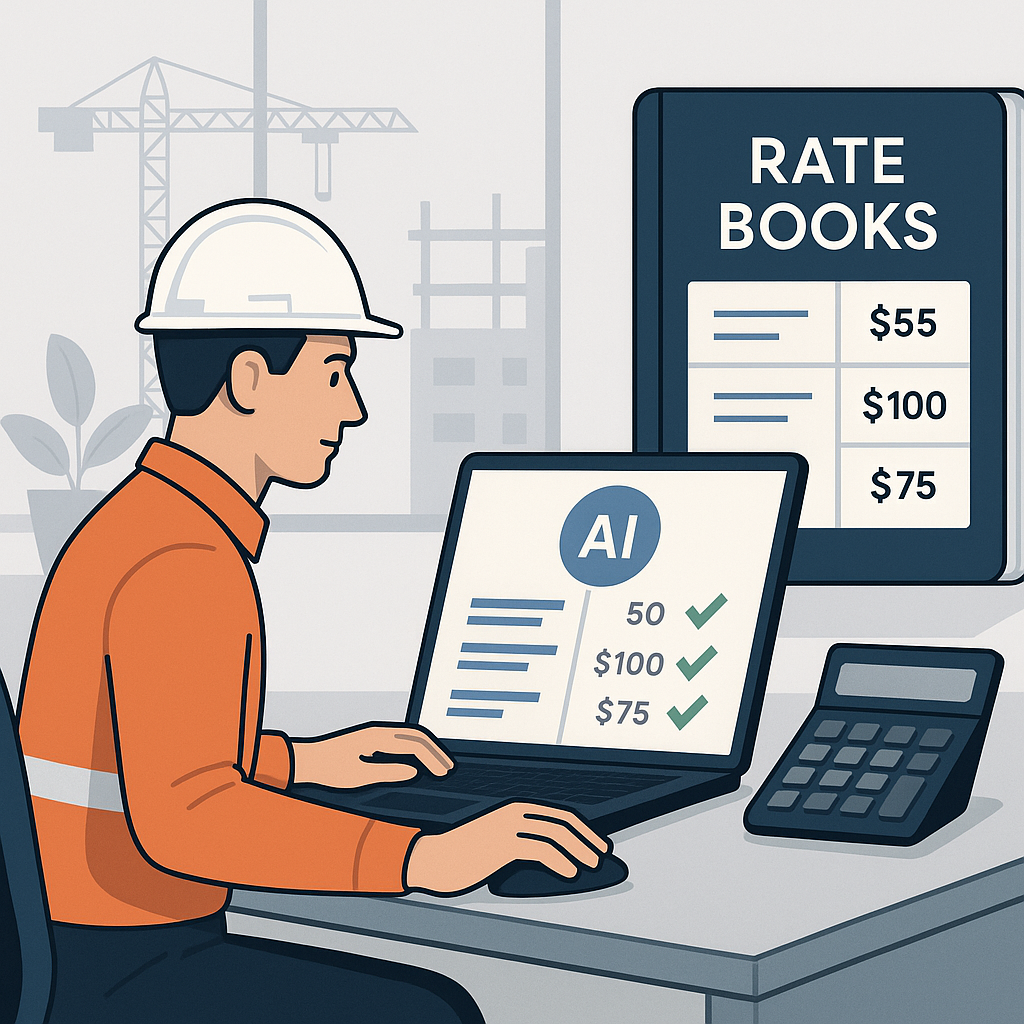
Why Rate Matching is Killing Your Estimation Efficiency
Ever spent hours flipping through rate books to find the labor cost for a specific item? Let’s be honest—it’s frustrating, inefficient, and prone to errors. A typical CPWD DSR or RSMeans book runs over 2,000 pages. For every project, you’re repeating the same process: look up item codes, match rates, double-check for inflation adjustments. Multiply that by 200+ BOQ items, and you’re easily wasting half a day.
Here’s the kicker: you don’t even know if the rates you’ve matched are optimized for the bid. If you’re off by even 5%, it could mean losing the contract—or worse, winning it at a loss.
Breaking Down the Problem
Why Manual Rate Matching Fails
Manual rate matching feels like an unavoidable evil in the construction industry. But it’s riddled with inefficiencies:
-
Time-Consuming: Matching rates for hundreds of BOQ items means flipping through endless pages of rate books or spreadsheets. For example, a mid-sized infrastructure project with 300 BOQ items can easily take 16–20 hours just to match rates manually.
-
Error-Prone: Human errors are inevitable. Missing an inflation adjustment or selecting the wrong rate for a similar item could result in bid inaccuracies. A single miscalculation on a high-cost item (e.g., precast girders) could cost thousands—or even millions—in profit.
-
Lack of Optimization: Manual methods don’t allow for real-time adjustments. For instance, you might miss the opportunity to incorporate regional inflation rates or vendor-specific discounts because the process is too rigid.
Concrete Example: A Small Contractor’s Struggles
Imagine a small contractor working on a $1.2M office renovation. They rely on old CPWD DSR PDFs for rate matching. For every line item (e.g., “10mm aggregate supply”), they spend 5–10 minutes locating the rate, double-checking for regional adjustments, and manually entering it into their estimate. Across 150 BOQ items, that’s over 20 hours. Worse, they accidentally use outdated rates for HVAC systems, which inflates their bid by 7%. They lose the contract to a competitor with more accurate pricing.
The AI Fix: Semantic Rate Matching
This is where AI-powered tools like EstimateNext change the game. Instead of manually searching PDFs or Excel sheets, you upload your BOQ, and the system instantly matches rates across 78,000+ items. How does it work? Semantic search. Type in “labor for prestressed concrete girders,” and the AI pulls the exact match—no guessing, no errors.
How Does It Work?
-
Smart Search Capabilities: Unlike keyword-based searches, semantic AI understands the context. For example, if you type “high-grade steel reinforcement,” it will return results for both TMT bars and rebar specifications based on your catalog.
-
Inflation Adjustments: The software automatically updates rates to reflect current market conditions. If steel prices rose by 8% in Q3, the system adjusts rates accordingly, ensuring your bid stays competitive.
-
Custom Rate Profiles: Have a negotiated rate with a specific vendor? AI tools let you upload your own catalogs, ensuring custom rates are always prioritized.
Real-World Impact
A contractor bidding on a $50M residential apartment project used EstimateNext to match rates for 280 BOQ items. Without AI, they estimated it would take 18 hours. With AI, it took just 30 minutes. Even better, the tool suggested value-engineered alternatives (e.g., swapping imported tiles for a local equivalent), saving $300,000 on the bid. Source: EstimateNext
Example: A $108M Rail Project
Take a major general contractor’s rail bridge bid as an example. They had to match rates for everything from structural steel to rail ties using DOT-approved catalogs. With manual methods, that would’ve taken days. AI tools streamlined the process, cutting hours into seconds. And they didn’t miss the nuances—rates were pulled from catalogs specific to the state and project type. Source: EstimateNext
This isn’t just about time savings. By optimizing their rate matching, they minimized the risk of underbidding—a common issue when rates aren’t adjusted for inflation or regional factors. As a result, their bid was not only competitive but also profitable.
Why It Works for Everyone
You might think, “Sure, this works for big firms, but what about smaller contractors?” The truth is, AI scales. Whether you’re pricing a $1M office fit-out or a $1B infrastructure project, the same principles apply. For regional contractors in India, the AI can sift through 2,000-page CPWD DSR PDFs in seconds. For GCC firms, it handles multi-country rate profiles seamlessly.
Actionable Steps for Small Contractors
- Start With Your Biggest Pain Points: If rate matching is eating up hours of your team’s time, it’s the perfect place to start with AI tools.
- Upload Custom Catalogs: Even if you’re a small contractor with a limited set of negotiated rates, uploading these ensures precision in your bids.
- Focus on High-Value Tasks: Let AI handle repetitive tasks like rate matching, freeing up your team for value-driven work like client negotiations or project planning.
Comparison Table: Manual vs. AI Rate Matching
| Feature | Manual Rate Matching | AI-Powered Rate Matching |
|---|---|---|
| Time Required | 16–20 hours for 200 BOQ items | 15–30 minutes |
| Accuracy | Prone to human error | Highly accurate, self-learning |
| Inflation Adjustments | Manual updates required | Automated, real-time |
| Custom Rate Integration | Limited | Seamless |
| Scalability | Time increases with project size | Scales effortlessly |
The Bottom Line
Flipping through rate books is outdated. AI-powered rate matching saves time, reduces errors, and ensures your bids are competitive. It’s not just about working faster—it’s about working smarter.
For contractors of all sizes, adopting AI tools like EstimateNext can drastically improve efficiency and accuracy in project estimation. Don’t let outdated methods hold you back. If you’re tired of wasting hours on manual rate lookup, it’s time to adapt.


