Why Rate Lookups Are Killing Estimators
If you’ve ever spent hours flipping through RSMeans or CPWD DSR catalogs, you know the pain. Rate lookups are slow, error-prone, and downright frustrating. On average, estimators lose 12 hours per estimate just matching BOQ items to rate books. That’s not just time—it’s opportunity cost.
Missed a bid deadline because you couldn’t finish on time? Or worse, underbid because you miscalculated rates? You’re not alone. A 2023 McKinsey study found that inefficiencies in preconstruction workflows contribute to 10-20% higher project costs on average. Rate lookups are one of the biggest culprits.
Let’s dig deeper into why these inefficiencies exist and how innovative tools are turning the tide.
The Hidden Costs of Manual Rate Lookups
Manual rate lookups have been the industry standard for decades, but they’re far from efficient. Here’s why they’ve become such a bottleneck:
-
Time Drain: Searching through thousands of rate items is tedious. If your BOQ has 200 line items, and it takes 3-5 minutes to find a single rate, that’s 10-15 hours per estimate.
- Example: A Tier-2 contractor in California shared that their estimators spend up to 20% of their time per week just flipping through RSMeans. That’s 8 hours out of a 40-hour workweek gone.
-
Error-Prone Processes: Humans make mistakes, especially under tight deadlines. Missing a rate or applying the wrong one can skew your entire bid.
- Case Study: In 2022, a construction firm bidding for a $5M highway project underestimated their bid by $250,000 due to an incorrect rate lookup. They won the bid but took a loss on the project.
-
Opportunity Cost: Every extra hour spent on rate lookups is an hour you’re not spending on higher-value tasks like refining your bid strategy or negotiating with vendors.
The inefficiency isn’t just about lost time; it’s about lost revenue and increased project risks. Fortunately, AI is stepping in to eliminate these pain points.
The AI Advantage: Instant Rate Matching
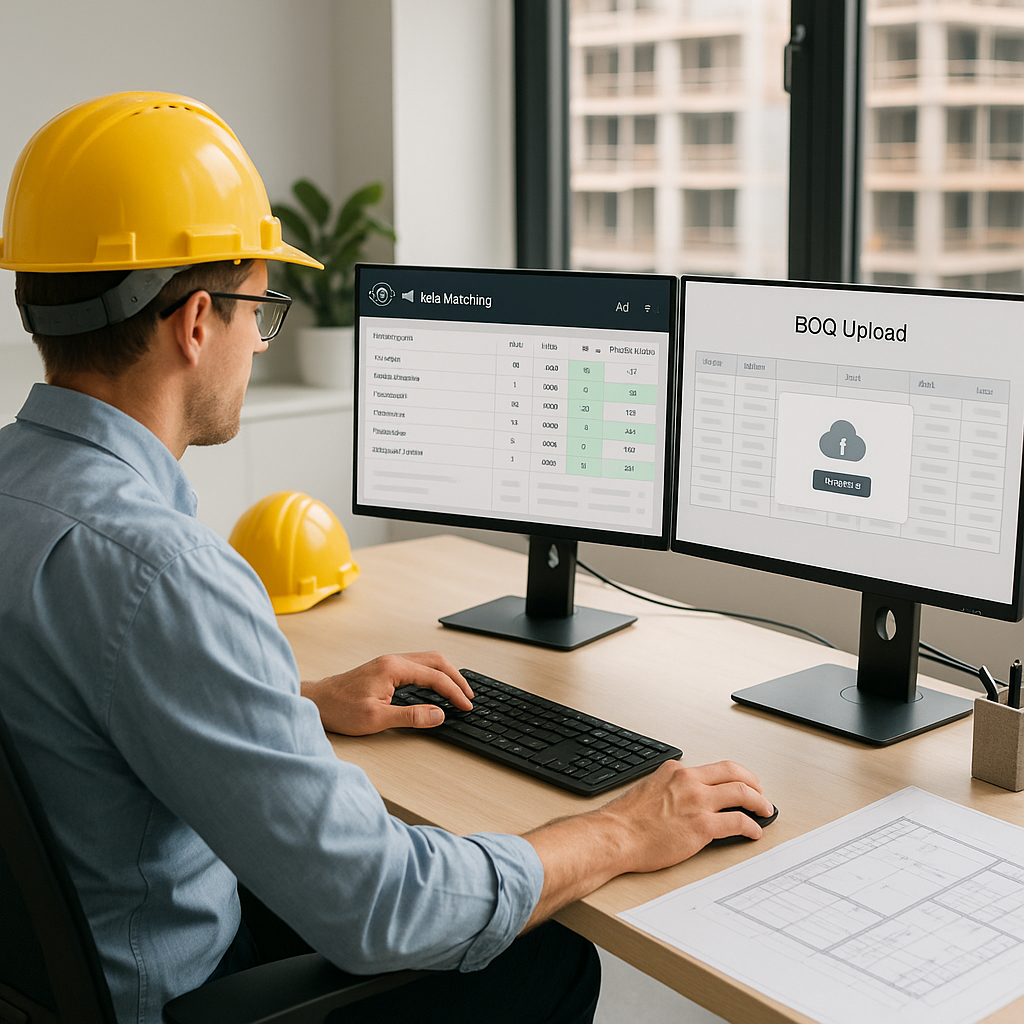
AI-powered tools like EstimateNext are transforming how estimators work. Instead of manually searching through thousands of rate items, AI platforms use semantic search to match BOQ descriptions to preloaded catalogs. Here’s how it works:
- BOQ Upload: Drag and drop your Excel BOQ file. The AI parser auto-detects merged cells, hierarchies, and section headers.
- Semantic Search: The system scans your BOQ line items and matches them to the most relevant rates in its database.
- Custom Catalogs: Got custom rates? Upload them. The AI prioritizes your proprietary rates over default ones.
- Audit Trail: Review matches, flag issues, or override the AI. Every action is logged for transparency.
Real-World Example
A mid-sized contractor bidding on a high-rise project saved 12 hours on rate matching using EstimateNext. With over 78,000 SOR items across 135+ catalogs (including RSMeans, CPWD DSR, and NRM2), the tool flagged exact matches instantly and suggested alternatives where no direct match existed. The estimator reviewed, adjusted where needed, and finished the task before lunch.
Concrete Benefits of Adopting AI
Time Savings
By automating rate lookups, you can save 12 hours per estimate. If you handle five bids a month, that’s 60 hours saved. For a team of three estimators, you’re looking at 180 hours per month—time that can be redirected toward creating more competitive bids.
Financial ROI
Let’s do the math:
- Average estimator hourly rate: $75/hour
- Time saved per month (one estimator): 60 hours
- Total savings: $4,500 per month, or $54,000 annually
For larger teams, the savings multiply. And that doesn’t even account for the revenue gained from winning more bids.
Improved Accuracy
AI tools offer 95-98% match accuracy when BOQ descriptions are clear and well-structured. This reduces costly errors and ensures your bids are competitive without being underpriced.
Competitive Edge
Faster estimates mean you can respond to more bids. Subcontractors who use AI tools report a 50% increase in bid turnaround, enabling them to pursue opportunities they’d otherwise miss.
Addressing Common Objections
Objection: “AI Can’t Handle Custom Rates”
This is a valid concern, but modern AI tools have evolved to address it. Platforms like EstimateNext allow contractors to upload custom rate catalogs or define project-specific rates. Once uploaded, the system learns and prioritizes these rates for future matches.
- Example: A contractor in Texas uploaded their custom asphalt paving rates into the system. Within three projects, the AI had fully adapted to their pricing structure, reducing manual intervention by 80%.
Objection: “My BOQ Is Too Complex”
Complex BOQs with merged cells and non-standard formats can be challenging, but AI tools are designed to handle this. Advanced parsers can auto-detect and organize messy data for seamless processing.
Objection: “Learning New Software Is Too Hard”
While there’s always a learning curve, most users report being fully operational within two weeks. The time investment is minimal compared to the long-term gains.
Comparison Table: Manual Rate Lookups vs. AI-Powered Rate Matching
| Feature | Manual Lookups | AI-Powered Matching |
|---|---|---|
| Time per BOQ item | 3-5 minutes/item | 5-10 seconds/item |
| Error Rate | High (manual mistakes) | Low (95-98% accuracy) |
| Custom Rate Integration | Manual entry required | Automated upload |
| Learning Curve | None | 1-2 weeks |
| Cost | Labor-intensive | Subscription-based |


