Stop Flipping Through Rate Books
Manual rate lookup is brutal. A mid-sized GC (General Contractor) estimator spends an average of 12 hours per project flipping through PDFs or Excel spreadsheets just to match BOQ (Bill of Quantities) items to RSMeans or CPWD rates. That’s time wasted, and it’s not just about speed—manual processes are error-prone and inconsistent. Miss one line item, and you might underbid or lose margin on a $10M project. The stakes are high.
Now, consider this: What if you could eliminate the grunt work and focus on refining your bid margins or negotiating with subs? This isn’t wishful thinking. AI-powered tools fix this. Here’s how tools like EstimateNext transform rate matching from a time sink into a competitive advantage.
How AI-Powered Tools Solve Manual Rate Matching
Here’s a breakdown of how tools like EstimateNext simplify and optimize rate matching:
1. Semantic Search Across 78K+ Items
Instead of manually searching for “concrete column rebar labor rate” in a static PDF or Excel, you type it into an AI tool. The system instantly pulls the closest matches, whether it’s a CPWD item or a state DOT-approved rate.
- Concrete Example: Imagine bidding on a public infrastructure project requiring compliance with state DOT rates. You type in "asphalt paving," and in under three seconds, the AI presents the most relevant rates, including labor, materials, and equipment.
- Time Saved: A process that took hours now takes seconds, reducing the risk of human error.
2. Custom Catalogs for Proprietary Rates
If your firm uses project-specific or proprietary rates, AI tools allow you to upload those catalogs. The AI integrates them into its database for future use.
- Why This Matters: Many GCs and subcontractors rely on negotiated rates for specific suppliers or labor teams. With custom catalogs, you’re no longer manually copying and pasting rates for every bid.
- Actionable Tip: Upload your proprietary rate sheet once. From then on, the AI remembers and applies those rates automatically.
3. Learning Curve: AI That Gets Smarter Over Time
AI tools like EstimateNext leverage feedback loops. Correct a rate match once, and the system remembers for future projects.
- Case Study: A mid-sized GC in California reported that by their third project using EstimateNext, the tool was automatically matching 95%+ of their BOQ items correctly, leaving only niche or custom items for manual validation.
- ROI: Over one year, this saved the GC 120+ hours in rate matching alone, not to mention the improved accuracy in their bids.
Why Manual Estimation is Failing
Manual estimation isn’t just tedious—it’s unsustainable in today’s fast-paced construction industry. The sector is projected to grow to $15 trillion globally by 2030 (source: McKinsey), but there’s a massive shortage of skilled estimators. Preconstruction directors often demand more from fewer people, leading to burnout and errors.
Real-World Impact of Manual Errors
- The Large Rail Bridge Example: Take a major national general contractor's $1B rail bridge project. On bids like this, rate matching isn’t optional—it’s critical. Rates for everything from structural steel to rail ties need to come from DOT-approved catalogs. A single error in rate matching could cost hundreds of thousands of dollars in lost margins or a failed bid.
- Data Point: According to a study by KPMG, 70% of construction projects worldwide experience cost overruns, with inaccurate estimates being a leading cause.
The Scalability Problem
Manual workflows don’t scale. If your team is spending 12 hours per bid on rate matching and you’re handling 10 bids per year, that’s 120 hours wasted. Multiply that across a team of 5 estimators, and you’re looking at 600 hours annually—time that could be spent on high-value tasks like refining bid strategies or building relationships with subcontractors.
The Obvious Objection: “But AI Can’t Think Like an Estimator”
True. AI doesn’t replace your expertise—it amplifies it. You’re still the one making judgment calls on overhead percentages, profit margins, and risk factors. But the grunt work—rate matching, takeoffs, what-if recalculations—is handled by the AI.
Why Pairing Junior Estimators with AI Tools is a Game-Changer
- Scenario: A senior estimator spends hours mentoring junior staff on manual rate lookup. With AI tools, junior estimators can handle the rate matching themselves, freeing up senior staff to focus on bid strategy or client negotiations.
- Think of AI as an Apprentice: The AI learns from your team’s corrections, takes over repetitive tasks, and enables your team to scale without sacrificing quality.
How to Start Using AI in Your Workflow
1. Test Small Projects First
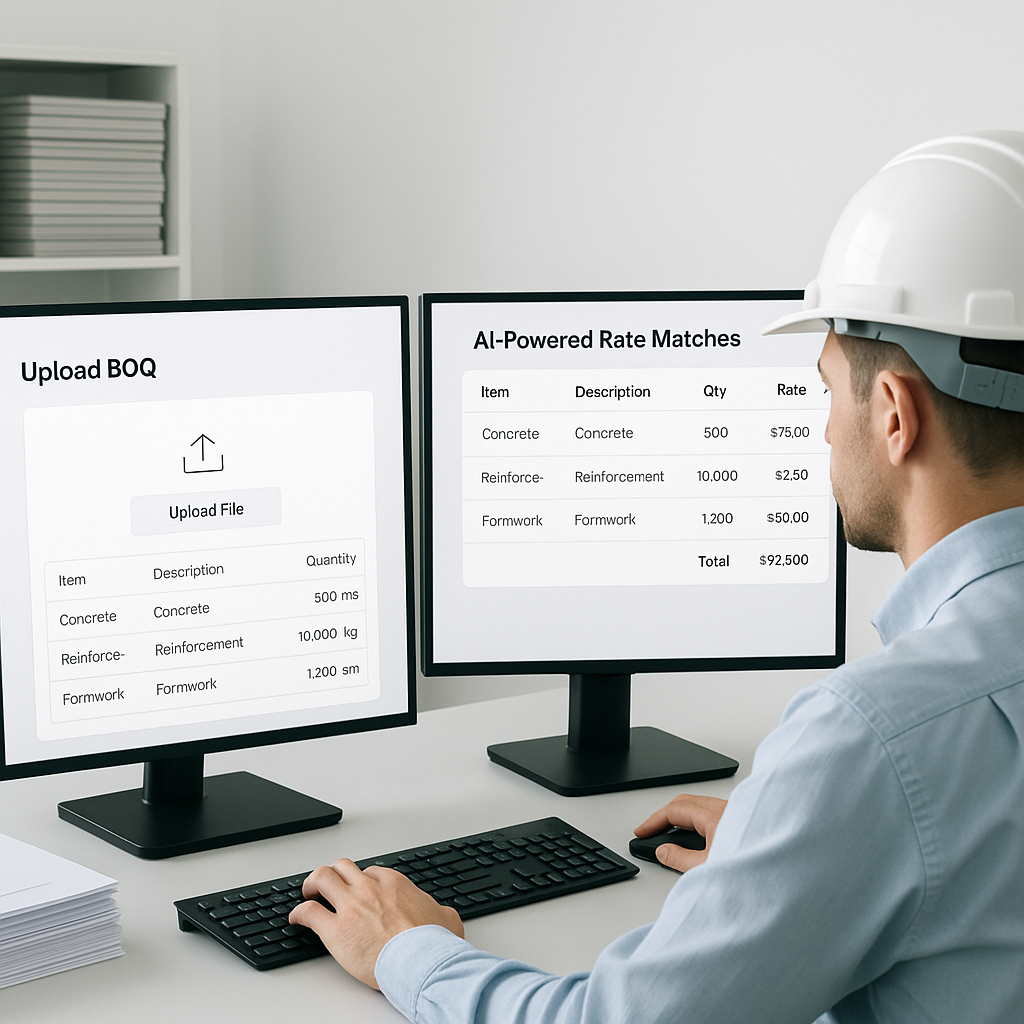
Start by uploading a BOQ for a small project to the free tier of a tool like EstimateNext. Compare its rate matching to your manual process. Track time savings and accuracy to build confidence.
2. Integrate Custom Rates
Upload your proprietary materials or labor rates. This ensures the AI tailors its recommendations to your specific needs.
3. Train Your Team
Even though AI tools are intuitive, training ensures your team uses them effectively. Most firms report full adoption within two weeks when training is included.
4. Measure ROI
Track the time and cost savings over your first few projects. Many firms report saving 10-12 hours per bid, which translates into significant cost savings annually.
Comparison Table: Manual Rate Matching vs. AI Tools
| Feature | Manual Rate Matching | AI-Powered Tools |
|---|---|---|
| Time to Match Rates | 12 hours/project | 10 minutes/project |
| Error Rate | High (human error) | Low (99% accuracy with AI) |
| Scalability | Limited | Easily scales with workload |
| Integration with Custom Data | Requires manual input | Seamless integration |
| Learning Curve | Steep | Easy with feedback loops |
Call to Action
If you’re tired of wasting 12 hours per bid on manual rate matching, it’s time to upgrade your workflow. AI tools like EstimateNext can help you save time, reduce errors, and scale your operations without adding headcount. Get started free →