Why Manual Takeoffs Are Killing Your Productivity
Let’s be honest—manual takeoffs are a nightmare. If you’ve ever spent two full days measuring wall lengths and counting door openings on a PDF, you know exactly what I’m talking about. It’s slow, repetitive, and prone to errors. And for general contractors handling five to eight GMP pursuits per year, those hours aren’t just frustrating—they add up fast.
But here’s the real problem: manual takeoffs don’t just waste time. They limit how many bids you can pursue, which directly caps your revenue potential. Think about it—if your team spends 40 hours per estimate, how many opportunities are slipping through the cracks simply because you don’t have the bandwidth? Multiply that by months or even years of operations, and you’re looking at serious missed opportunities.
Hidden Costs of Manual Takeoffs: A Case Study
Take the example of a mid-sized construction firm bidding on high-rise projects. Their estimation team spent an average of 40 hours per bid, working overtime to meet deadlines. At $130/hour for labor, this translated to $5,200 per bid in costs—just for takeoffs. Now consider they only had the capacity to bid on six projects annually. What’s worse, they often missed deadlines on promising opportunities due to the grueling manual process.
This isn’t just a one-off problem. According to a survey by the Construction Industry Institute (CII), nearly 65% of firms report that inefficiencies in preconstruction directly impact their ability to win bids. Manual takeoffs are a key culprit—they’re time-intensive and prone to human error, which can lead to overestimating or underestimating costs.
The AI Alternative: 10 Minutes, Not 40 Hours
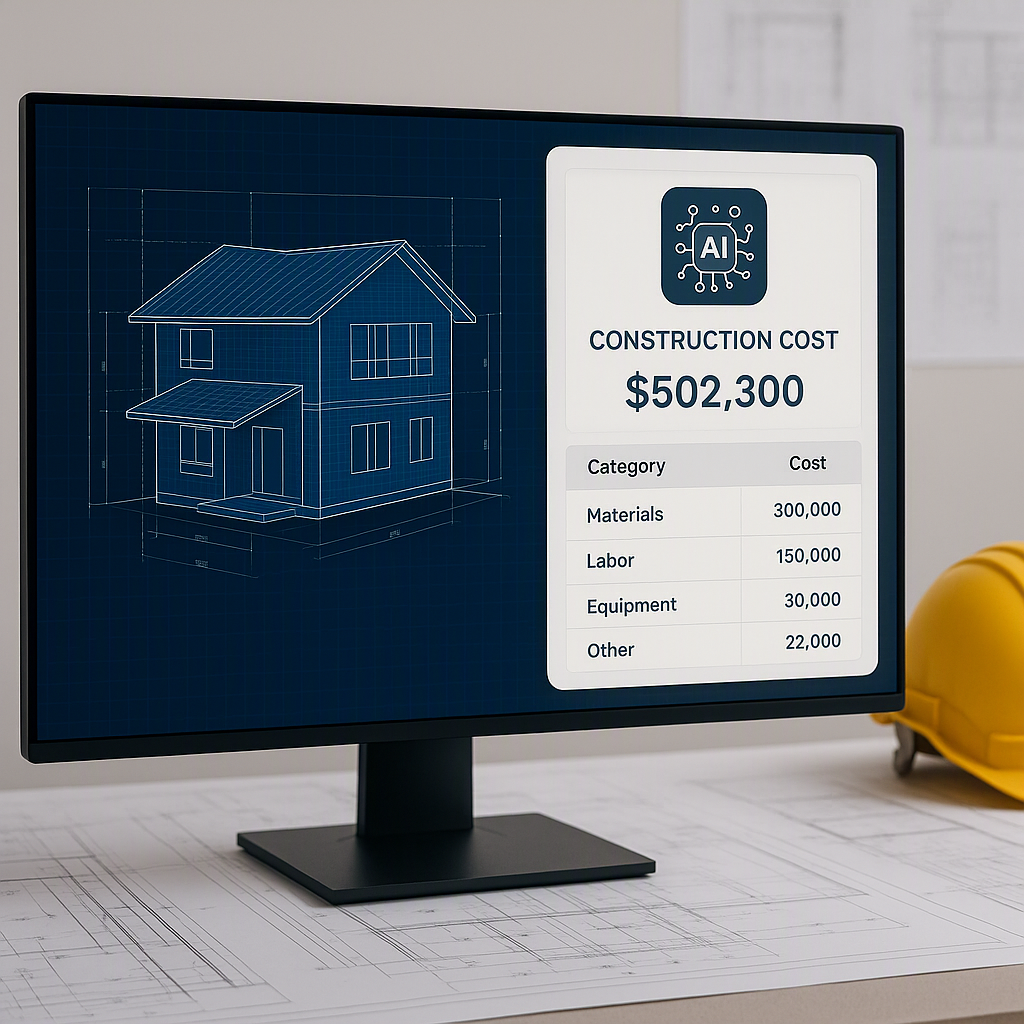
This is where AI-powered tools like EstimateNext come in. Their Vision AI feature automates the entire quantity takeoff process. You upload a set of drawings—PDF, CAD, whatever—and in about 10 minutes, you’ve got a complete breakdown of room areas, wall lengths, door/window counts, and more.
How Does AI Work?
Vision AI uses machine learning to analyze architectural drawings, identify patterns, and extract quantities with remarkable precision. It’s like having an extra estimator who never sleeps, doesn’t make mistakes, and works at lightning speed. Unlike manual methods, AI tools highlight low-confidence areas where human review might be needed, reducing risk while saving time.
Real-World Impact
Let’s revisit our mid-sized GC. When they tested EstimateNext on a high-rise bid, they were able to save 36 hours and avoid $4,680 in labor costs. That’s two full workdays back in their schedule, just from automating one task. Better yet, those extra hours allowed them to submit two additional bids that quarter, one of which they won—adding $2.3 million to their project pipeline.
“But AI Can’t Think Like an Estimator”
This is the most common objection—and it’s valid. AI doesn’t replace your expertise. It doesn’t understand local market dynamics, zoning regulations, or have relationships with subcontractors. But that’s not the point.
AI handles the grunt work so you can focus on strategic tasks. Instead of spending hours tracing floor plans, you can evaluate subcontractor bids, refine your pricing strategy, or negotiate better rates. By automating low-value, repetitive tasks, AI amplifies your team’s impact and frees up time for decision-making.
Actionable Steps to Integrate AI Without Losing Control
- Start Small: Test AI tools like EstimateNext on a single project to evaluate accuracy and efficiency.
- Leverage Confidence Scores: Use the tool’s low-confidence flagging feature to prioritize areas for manual review.
- Train Your Team: Host a training session to ensure your estimators understand how to interpret and validate AI outputs.
- Combine AI with Local Expertise: Use AI outputs as a baseline and refine estimates based on local conditions and subcontractor input.
Real-Time What-If Scenarios
Another major advantage of AI tools is their speed and flexibility. Imagine your client wants to know how a 15% increase in steel prices affects the overall budget. If you’re using Excel, you’d have to manually update rates, recalculate totals, and triple-check for errors. With EstimateNext, you simply tweak the rate in the software, and the system updates everything in real-time.
This kind of agility can win bids. Clients love seeing multiple cost options without waiting days for revisions. And when you can respond faster than your competitors, you’ve got a serious edge.
Example: Dynamic Cost Adjustments
In one case, a GC used EstimateNext to prepare alternate pricing scenarios for a municipal project. The client requested cost adjustments for four material variations, expecting updates within a week. Using AI, the GC provided the revised estimates in less than 24 hours. The result? A faster decision-making process for the client, and the GC secured the contract.
The ROI Is a No-Brainer
Let’s break down the math:
- Time Saved: If you’re saving 36 hours per bid and your estimators cost $130/hour, that’s $4,680 saved.
- Annual Savings: Multiply that by five bids per year, and you’re looking at $23,400 in labor savings.
- Cost of AI Tools: EstimateNext costs $99/month per seat, or $1,188 annually.
Bottom line? The ROI is insane. Beyond the monetary savings, faster turnarounds mean more bids submitted, which directly translates to more wins. For subcontractors, this could mean responding to 50% more bid packages per year. For general contractors, it means locking in better margins by spotting risks earlier.
What About Smaller Firms?
You might be thinking, “This all sounds great, but what if my team only handles a few projects a year?” The truth is, AI scales. Whether you’re bidding on a $1 million renovation or a $1 billion rail bridge, the time savings are the same.
In fact, smaller firms often stand to gain the most. Why? Because they don’t have the luxury of large teams. Automating takeoffs lets them compete with bigger players without hiring more staff.
Comparison: Manual vs. AI Takeoffs
| Category | Manual Takeoffs | AI-Powered Takeoffs |
|---|---|---|
| Time Per Bid | 40 hours | 10 minutes |
| Cost Per Bid | $5,200 | $99/month per seat |
| Error Risk | High | Low, with confidence flags |
| Scalability | Limited | Unlimited |
| Strategic Focus | Minimal | Significant |
The Bottom Line
If you’re still doing manual takeoffs, you’re leaving money on the table. AI-powered tools like EstimateNext save time, reduce errors, and free your team to focus on high-value tasks that drive revenue. Whether you’re a small firm or a major player, the benefits are undeniable.
Ready to transform your preconstruction process? Start free with EstimateNext →