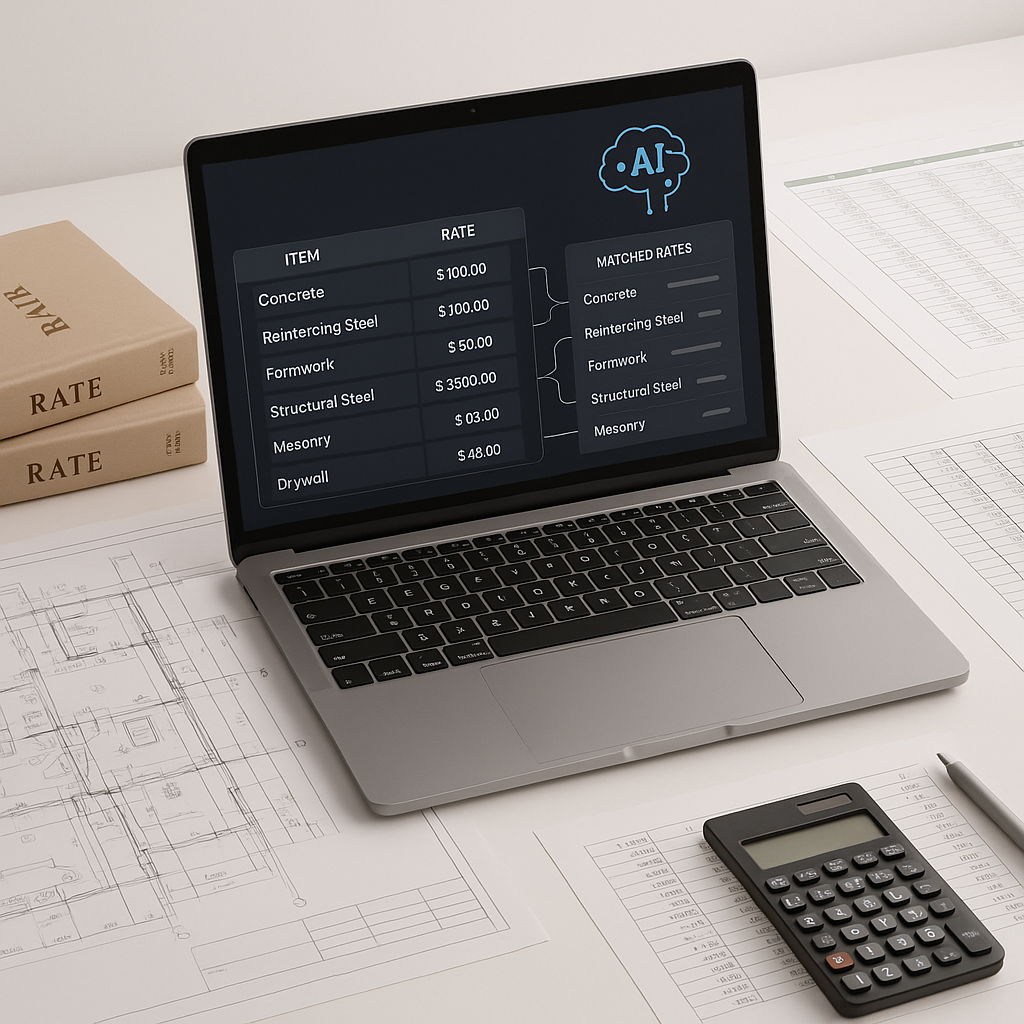
Manual Rate Lookup: The Time Sink No One Talks About
If you've ever priced a bid, you know the pain of rate lookup. Flipping through a 2,000-page RSMeans book or CPWD DSR catalog isn't just tedious—it’s a productivity challenge. Need to find the labor rate for installing pre-stressed concrete girders? That can involve significant time spent scrolling, searching, and cross-referencing.
Why does this matter? Because every line item matters in construction estimation. If you miss a rate or miscalculate, your bid can either tank your margins or make you uncompetitive. And for most estimators, this process repeats across hundreds of BOQ lines.
The AI Solution: Semantic Rate Matching
AI-powered rate matching tools are transforming this workflow. Instead of manual lookup, you can upload your BOQ, type in the item description, and let the tool do the heavy lifting. These tools use semantic search across extensive SOR items to return matches quickly—whether you need a rate for labor, materials, or equipment.
Here’s what makes it effective:
- Speed: Manual rate lookup can take significant time. AI reduces this process to seconds.
- Accuracy: Human error is common in manual lookups. AI tools integrate custom catalogs, fallback rates, and user feedback loops to improve accuracy over time.
- Customization: Got project-specific rates? Upload them. AI tools allow you to define custom rates and reuse them across projects.
How This Changes Your Workflow
Let’s put this into perspective. If your team spends hours per bid on rate lookup and estimation, AI tools can save most of that time. Here’s the ripple effect:
- More bids: With time saved, you can handle additional pursuits without adding headcount.
- Better accuracy: Fewer errors mean fewer margin hits.
- Improved ROI: Early adopters of AI in construction often report significant cost savings per project.
Common Questions About AI Rate Matching
Q: Is AI reliable for niche items?
A: Yes. AI tools use fallback mechanisms to suggest rates for edge-case items. User feedback loops improve accuracy over time.
Q: Can I use my own rate catalogs?
A: Absolutely. Many AI tools let you upload custom catalogs and integrate them seamlessly for future use.
Q: How long does it take to set up?
A: Most tools are ready to use after a quick upload and basic configuration. Training typically takes a short amount of time.
Mistakes to Avoid
- Ignoring Confidence Scoring: AI tools often include confidence scores for rate matches. Review low-confidence matches manually to avoid costly errors.
- Skipping Feedback: Your input matters. Every accept/reject improves the AI’s accuracy for future projects.
- Underusing Custom Catalogs: If you have project-specific rates, upload them. It’s a simple step that can massively improve precision.
Conclusion
Manual rate lookup is outdated. AI-powered tools don’t just save time—they make your bids more accurate and competitive. If your team’s still flipping through rate books, it’s time to rethink your approach.


