The Real Bottleneck in Preconstruction Estimation
Manual drawing takeoffs are a significant time sink. Estimators often spend hours tracing PDFs, counting columns, and verifying quantities. This process is prone to human errors, missed quantities, and can leave teams exhausted.
AI-powered tools are transforming this workflow by automating repetitive tasks and reducing manual effort. These tools streamline the takeoff process, allowing estimators to focus on higher-value activities.
How AI Takeoffs Work
Here’s the process:
-
Upload Your PDF Drawings Drop your plans into the tool — no need to convert them into other formats. Modern AI tools handle CAD files, scanned images, and even poorly labeled PDFs.
-
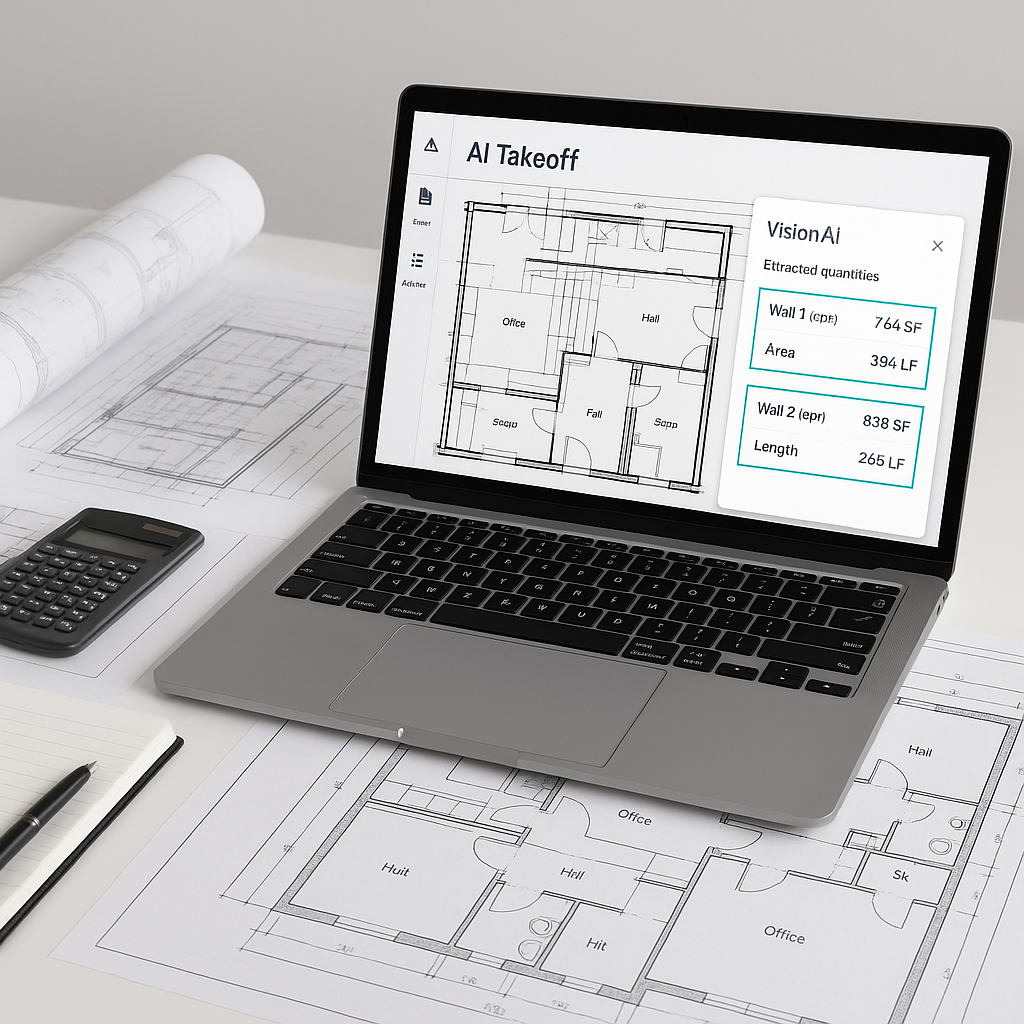
Automated Quantity Extraction The AI scans the drawings and extracts quantities like room areas, wall lengths, and fixture counts. It can identify structural elements such as beams and columns directly from sectional views.
-
Flagging for Review Not all AI outputs are perfect. Many tools offer features to flag areas of low confidence for manual review, ensuring accuracy.
-
Revisions and Overrides When updated drawings are uploaded, the AI compares them to the original set and flags changes automatically, saving time on remeasuring.
Why It Matters
Automating takeoffs can save significant time per project, freeing up estimators to focus on tasks like preparing bids, negotiating with subcontractors, or refining rate libraries. The efficiency gained can lead to better project outcomes and increased competitiveness.
The Obvious Objection: “AI Can’t Think Like an Estimator”
It’s true — AI doesn’t replace experience or judgment. The goal is not to take over an estimator’s job but to handle repetitive tasks, allowing professionals to focus on strategic decisions. Estimators still make judgment calls, negotiate with subs, and decide on margins. AI simply removes the tedium.
Common Questions
Q: How accurate are AI-powered takeoffs? AI tools are designed to be highly accurate, but their effectiveness depends on the quality of input data. Human oversight remains essential to ensure precision.
Q: Do AI tools work for smaller projects? Yes, AI tools are scalable and can be used for projects of varying sizes, from small renovations to large infrastructure developments.
Q: Can AI integrate with other software? Many AI tools integrate seamlessly with platforms like Bluebeam and Procore, allowing users to export estimates directly into their workflows.
What to Watch For
- Poor Input Quality: Blurry or disorganized drawings can affect AI accuracy. Always review outputs for flagged errors.
- Training Time: While many tools are intuitive, teams may need time to familiarize themselves with the system.
- Overconfidence: Use AI outputs as a starting point, but verify critical measurements manually.
The Bottom Line
AI-powered tools can significantly streamline preconstruction estimation, reducing manual effort and improving efficiency. They are not a replacement for skilled estimators but a valuable resource to enhance productivity and accuracy.


