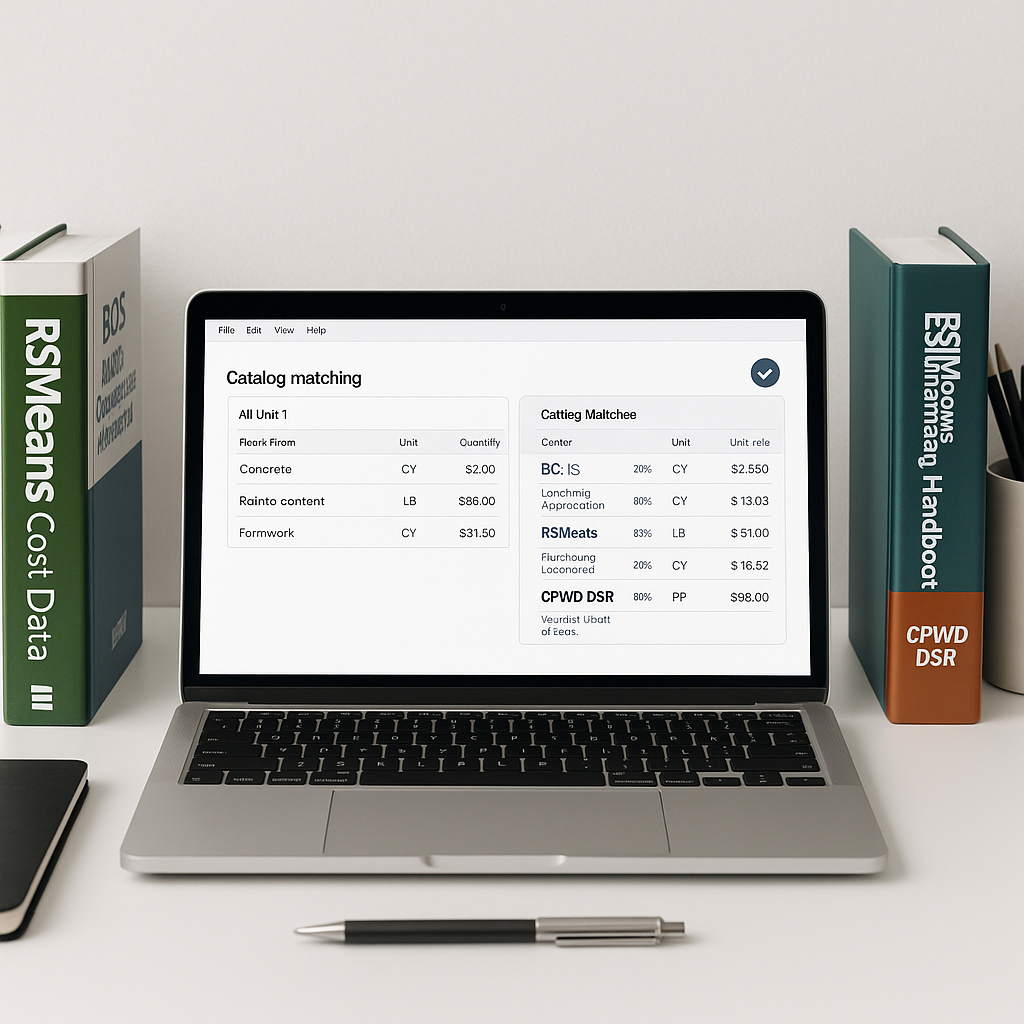
The Rate Lookup Time Sink
If you’ve ever spent significant time flipping through rate books like RSMeans or CPWD DSR, you know how tedious it can get. Even experienced estimators often spend considerable time hunting for the right line items and manually matching rates to their BOQs. This process is not only slow but also prone to errors. Missing a line or selecting the wrong rate can negatively impact bid margins.
Rate lookup is a repetitive task that doesn’t require much judgment but demands a lot of time. It’s an unavoidable part of the process, especially when dealing with custom items or unique catalog requirements for each project. For estimators managing multiple bids, every extra hour spent on this task takes away from strategic activities like bid leveling or negotiating with subcontractors.
The AI Solution: Semantic Rate Matching
AI-powered rate matching offers a transformative solution. Instead of manually searching through thousands of catalog entries, AI tools use semantic search to find matches quickly. Here’s how the process generally works:
- Upload Your BOQ: The system parses your document, whether it’s in Excel, CSV, or ODS format, and identifies line items.
- Search Across Catalogs: The AI scans extensive databases of SOR items across regional and international catalogs (e.g., RSMeans, CPWD DSR, state DOTs).
- Match Rates with Context: It interprets the context of your query — whether it involves materials, labor, or equipment — to identify the most relevant match.
- Custom Catalogs: If your firm uses unique rates, the AI can integrate them for seamless future use.
Illustrative example — Suppose you’re pricing a high-rise steel frame and need the labor rate for welding structural connections. Instead of manually searching through RSMeans, you input the query into the AI. It identifies the rate quickly and provides an audit trail explaining how the match was determined.
Benefits: Speed and Accuracy
Manual rate lookup can consume significant time during the estimation process. AI-powered tools can reduce this time dramatically, allowing estimators to focus on higher-value tasks. Additionally, accuracy improves as AI minimizes the risk of human error, such as underpricing, overpricing, or mismatched scopes.
AI tools are designed to complement, not replace, the expertise of estimators. While the AI handles repetitive tasks, estimators retain control over strategic decisions, such as adjusting rates or analyzing vendor quotes.
Common Objections
“AI can’t think like an estimator.”
That’s true, but it doesn’t need to. The purpose of AI is to handle repetitive tasks, freeing up estimators to focus on strategic aspects like crafting competitive bids and managing relationships.
“What if the AI picks the wrong rate?”
Most AI tools include manual overrides and audit trails. Estimators can review and adjust matches as needed, ensuring the final bid aligns with their expertise.
“Does this work for custom rates?”
Yes. Many AI tools allow users to upload custom rate catalogs or define project-specific rates, which the system integrates for future use.
What to Watch For
- Garbage In, Garbage Out: The quality of the AI’s output depends on the quality of your input data. Ensure your BOQ is clean and well-structured before uploading.
- Training Time: AI tools improve with use. While they may not be perfect initially, they learn and adapt over time.
- Manual Review: Always review the AI’s output to ensure accuracy. Your expertise is essential for finalizing bids.
Why It Builds Trust
AI-powered rate matching is not only fast but also transparent. Each match includes an audit trail that explains where the rate came from, how it was calculated, and why it was chosen. This transparency helps build trust with clients, as you can provide data-backed justifications for your estimates.
Accurate rate matching also ensures fair comparisons across subcontractor quotes, fostering trust and collaboration within the construction ecosystem.
Conclusion
Rate lookup doesn’t have to be a bottleneck in your estimation process. AI-powered tools can save time, reduce errors, and enhance transparency, allowing you to focus on strategic tasks and build stronger client relationships.


