Why Rate Matching is a Bottleneck
If you’ve ever flipped through a lengthy rate book trying to price a bill of quantities (BOQ), you know the pain. It’s slow, tedious, and prone to mistakes. On large projects, manual rate lookup can consume significant time—especially when dealing with complex items like custom finishes or specialized materials.
That’s time you could’ve spent refining your bid strategy or negotiating with subcontractors. Instead, you’re stuck in repetitive manual tasks.
But here's the good news: AI-powered rate matching tools are changing the game.
How AI Rate Matching Works
Let’s break it down practically. Say you’re pricing a high-rise project. Your BOQ includes items like concrete columns, steel beams, and HVAC ductwork. Traditionally, you’d:
- Look up rates in a printed or PDF catalog like RSMeans or CPWD DSR.
- Cross-check the specs to ensure compliance.
- Manually adjust for inflation, location indices, and labor costs.
That’s hours of work for a single line item.
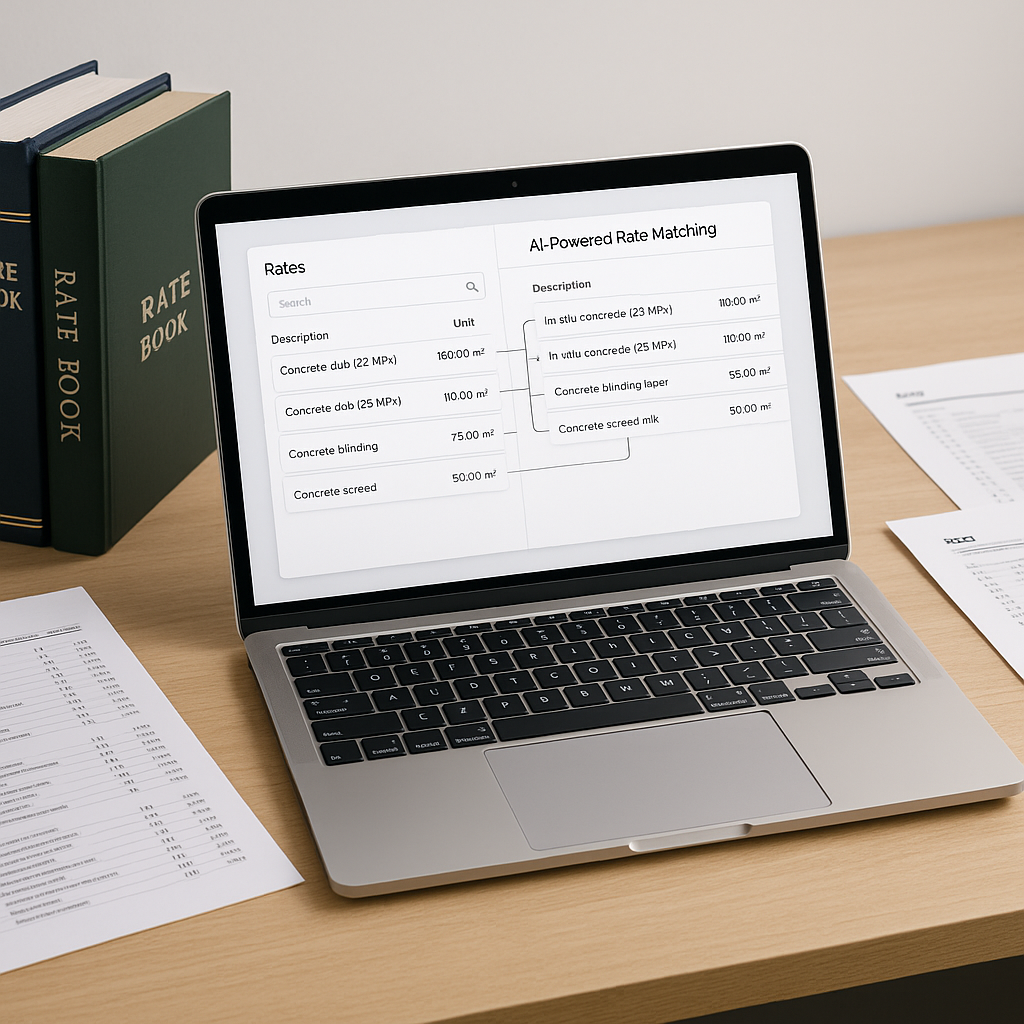
With AI-powered tools, you upload your BOQ, and the system matches each item to the relevant rate in seconds. Here's what happens:
- Semantic Search: The AI scans thousands of standard items across catalogs, using context (not just keywords) to find the right match.
- Custom Catalogs: If your firm uses proprietary rates, you can upload them for AI integration.
- Inflation Adjustments: The system auto-suggests adjustments based on catalog year and location.
- Audit Trail: Every rate match includes a breakdown—material, labor, equipment—so you can defend your numbers in negotiations.
Benefits of AI Rate Matching
- Time Savings: Automating rate lookup frees up time for higher-value tasks like strategy and negotiation.
- Error Reduction: AI minimizes human error by ensuring consistent and accurate rate matching.
- Scalability: AI tools handle large BOQs efficiently, making them ideal for complex projects.
Common Objections to AI Rate Matching
- “AI doesn’t understand construction nuances.”
True, AI isn’t a substitute for experience. But it amplifies your expertise by handling the repetitive tasks. You’re still the one making judgment calls and negotiating with subcontractors. AI just gets you the data faster.
- “My rates are custom. How can AI help?”
Most AI tools allow you to upload custom rate catalogs. The system integrates them seamlessly for future use.
- “What if the AI gets it wrong?”
Good platforms include manual override features. You can review, adjust, and save corrections for future projects. The AI learns from your feedback.
What to Watch For
- Overreliance on AI: Always review high-impact rates manually. A missed detail can cause big problems.
- Incomplete Catalogs: If your AI tool doesn’t support local standards (e.g., CPWD DSR in India), you’ll still need manual lookup.
- Training Curve: While many tools are intuitive, expect a learning curve when adopting new technology.
Conclusion
If manual rate lookup is slowing down your bids, AI-powered tools can help. With features like semantic search and custom catalog integration, you’ll save time and reduce errors. Explore available tools to see how they can streamline your preconstruction estimation process.


