The Hidden Time Sink in Preconstruction Estimation
Let’s talk about rate matching. If you’ve ever spent hours flipping through a 2,000-page RSMeans book or a dense CPWD DSR catalog, you already know the pain. Finding the right rate for a specific item—whether it’s a ductwork installation or a concrete pour—takes significant effort. And that’s before you even factor in cross-checking prices, materials, or regional adjustments.
Time isn’t the only problem here. Manual lookups are error-prone. Miss one rate, and your estimate could be off significantly—or worse, cause you to underbid a project entirely.
Enter AI-Powered Rate Matching
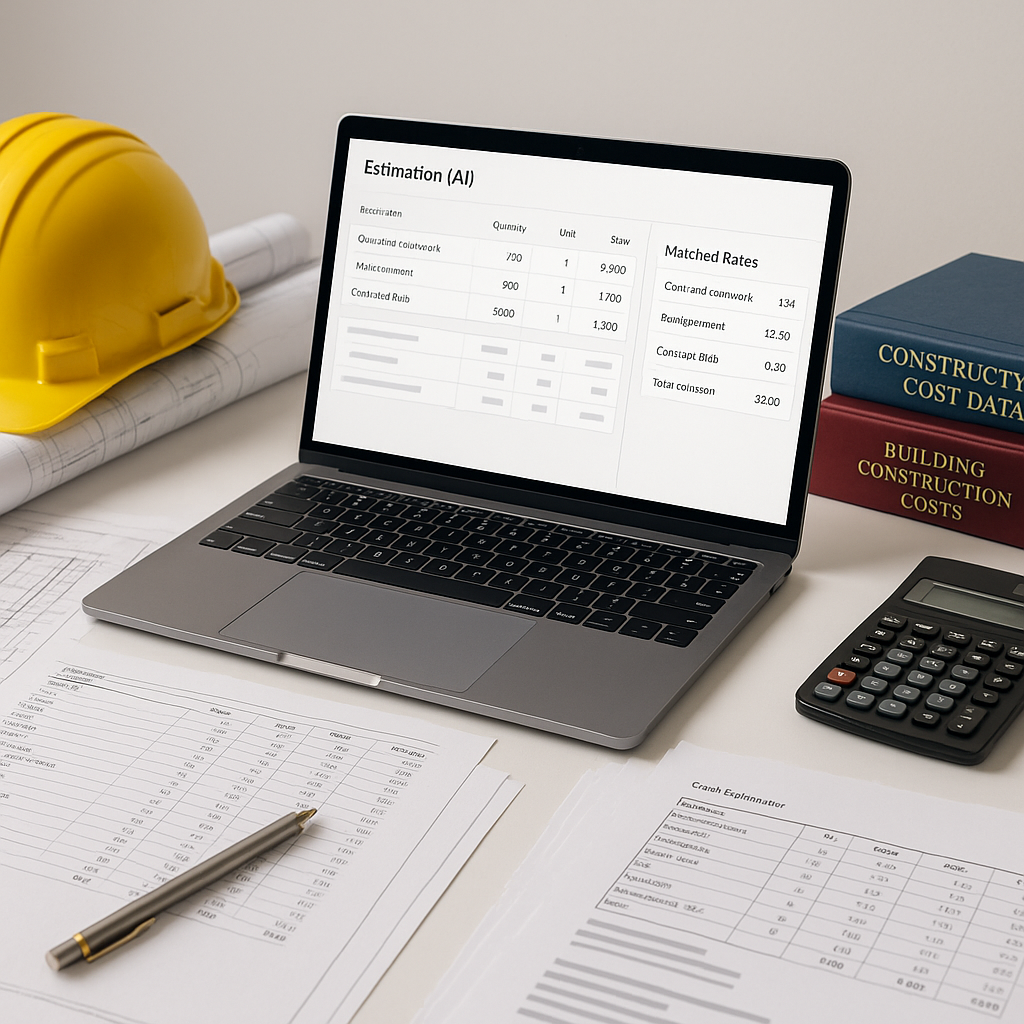
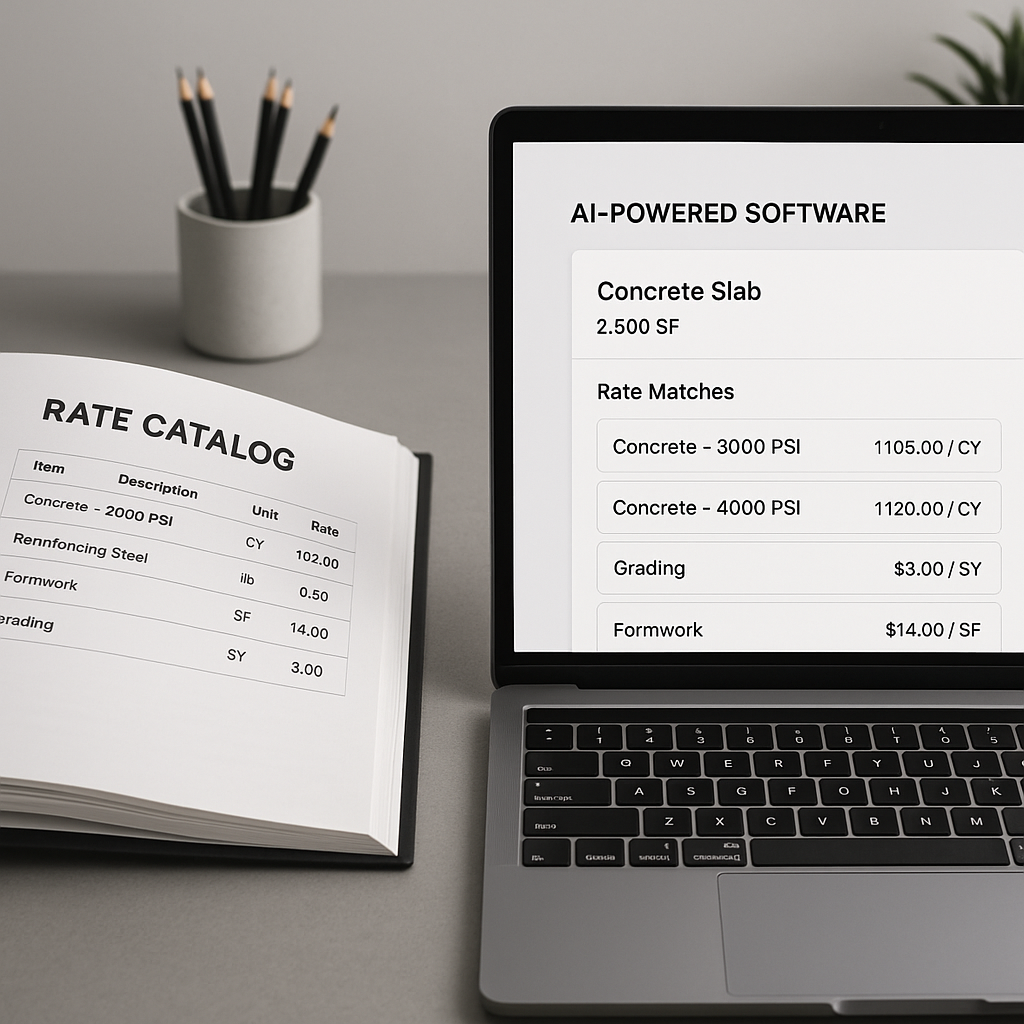
AI tools are transforming this process. Instead of manually hunting through catalogs, you upload your BOQ (Bill of Quantities), type in the item you’re pricing, and let the AI do the heavy lifting. These tools scan thousands of SOR items from catalogs like RSMeans, CPWD DSR, and others, delivering matches with breakdowns for labor, materials, and equipment.
Why Does This Matter?
Speed: Manual rate lookups can take hours per project. AI tools drastically reduce this time, allowing estimators to focus on higher-value tasks.
Accuracy: AI reduces human error. Semantic search ensures you’re not just skimming pages or making assumptions about rates. It even handles regional nuances, like adjusting for location-specific labor costs or inflation.
Scalability: Whether you’re pricing a small renovation or a large-scale infrastructure project, AI scales effortlessly. No more stressing over the size of the catalog or the complexity of the BOQ.
Practical Example: HVAC Rate Matching
Illustrative example — Imagine you’re pricing an HVAC system for a new office building. Your BOQ specifies:
- 500 linear feet of ductwork (galvanized steel, 24-gauge)
- 4 air handling units (5,000 CFM capacity)
- Insulation for all ducts (R-value 6)
Traditionally, you’d need to:
- Find the ductwork rate in your catalog.
- Look up the labor cost for installation.
- Add material costs for insulation.
- Adjust for regional pricing (if applicable).
- Double-check for errors.
With AI, you upload your BOQ, search for “galvanized ductwork,” and get a rate that includes labor, material, and equipment. Need insulation rates? Just refine the search. You can even set custom inflation factors or overhead percentages, and the AI recalculates instantly.
The Obvious Objection: “It’s Not Perfect”
You’re right. No AI tool is perfect. Rate matching depends on the quality of your inputs. If your BOQ is messy or missing key details, you’ll still need to clean it up. That’s why many tools include manual override options. You can review suggested rates, tweak them, and save those adjustments for future projects. Over time, the AI learns from your edits, getting smarter with every use.
What to Watch For
- Custom Rates: If your project involves custom materials or unique specifications, ensure the AI tool allows you to upload your own rates or create new ones.
- Catalog Coverage: Not all AI tools support every catalog. Check if your preferred rate sources (e.g., CPWD, RSMeans) are included.
- Integration: Can the tool export data to your existing software stack (e.g., Procore, Excel)? If not, you might spend extra time reformatting.
FAQ
Q: How accurate are AI-powered rate matches?
A: They are generally accurate but still require human oversight for edge cases or unique project requirements.
Q: Can I use custom rates?
A: Yes. Most AI tools allow you to upload custom rate catalogs or define project-specific rates.
Q: How long does it take to learn these tools?
A: Most platforms are user-friendly and require minimal training, even for teams unfamiliar with AI.
The Bottom Line
Rate matching doesn’t have to be a time-consuming, error-prone process. AI-powered tools streamline this critical step in preconstruction estimation, saving time and improving accuracy. The result? Faster bids, fewer mistakes, and more competitive pricing.