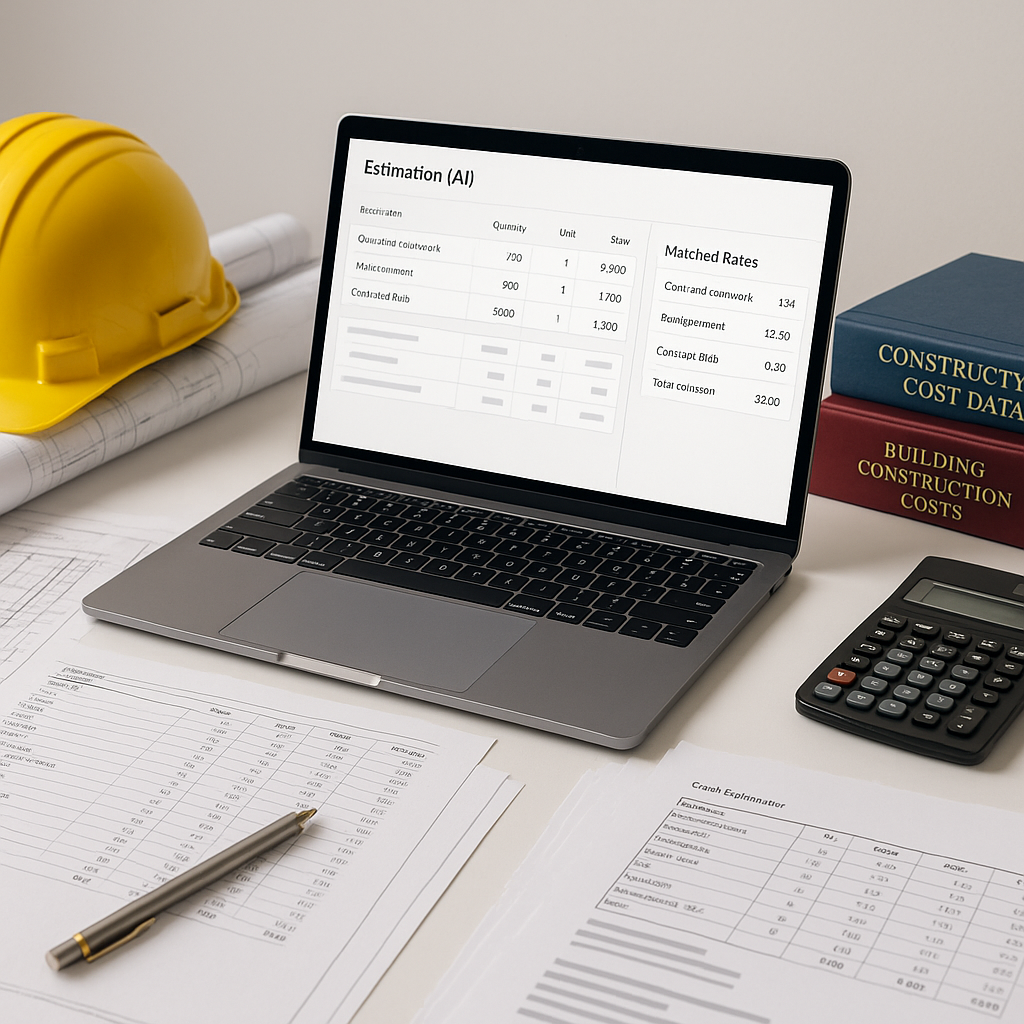
The Challenge of Manual Rate Matching in Estimation
Rate matching can be a time-consuming and error-prone process. When working with a bill of quantities (BOQ) containing hundreds of line items, finding the right rate for each one often involves manually searching through catalogs like RSMeans, CPWD DSRs, or custom Excel sheets. This process is not only tedious but also prone to errors, which can lead to inaccurate estimates and missed opportunities in competitive bidding scenarios.
AI-powered rate matching tools offer a solution to these challenges by automating the process and improving both speed and accuracy.
How AI Simplifies Rate Matching
Traditional rate matching requires manually searching for and matching line items, which can be a slow and repetitive task. AI-powered tools streamline this process through several key features:
-
Semantic Search: AI can understand the context of a line item description and suggest the closest matching rates from various catalogs, even if the match is not exact.
-
Custom Catalog Integration: Users can upload their own rate catalogs, enabling the AI to prioritize custom data over standard sources.
-
Smart Suggestions: When an exact match is unavailable, the AI suggests similar items and flags them for manual review, ensuring the estimator retains control over the final decision.
Illustrative example — Consider a mid-sized project with a BOQ containing hundreds of line items. Using AI, the time spent on rate matching could be significantly reduced compared to manual methods, allowing estimators to focus on higher-value tasks.
Enhancing Accuracy with AI
AI tools not only speed up rate matching but also improve accuracy through features like:
-
Audit Trails: Each matched rate includes a source reference, providing transparency and traceability for clients or auditors.
-
Learning Over Time: AI systems improve with use, adapting to user preferences and becoming more effective with each project.
-
Error Reduction: By automating repetitive tasks, AI minimizes the risk of overlooked items or mismatched rates, leading to more reliable estimates.
According to a 2023 McKinsey report, early adopters of AI in construction have seen cost savings partly due to fewer errors in preconstruction processes.
Addressing Common Concerns About AI in Rate Matching
“What if my rates are custom?”
AI tools can handle custom rates by allowing users to upload their own catalogs. The system learns to prioritize this data, ensuring estimates reflect real-world costs.
“Does AI make mistakes?”
While AI may occasionally suggest incorrect matches, most platforms include options for manual review and adjustment, keeping the estimator in control.
“How long does it take to learn the tool?”
AI platforms are designed to be user-friendly, with most users able to see results within a short training period.
Why AI Matters in Today’s Market
In a competitive construction market with tight deadlines and rising material costs, inefficiencies in preconstruction processes can be costly. AI-powered rate matching tools help estimators save time, reduce errors, and improve the overall accuracy of their estimates. By adopting these tools, teams can focus on pricing more bids, winning more work, and growing their business.


