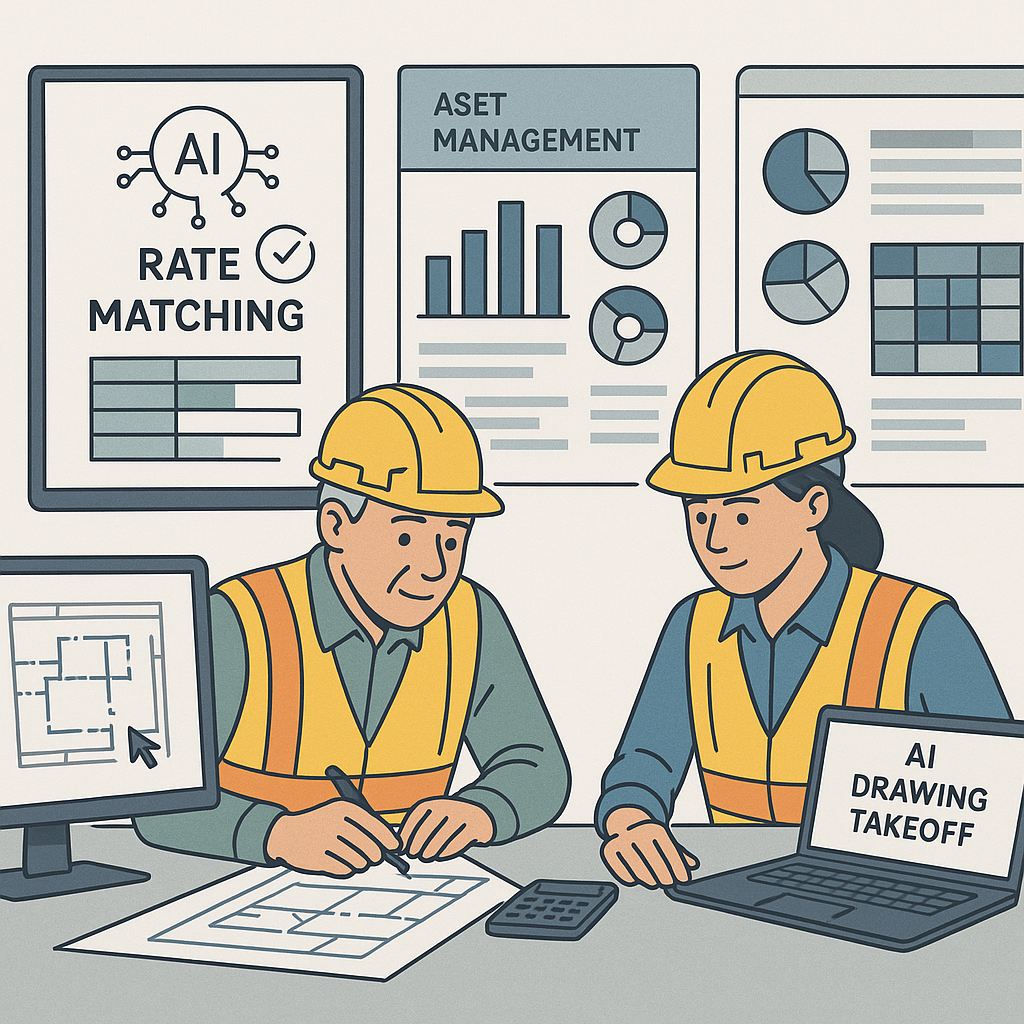
Autodesk’s $3.6 Billion Bet: MaintainX Joins the Fold
Last week, Autodesk announced its $3.6 billion acquisition of MaintainX. At first glance, it’s another massive merger in the construction and facilities software market. But if you look closer, this isn’t just about asset management. It’s about Autodesk’s play for the entire construction lifecycle—from preconstruction to operations.
Why does this matter for estimators? Simple. Everything downstream, from asset management to facilities maintenance, starts with accurate estimates upstream. If Autodesk can integrate MaintainX’s asset data into its construction cloud, it could reshape how we approach estimation.
Let’s break it down.
Estimation is the Foundation (But It’s Still Broken)
Every estimator knows the pain of disconnected workflows. You spend hours manually taking off drawings, referencing outdated rate books, and rebuilding spreadsheets for minor scope changes. Then, post-construction, your carefully crafted estimates vanish into thin air. No feedback loop. No real-world insights.
Autodesk’s acquisition highlights a growing trend: connecting preconstruction with operations. MaintainX, known for its asset management and work order tracking, could close the gap between what we estimate and what actually happens on-site. This could mean more accurate bidding, fewer surprises during construction, and better long-term project outcomes.
The Current State of Estimation Tools
Let’s take ProEst, Autodesk’s own cloud estimating tool, as an example. It’s great for basic workflows like quantity takeoffs and cost calculations, but it doesn’t solve core bottlenecks such as AI-powered takeoff or real-time rate matching. For instance:
- Manual Takeoffs: Most tools still require manual intervention for measurement and scope validation.
- Outdated Rates: Rate books aren’t updated in real-time, which can lead to inaccurate cost projections.
- Missed Feedback Loops: Once the bid is submitted, there’s no system for refining future estimates based on operational data.
That’s where platforms like EstimateNext stand out. Their AI-driven model automates tasks like takeoffs and rate matching, making workflows faster and more accurate.
The MaintainX Angle: Real-Time Feedback on Estimates
MaintainX excels at tracking asset performance, work orders, and maintenance costs. Imagine if that data flowed back into your estimation platform. Suddenly, you’d have:
- Realized Costs: Know exactly how much that HVAC unit or fire suppression system cost to maintain over five years.
- Predictive Insights: Use historical asset data to refine your estimates for future bids.
- Dynamic Rate Adjustments: Adjust rates based on real-world labor and material consumption.
Example: Hospital Project
Let’s say you’re bidding on a hospital project. Your estimate includes $1.2M for MEP systems. With MaintainX-integrated data, you’d know that similar systems in past projects required 12% more maintenance than planned. You could adjust your estimate—or even propose a higher-quality spec to reduce long-term costs.
Case Study: Commercial Real Estate
Consider a real-world example from commercial real estate. In one project, MaintainX revealed that elevators in a newly constructed office building required 18% more maintenance than industry norms due to installation errors. If this data had been fed back into the preconstruction phase, estimators could have flagged the risk and proposed a higher budget for higher-quality installations.
AI Estimation: The Missing Piece
Autodesk’s acquisition also underscores the growing importance of AI in construction tech. MaintainX uses AI to optimize asset performance. Estimation tools need to follow suit.
For instance, EstimateNext’s Vision AI Extraction automates drawing takeoffs in 10 minutes flat. It reads PDFs, extracts quantities, and even flags low-confidence areas for review. That’s not just saving time—it’s ensuring accuracy from the start.
How AI Can Revolutionize Estimation
Now, imagine layering MaintainX’s asset data on top of that. AI could:
- Predict Lifecycle Costs: Use historical maintenance data to estimate total costs for specific materials or systems.
- Suggest Alternative Specs: Recommend materials or systems with lower total cost of ownership.
- Highlight Risks: Flag items prone to higher maintenance or failure rates based on past projects.
Real-World Impact
AI-driven platforms are already delivering:
- 10X Faster Takeoffs: Automated workflows reduce manual effort significantly.
- 12X Faster Bid Leveling: AI analyzes multiple bids simultaneously, identifying anomalies and inconsistencies.
- Cost Savings: Improved accuracy reduces the risk of underbidding or overestimating.
Why Most Tools Aren’t Ready
Here’s the reality: most estimation tools can’t handle this level of integration. ProEst, for instance, is locked into Autodesk’s ecosystem. It’s great if you’re already using BIM 360 or PlanGrid, but not if you need flexibility across markets or standards.
Other tools like CostX and Cubit excel at specific tasks (like BIM takeoffs) but lack the AI and cloud-native flexibility needed for dynamic workflows. They’re desktop-heavy, expensive, and siloed.
Comparison Table: Estimation Tools
| Feature | ProEst | CostX | EstimateNext |
|---|---|---|---|
| AI-Powered Takeoffs | No | Limited | Yes |
| Cloud-Native | Yes | No | Yes |
| Real-Time Rate Updates | No | Limited | Yes |
| Feedback Integration | No | No | Yes |
| Global Market Support | Limited | Limited | Yes |
Platforms like EstimateNext are breaking that mold. They’re cloud-native, AI-powered, and designed for multi-market complexity. Whether you’re in the US, UK, GCC, or India, you get localized rates, configurable standards, and real-time updates.
But even EstimateNext isn’t perfect. To fully capitalize on trends like Autodesk’s MaintainX acquisition, estimation platforms need to:
- Integrate Asset Lifecycle Data: Ensure operational data flows seamlessly into preconstruction.
- Enable Real-Time Collaboration: Allow teams across functions to work together efficiently.
- Deliver Predictive Insights: Use AI to anticipate future trends and risks.
The Takeaway for Estimators
Autodesk’s MaintainX acquisition signals a shift toward lifecycle integration. For estimators, this means two things:
-
Your Tools Need to Evolve: If your current stack is just Bluebeam and Excel, you’re already behind. AI-powered platforms like EstimateNext can save you 40+ hours per estimate—time you’ll need to stay competitive as workflows become more integrated.
-
Get Ready for Feedback Loops: Estimation won’t stop at bid submission anymore. As operational data flows back into preconstruction, you’ll need tools that can adapt and learn in real-time.
The obvious question is: when will this shift happen? In my view, it’s already starting. Autodesk’s move is a clear signal that the market is headed this way. The only question is whether your team is ready.
If you’re ready to save time and stay ahead of the curve, EstimateNext can help. Try it free today.


