Cash Flow: The Number That Kills Projects
Construction projects do not fail because of cost overruns alone. They fail because of cash flow mismatches — the gap between when you spend money and when you get paid. A project can be profitable on paper and still bankrupt the contractor if the cash flow timing is wrong.
Yet most estimation processes stop at the total cost. They tell you the project will cost $25 million but say nothing about when that money needs to be spent, when you will invoice, and when the client will actually pay.
The Gap Between Estimate and Cash Flow
Traditional estimation produces a cost summary. Traditional scheduling produces a programme. But the two rarely talk to each other. The estimator prices the project at $25 million. The planner schedules it over 18 months. The finance team creates a cash flow by spreading the $25 million linearly across 18 months — $1.39 million per month.
This linear assumption is almost always wrong. Construction spending follows an S-curve, not a straight line. Early months are light (mobilisation, site setup, foundations). Middle months are heavy (structure, MEP rough-in). Late months taper off (finishes, commissioning).
A realistic cash flow based on the actual schedule shows a very different profile:
- Months 1-3: $2.8M (mobilisation, piling, substructure)
- Months 4-9: $14.2M (superstructure, MEP, facade — peak spending)
- Months 10-15: $6.4M (finishes, fit-out, services)
- Months 16-18: $1.6M (testing, commissioning, snag clearing)
Now add payment terms. If the client pays 45 days after invoice (which is optimistic in many markets), your cash exposure peaks at $4.5M in month 7 — meaning you need $4.5M of working capital just to keep the project running.
Schedule-Linked Cash Flow Projection
The right approach links your estimate directly to your programme:
- Map BOQ items to schedule activities. Each line item in your estimate connects to one or more activities in the programme.
- Apply spending curves per trade. Structural concrete spending follows a different curve than MEP installation. The system knows these trade-specific profiles.
- Generate the contractor's cash out. This is when you actually spend money — on materials, subcontractors, labour, and plant.
- Overlay the client's cash in. Based on your progress billing schedule and the client's payment terms, when do you actually receive money?
- Calculate the gap. The difference between cash out and cash in at any point in time is your working capital requirement.
The S-Curve That Finance Cares About
Your finance director does not care about individual line items. They care about three curves:
- Cumulative cost curve (S-curve): Total spend over time. This shows the project's spending profile and peak cash requirement.
- Revenue curve: Cumulative invoiced and received amounts. This shows the income profile.
- Net cash position: The gap between the two curves. This tells finance how much working capital the project needs and when.
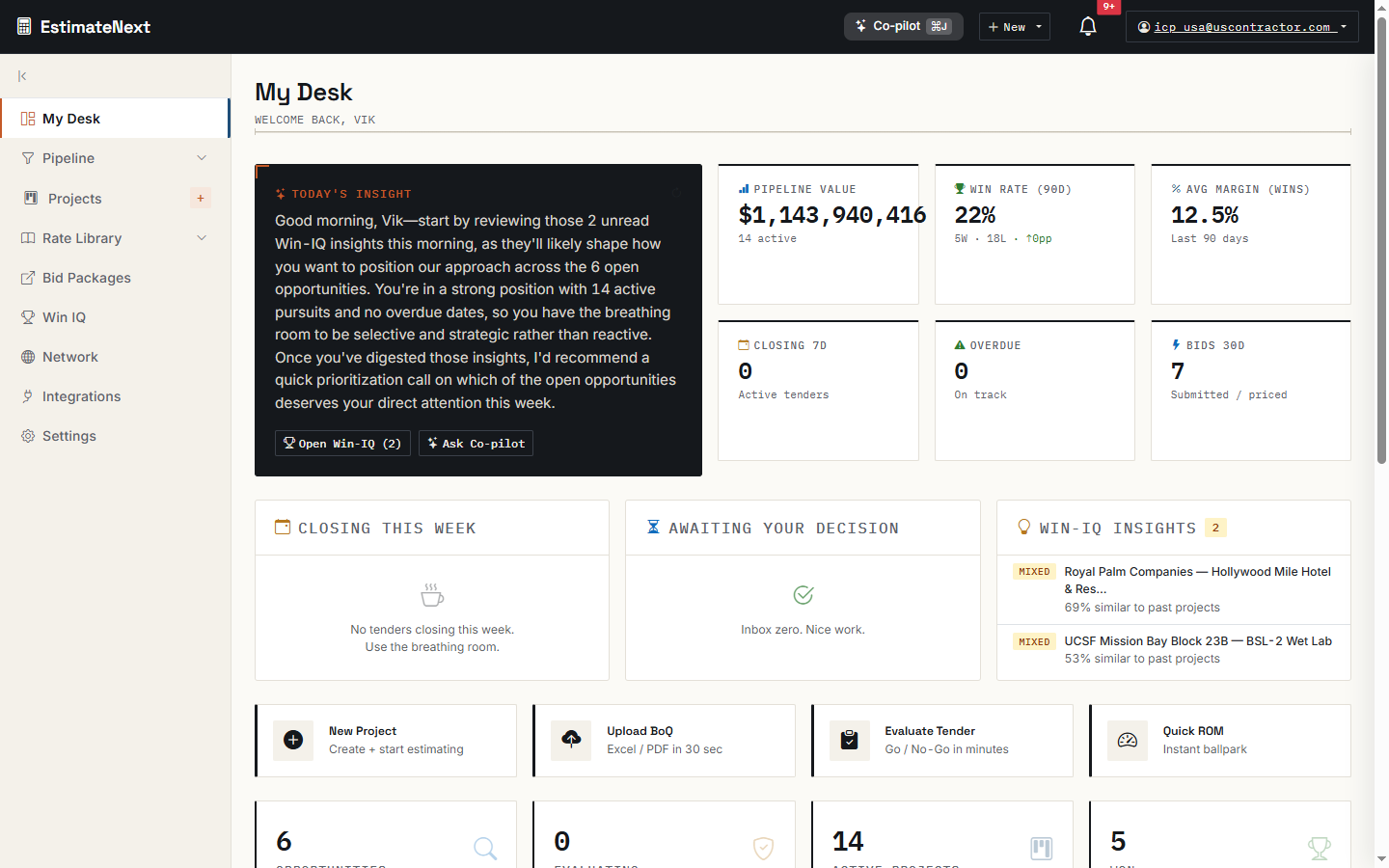
EstimateNext generates these curves automatically from your estimate and programme linkage. Change the programme — accelerate the structure by two weeks, delay the cladding by four weeks — and the cash flow recalculates instantly.
Why This Changes How You Bid
Cash flow analysis often changes bid strategy in ways that pure cost estimation does not:
Front-Loading
You might choose to front-load your billing schedule — pricing early activities higher and late activities lower — to improve your cash position. The total contract value is the same, but the cash flow is dramatically different.
Advance Payment Requests
If the cash flow shows a $5M working capital peak, and your firm's overdraft facility is $3M, you need either a larger facility (expensive) or an advance payment from the client (better). The cash flow projection gives you the data to negotiate that advance.
Subcontractor Payment Terms
If you pay subs at 60 days and the client pays you at 45 days, your cash position on subcontracted work is actually positive for the first 15 days. But if the client stretches to 75 days, that positive position evaporates. The cash flow model lets you stress-test these scenarios.
Preliminary Cost Timing
Preliminary costs (site establishment, management, insurance) are front-loaded by nature. The crane goes up before the first floor is poured. Cash flow analysis shows the impact of these early costs on your working capital.
Real Scenario: Mixed-Use Development
An 18-month mixed-use development — retail podium, residential tower, basement car park. Total estimate: $42 million.
Linear cash flow assumption: $2.33M per month, every month.
Schedule-linked cash flow reality:
- Months 1-2: $3.2M (enabling works, piling, dewatering)
- Months 3-5: $7.8M (substructure, basement)
- Months 6-10: $18.5M (superstructure, MEP rough-in, facade)
- Months 11-15: $9.8M (finishes, fit-out, landscaping)
- Months 16-18: $2.7M (commissioning, handover)
Peak monthly spend: $4.1M in month 8. With 45-day payment terms, peak cash exposure: $6.2M.
This information changes everything — from the overdraft facility you need to the retention bond you negotiate to the subcontractor payment schedule you set.
Getting Started with Cash Flow Integration
Start by linking your current project's estimate to its programme. Even a rough linkage — mapping major cost groups to programme phases — gives you a more realistic cash flow than a linear assumption.
Ready to see schedule-linked cash flow on your project? Request a demo and bring your programme and estimate.
Ready to see EstimateNext in action?
AI-powered preconstruction estimation platform — from BOQ upload to priced bid package in minutes. 78K+ SOR items, 7 specialist trade tools, bid intelligence, and a procurement network.
Get Started Free →