EPC Estimation: A Different Scale Entirely
EPC (Engineering, Procurement, and Construction) contractors estimate projects that most other firms would consider impossibly complex. A petrochemical plant, a power station, a water treatment facility — these are not buildings. They are systems of interconnected systems, each with its own engineering discipline, equipment specifications, and procurement lead times.
The estimation challenge is not just size — it is the interdependence. Piping quantities depend on equipment layout. Electrical loads depend on mechanical equipment selections. Instrumentation depends on process design. Change one thing and ripple effects cascade through every discipline.
Discipline-Based Estimation
EPC estimation is inherently multi-discipline. A typical industrial project involves:
Process and Piping
- Process equipment (vessels, exchangers, pumps, compressors)
- Piping by diameter, schedule, material, and routing
- Valves, fittings, and specialty items
- Insulation and painting by surface area
Structural
- Steel structures (pipe racks, equipment supports, buildings)
- Foundations (equipment bases, pile caps, grade beams)
- Civil works (roads, drainage, underground utilities)
Electrical
- Power distribution (transformers, switchgear, MCCs)
- Cable and cable tray by routing and size
- Lighting and small power
- Earthing and lightning protection
Instrumentation and Controls
- Field instruments (transmitters, control valves, analysers)
- Control systems (DCS, PLC, SCADA)
- Instrument cables and tubing
- Junction boxes and marshalling cabinets
Mechanical
- HVAC for buildings and control rooms
- Fire protection (detection, suppression, hydrant systems)
- Cranes and material handling
- Rotating equipment installation
The Quantity Development Challenge
In EPC estimation, quantities evolve as the design progresses. At tender stage, you might have:
- Conceptual stage: Equipment list and preliminary P&IDs. Piping is estimated as a factor of equipment cost (typically 30-60% depending on process type).
- Basic engineering: Piping line list available, structural steel preliminary design, electrical load list defined. Quantities are semi-detailed.
- Detailed engineering: Full material take-offs from 3D models. Quantities are accurate but the tender was submitted months ago.
The challenge is estimating accurately enough at conceptual stage to win the tender, while managing the risk of quantity growth as design develops.
Factor-Based vs. Detailed Estimation
EPC contractors use both approaches, often on the same project:
Factor-based for early-stage estimation. Take the equipment cost, apply discipline-specific factors (piping 40%, electrical 15%, instrumentation 12%, civil/structural 20%, indirect 35%), and you have a rough order of magnitude. This gets you to within 20-30% accuracy in a few days.
Detailed estimation for tender submission. Every line of pipe, every cable run, every foundation is quantified and priced. This takes weeks but gets you to 5-10% accuracy.
The right platform supports both modes and lets you progressively refine from factor-based to detailed as design information becomes available. You start with factors, replace them with actual quantities discipline by discipline, and track your estimate's maturity.
Procurement Integration
Unlike building construction where 70-80% of cost is subcontracted, EPC projects involve heavy direct procurement. Equipment can be 25-40% of total project cost, and the difference between a Chinese-manufactured heat exchanger and a European one can be 50% of the equipment cost.
Your estimate needs to handle:
- Budget pricing from equipment vendors at tender stage
- Firm quotes during negotiation and execution
- Bulk material pricing for pipe, cable, steel with escalation clauses
- Freight and logistics costs that vary dramatically by project location
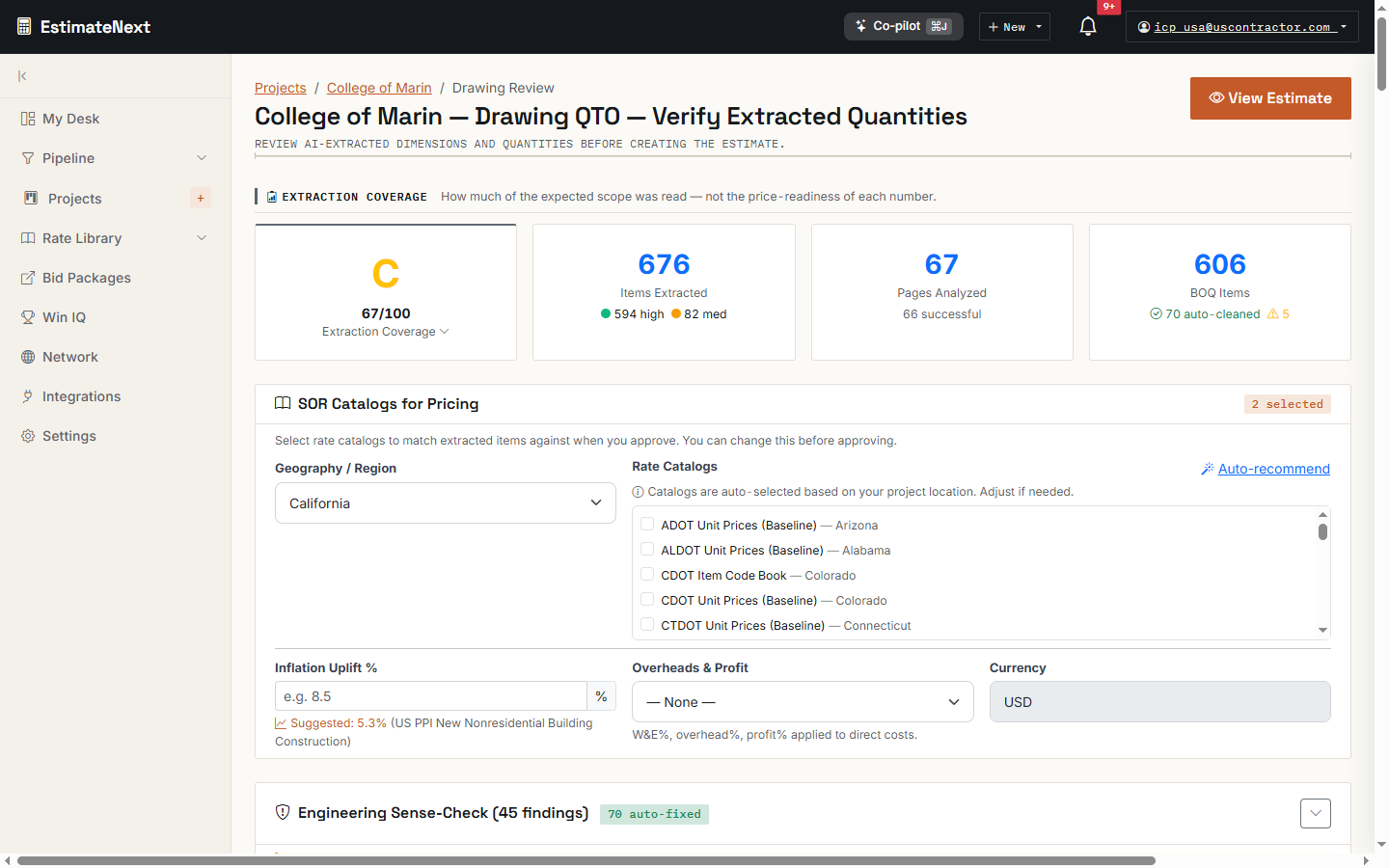
EstimateNext integrates procurement pricing into the estimate so you can see the impact of vendor selections on total project cost in real time.
Real Scenario: 100 MW Solar Power Plant
A utility-scale solar power plant EPC estimate involves:
- 350,000 solar modules across 4,000 mounting structures
- 1,200 string inverters and 12 central inverters
- 180 km of DC cable and 45 km of AC cable
- 8 transformer substations with step-up transformers
- 25 km of internal roads and security fencing
- Grid connection infrastructure
The estimate spans electrical, civil, structural, and mechanical disciplines. Manual estimation takes three to four weeks with a team of five. With structured multi-discipline estimation, the same scope takes eight to ten days because:
- Module layout drives mounting structure quantities automatically
- Cable routing follows the electrical design with automated length calculations
- Civil quantities (foundations, roads, trenches) derive from the layout
- A change in module type (and therefore count) ripples through every discipline
Managing Estimate Risk
EPC contracts carry significant risk. A lump-sum turnkey tender means your estimate is your contract price. Getting it wrong costs you money directly. EPC estimators therefore need:
- Contingency modelling at discipline level, not just a single percentage
- Escalation forecasts for a two to three year construction programme
- Currency exposure analysis for multi-source procurement
- Scope gap analysis to identify items in the employer's requirements but not in your estimate
These risk management features are not add-ons — they are core to EPC estimation.
Getting Started for EPC Firms
If your firm does EPC contracting, start with a recent lump-sum tender. Upload the BOQ or build it from your discipline estimates, and see how the platform handles multi-discipline consolidation. Pay particular attention to how discipline-level changes propagate through the total estimate.
Ready to streamline EPC estimation? Schedule a walkthrough with your team and bring a real project scope.
Ready to see EstimateNext in action?
AI-powered preconstruction estimation platform — from BOQ upload to priced bid package in minutes. 78K+ SOR items, 7 specialist trade tools, bid intelligence, and a procurement network.
Get Started Free →