The Go/No-Go Decision Is the Most Important Bid You Never Price
Every contractor and consultant makes go/no-go decisions. Most make them badly — in a five-minute conversation between the MD and the chief estimator, driven by gut feel, available capacity, and how hungry the firm is for work.
The result? Firms chase tenders they cannot win, underestimate risk on projects they should decline, and miss opportunities they should have pursued aggressively. Studies consistently show that average bid-to-win ratios in construction hover around 1:6 to 1:8. That means 80-85% of estimation effort produces zero revenue.
What if you could improve that ratio to 1:4 by being smarter about which tenders you pursue?
The 26-Point Rubric
A structured go/no-go evaluation replaces gut feel with data. The 26-point rubric covers five categories:
Strategic Fit (6 points)
- Does this project align with our core competency?
- Is the client a target client or sector?
- Does this geography match our operational footprint?
- Does this project type match our track record?
- Is the project size within our bonding capacity?
- Does the timeline fit our current programme?
Competitive Position (5 points)
- Do we have a pre-existing relationship with this client?
- Have we done similar work in the last 24 months?
- Do we have proprietary advantages (methods, equipment, IP)?
- Are we the incumbent or have we been invited to bid?
- How many competitors are likely bidding?
Risk Profile (6 points)
- Contract type (lump sum, cost-plus, GMP, design-build)
- Design completeness at tender stage
- Ground condition risk (brownfield, contaminated, unknown)
- Permitting and regulatory risk
- Client payment history and financial stability
- Liquidated damages exposure
Resource Availability (5 points)
- Do we have a project manager available for this timeline?
- Is our estimation team available to produce a quality bid?
- Do we have the specialist workforce or subcontractor relationships?
- Can we mobilise equipment within the required timeframe?
- Do we have the working capital for this project's cash flow profile?
Commercial Viability (4 points)
- Is the expected margin above our hurdle rate?
- Is the project fundable (bank guarantees, performance bonds)?
- Are the payment terms acceptable?
- Is the contract balanced or heavily biased toward the client?
Scoring and Decision Thresholds
Each point scores 1-5 (poor to excellent). Total possible score: 130.
- Above 100: Strong pursuit — allocate senior estimation resources
- 80-100: Qualified pursuit — bid but manage cost of pursuit
- 60-80: Selective pursuit — bid only if capacity allows and one or two weaknesses can be mitigated
- Below 60: Decline — the risk-adjusted expected value is negative
This is not a rigid formula. It is a framework for structured discussion. When the MD wants to chase a project that scores 55, the rubric forces a conversation about which factors are weak and whether they can be addressed.
What the Data Shows Over Time
Firms that track go/no-go scores against actual outcomes find revealing patterns:
- Projects scored above 90 have win rates of 35-40% (versus industry average of 12-15%)
- Projects scored 60-70 that were pursued anyway have win rates below 5%
- Projects scored 70-80 where specific weaknesses were addressed before bidding have win rates of 20-25%
The maths is clear: pursuing ten projects scored above 90 costs the same estimation effort as pursuing ten projects scored 60-70, but produces three to four times as many wins.
Go/No-Go in EstimateNext
The platform embeds this rubric into your tender management workflow:
- New tender arrives. Before any estimation work begins, the BD team fills out the 26-point evaluation.
- Score is calculated automatically. The system highlights weak areas and suggests mitigation actions.
- Decision is recorded. Whether you pursue or decline, the decision and rationale are logged.
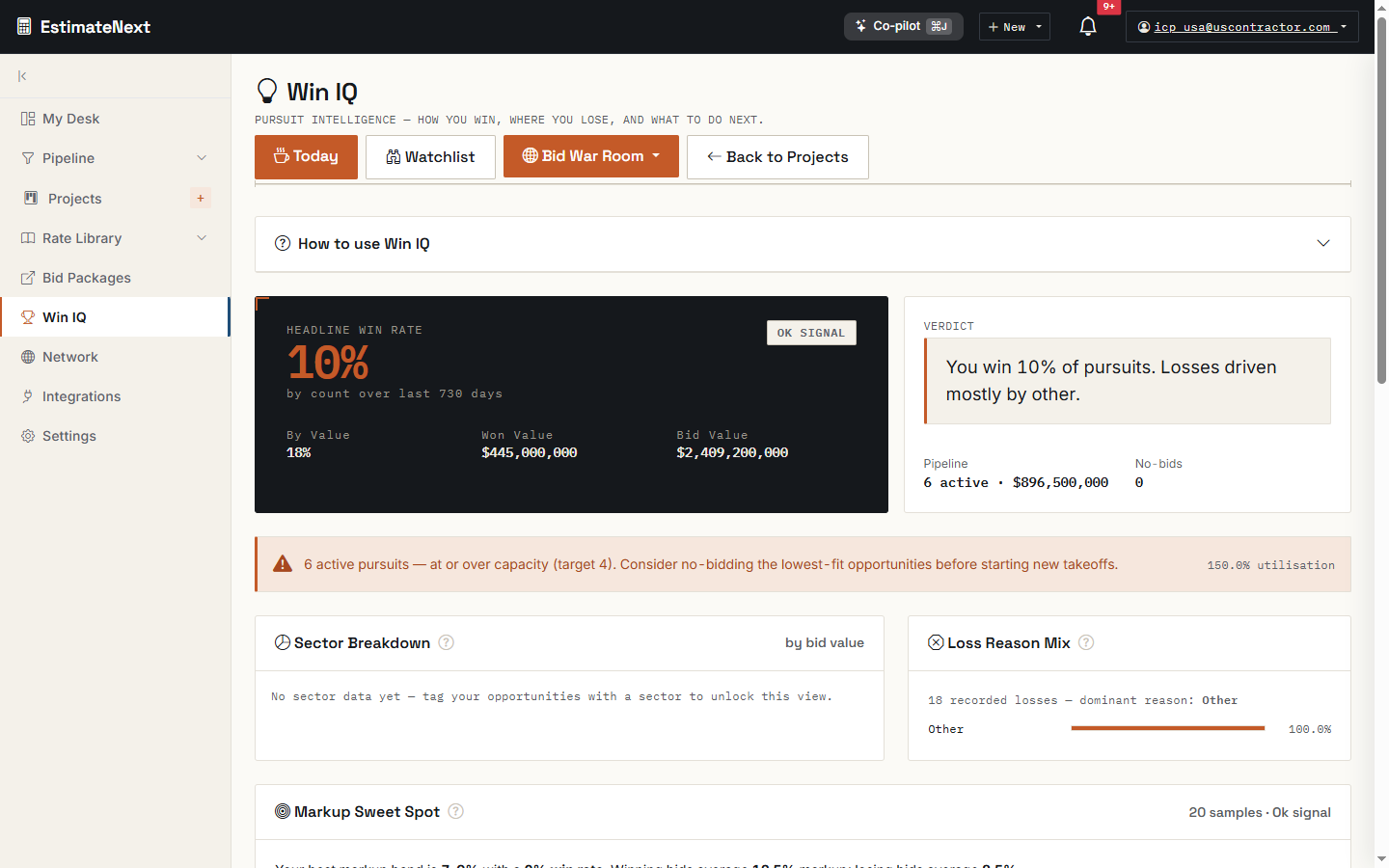
- Outcome tracking. When pursued tenders are won or lost, the outcome links back to the original go/no-go score.
- Pattern recognition. After 20-30 evaluations, the system shows you which factors most strongly predict your firm's wins and losses.
Over time, this becomes a competitive intelligence tool. You learn that your firm wins 45% of invited-bid hospital projects but only 8% of open-tender highway projects. That insight alone is worth the cost of the platform.
The Hidden Cost of Bad Go/No-Go
When you pursue a tender you should not, the cost is not just the estimation hours. It is:
- Opportunity cost: Your estimation team was busy on a low-probability bid when a high-probability one came in
- Margin pressure: Firms that bid everything tend to bid low on everything because they are desperate for wins
- Reputation risk: Submitting a non-competitive bid repeatedly signals to clients that you do not understand their project
- Team morale: Estimators who see 85% of their work result in losses get demotivated
Getting Started with Structured Go/No-Go
You do not need a platform to start. Create a spreadsheet with the 26 points, score your next five tenders, and track the outcomes. Within two quarters, you will have data that either validates your gut feel or reveals its blind spots.
Want to embed go/no-go into your tender workflow? See how EstimateNext handles it.
Ready to see EstimateNext in action?
AI-powered preconstruction estimation platform — from BOQ upload to priced bid package in minutes. 78K+ SOR items, 7 specialist trade tools, bid intelligence, and a procurement network.
Get Started Free →

