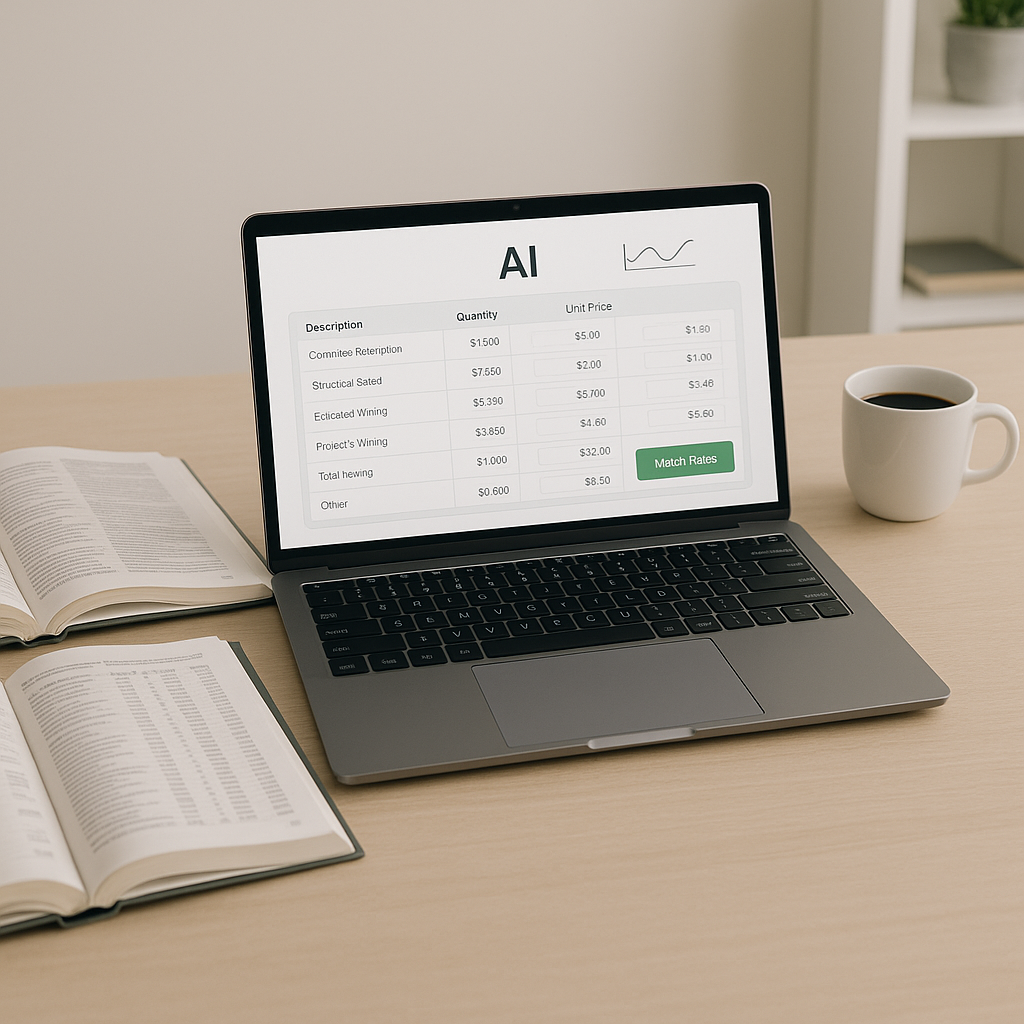
How Manual Rate Lookups Can Slow You Down
If you’ve ever flipped through a massive rate book or scrolled endlessly through spreadsheets, you know how tedious and time-consuming manual rate lookups can be. Finding the labor cost for installing structural steel or the material rate for pre-stressed concrete often requires navigating dense catalogs, which increases the risk of human error.
Traditional rate lookup methods rely on deciphering complex rate catalogs, such as RSMeans or other industry-standard resources. While these catalogs are comprehensive, they can be cumbersome to use, especially when time is of the essence.
AI-Powered Rate Matching: How It Works
AI tools are transforming the way rate lookups are conducted by introducing semantic search and intelligent rate matching. Instead of manually searching for the right rate, you can input a description, and the AI interprets the context to find the most relevant rate.
For example:
- Input: “Labor rate for installing pre-stressed concrete girders”
- Output: The relevant rate pulled from a catalog in seconds.
The key advantage of AI is its ability to understand context rather than relying solely on keyword matching. It can account for variations such as regional differences or material specifications. Additionally, these tools often support multiple catalogs, allowing users to pull rates from a wide range of sources, including custom rate books.
Benefits of AI-Powered Rate Lookups
AI-powered rate matching offers several benefits:
- Time Savings: Automating the lookup process significantly reduces the time spent searching for rates.
- Error Reduction: By cross-referencing multiple catalogs and ensuring up-to-date information, AI minimizes the risk of errors.
- Customization: Many tools allow users to upload custom rate catalogs, ensuring that unique project requirements are met.
Challenges and Considerations
While AI tools can greatly enhance efficiency, they are not without limitations. For example:
- Data Quality: The accuracy of AI-powered rate matching depends on the quality of the input data. Vague or inconsistent descriptions in the Bill of Quantities (BOQ) can lead to mismatches.
- Custom Rates: Some projects require highly specific rates that may not be available in standard catalogs. In such cases, manual input and oversight are necessary.
To address these challenges, many AI tools allow for manual overrides and learning from user inputs, improving accuracy over time.
Common Questions
Q: How accurate are AI-powered rate matches? AI tools improve in accuracy as they learn from user feedback and repeated use. However, manual oversight is still recommended for critical decisions.
Q: Can AI handle region-specific catalogs? Yes, many AI tools support region-specific catalogs and standards, making them suitable for multi-market projects.
Q: Can I integrate my existing rate books? Absolutely. Most AI tools allow users to upload custom catalogs, which are then integrated into the system.
Q: What happens if the AI doesn’t find a match? Users can manually input rates, and the system logs these inputs for future reference, improving its database over time.
Conclusion
Manual rate lookups are a common bottleneck in preconstruction estimation, leading to wasted time and increased errors. AI-powered tools offer a smarter, faster alternative by automating the process and reducing the risk of mistakes. By leveraging semantic search and self-learning algorithms, these tools allow professionals to focus on high-value tasks rather than tedious data searches.
If you’re looking to streamline your rate lookup process, consider exploring AI-powered solutions to enhance efficiency and accuracy.


