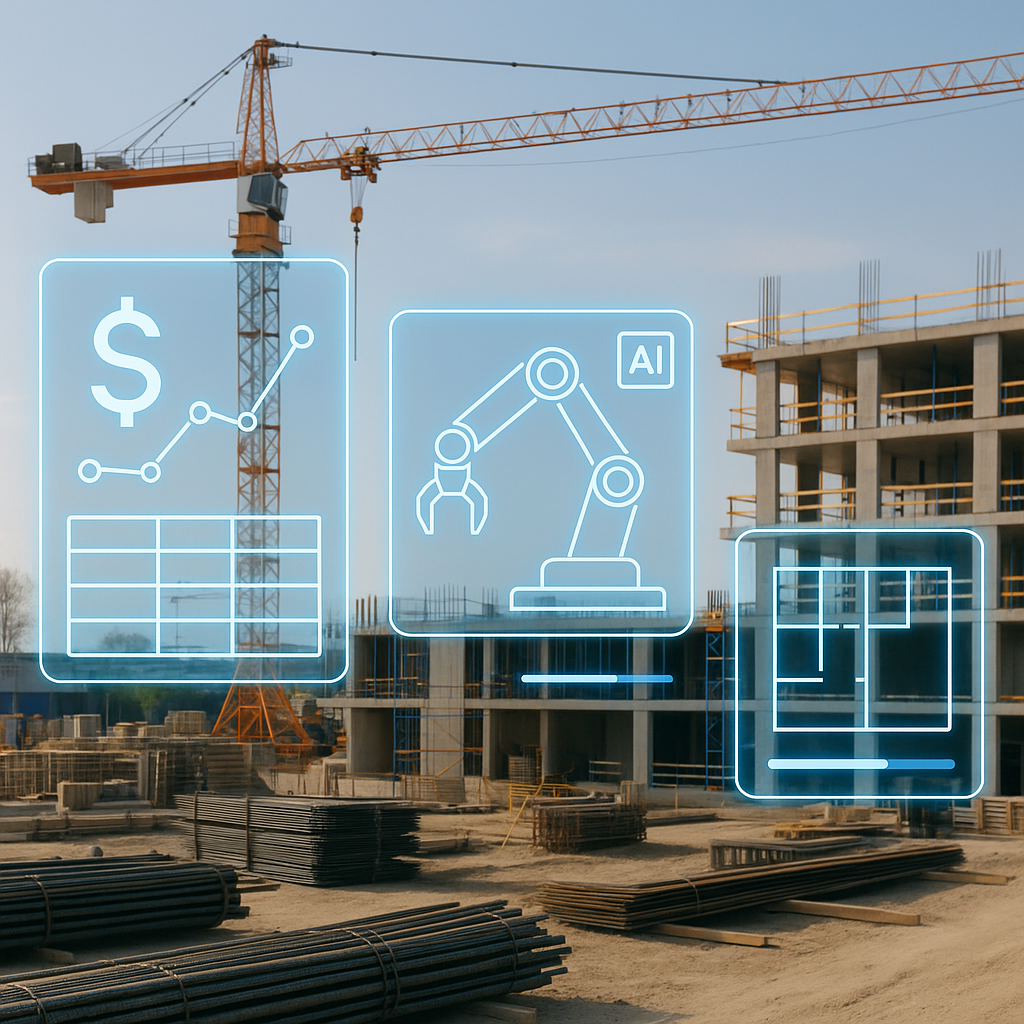
How AI-Driven Tools Can Improve Construction Estimation
AI is increasingly being adopted across industries, and construction is no exception. While much of the focus has been on areas like project management and hiring, the principles driving AI adoption in these areas can also revolutionize preconstruction estimation. By automating repetitive tasks, standardizing processes, and leveraging data, AI tools can help construction teams meet tighter deadlines, manage rising material costs, and improve overall efficiency.
The Problem: Estimation Is Still Stuck in the Past
Many construction firms still rely on outdated estimation workflows. Estimators often spend hours manually flipping through rate books like RSMeans or CPWD DSR, tracing lines on PDFs, and rebuilding Excel sheets for every "what-if" scenario. These manual processes are time-consuming, error-prone, and leave little room for strategic thinking.
How AI Estimation Tools Can Help
AI-driven estimation tools can address these challenges by focusing on three key principles:
- Automate the Repetitive: AI tools can take over tedious tasks like rate matching and quantity takeoff, freeing up estimators to focus on higher-value activities.
- Standardize for Scalability: By creating repeatable and consistent processes, AI tools ensure that bid packages are uniform and scalable across multiple projects.
- Use Data To Make Decisions: Data-driven insights can help teams evaluate bid/no-bid decisions, analyze historical performance, and predict win rates.
Automating Rate Matching: A Practical Example
Illustrative example — Imagine you have a 300-line Bill of Quantities (BOQ) that needs pricing. Without AI, you might spend hours flipping through rate books, searching for local market data, or referencing past estimates. This process is slow and prone to errors.
With AI-powered tools, you can upload your BOQ, and the system matches items to a database of standard rates. It can even adjust for inflation and local market conditions. What used to take hours can now be completed in minutes, allowing your team to focus on refining the bid strategy.
What About Human Oversight?
AI tools are not a replacement for human expertise—they are designed to augment it. For example, modern tools can flag low-confidence matches for manual review, ensuring that critical decisions are still made by experienced estimators. Think of it as having a junior estimator who handles repetitive tasks, while senior team members focus on strategic decisions.
The Benefits of AI Estimation Tools
Adopting AI-driven estimation tools can lead to significant improvements in efficiency and competitiveness. By automating manual tasks, teams can save time, reduce errors, and respond to more opportunities. Additionally, data-driven insights enable better decision-making, helping firms optimize their bids and win more projects.
What’s Next for AI Estimation?
AI is not just a trend—it’s a competitive advantage. As more construction firms adopt AI-driven tools, the industry as a whole can benefit from increased efficiency and innovation. For preconstruction teams, the next step is clear: embrace tools that automate manual processes, standardize workflows, and leverage data for better decision-making.
If your team is still relying on Excel, rate books, and manual processes, it’s time to explore the potential of AI-powered estimation tools. By adopting these technologies, you can streamline your workflows, improve accuracy, and stay ahead in a competitive market.


