Why Manual Takeoffs Are Challenging for Preconstruction Teams
If you've ever spent hours tracing PDFs with a ruler, you already know the pain. Drawing takeoffs are often a bottleneck in preconstruction workflows. A typical project can require significant manual takeoff work, involving detailed measurements and calculations to extract quantities from drawings.
And mistakes? They're almost guaranteed. Overlaps, missed lines, or simple fatigue can skew quantities and throw your entire estimate off. Worse, when the client sends a drawing revision, you're back to square one.
This isn’t just frustrating—it’s expensive. Every delay in preconstruction ripples through the project. Missed bids, thinner margins, and burnt-out estimators are the price we pay for sticking to outdated methods.
How AI Makes Takeoffs Faster
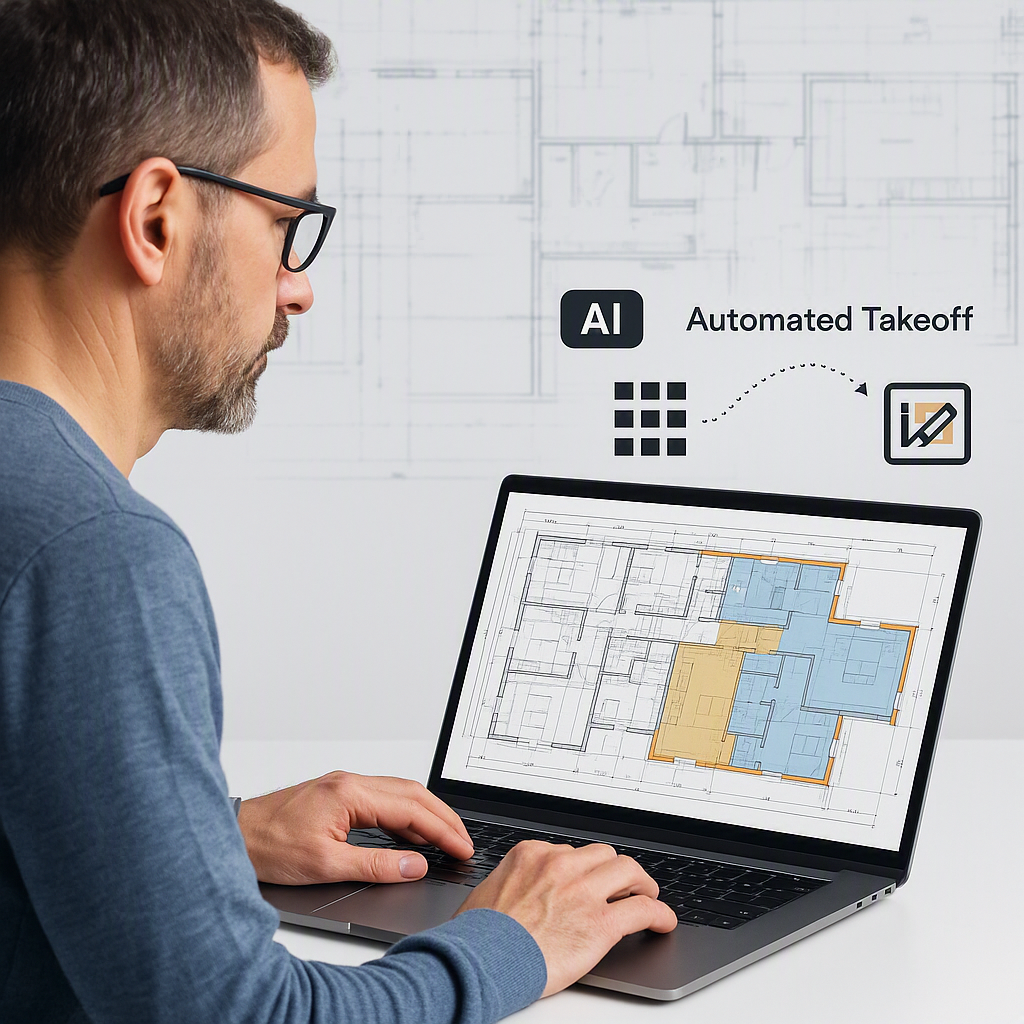
AI-powered tools are transforming this workflow. Instead of spending hours manually measuring, AI tools can extract quantities from drawings in a fraction of the time. This shift has the potential to significantly improve efficiency.
Here’s how it works:
- Upload Your PDF or Drawing Set: The tool reads your files instantly, no matter how complex the layout.
- AI Vision Scans the Drawing: Using advanced object recognition, the AI identifies areas, lengths, and counts for every element in the drawing (walls, windows, floors, etc.).
- Low-Confidence Lines Get Flagged: Unlike manual methods, AI tools highlight areas where it’s unsure, so you can double-check instead of redoing everything.
- Real-Time Updates: If you upload a revised drawing, the AI recalculates quantities automatically, saving hours of rework.
Why Accuracy Still Needs a Human Touch
Now, I know what you’re thinking: “Sure, AI is fast, but can it be trusted?”
Fair question. AI tools are highly accurate but not perfect. The quality of results depends heavily on the quality of input data. Smudged drawings, unclear labels, or missing legend keys can throw off even the smartest algorithms.
This is why human oversight remains critical. Think of AI as an assistant, not a replacement. You’re still the expert who validates quantities, checks assumptions, and applies professional judgment.
Practical ROI for Estimators
Illustrative example — Let’s consider a scenario where a team handles multiple projects annually, each requiring significant manual takeoff time. If AI tools reduce the time spent on takeoffs by a substantial margin, the cumulative time savings could translate into significant cost savings and allow estimators to focus on higher-value tasks.
Common Myths About AI in Construction Estimation
-
“AI is too expensive for small firms.” Many AI tools are now available at competitive pricing, making them accessible to firms of various sizes. Compare the cost of AI tools to traditional software or manual labor, and the value becomes evident.
-
“AI replaces jobs.” Not true. AI is there to do the repetitive tasks, freeing up your team to focus on higher-value activities like bid strategy and value engineering.
-
“AI will make mistakes.” Yes, it might—but so do humans. The key is to use AI as a tool to assist your judgment, not as a crutch.
What to Watch For When Choosing an AI Tool
Not all AI tools are created equal. Here’s what to look for:
- Ease of Use: A steep learning curve defeats the purpose. Look for intuitive interfaces and fast onboarding.
- Accuracy Rates: Ask vendors for real-world case studies and accuracy data.
- Customization: Can the tool adapt to your specific trade, region, or measurement standard?
- Support for Revisions: Does it handle drawing updates without requiring you to start over?
Final Thoughts
AI isn’t just a faster way to do takeoffs—it’s a smarter way. By automating the repetitive, error-prone parts of preconstruction, you free up your team to focus on what really matters: winning more bids and delivering better projects.
If you’re tired of wasting hours on manual takeoffs, it’s time to explore how AI can enhance your workflows.


