Why Manual Takeoffs Are Challenging for Preconstruction Teams
Ask any estimator about drawing takeoffs, and you'll often hear about the frustration involved. Manual tracing in tools like Bluebeam can be time-consuming and tedious. Estimators spend significant time measuring areas, counting fixtures, and recalibrating scales. This process can become even more burdensome when multiple projects or revisions are involved.
But manual takeoffs aren't just slow; they're also prone to errors. Missing a dimension or miscounting a fixture can lead to inaccurate estimates. When revisions come in, the process often has to start over, adding to the workload and increasing the risk of mistakes.
How AI Changes the Game
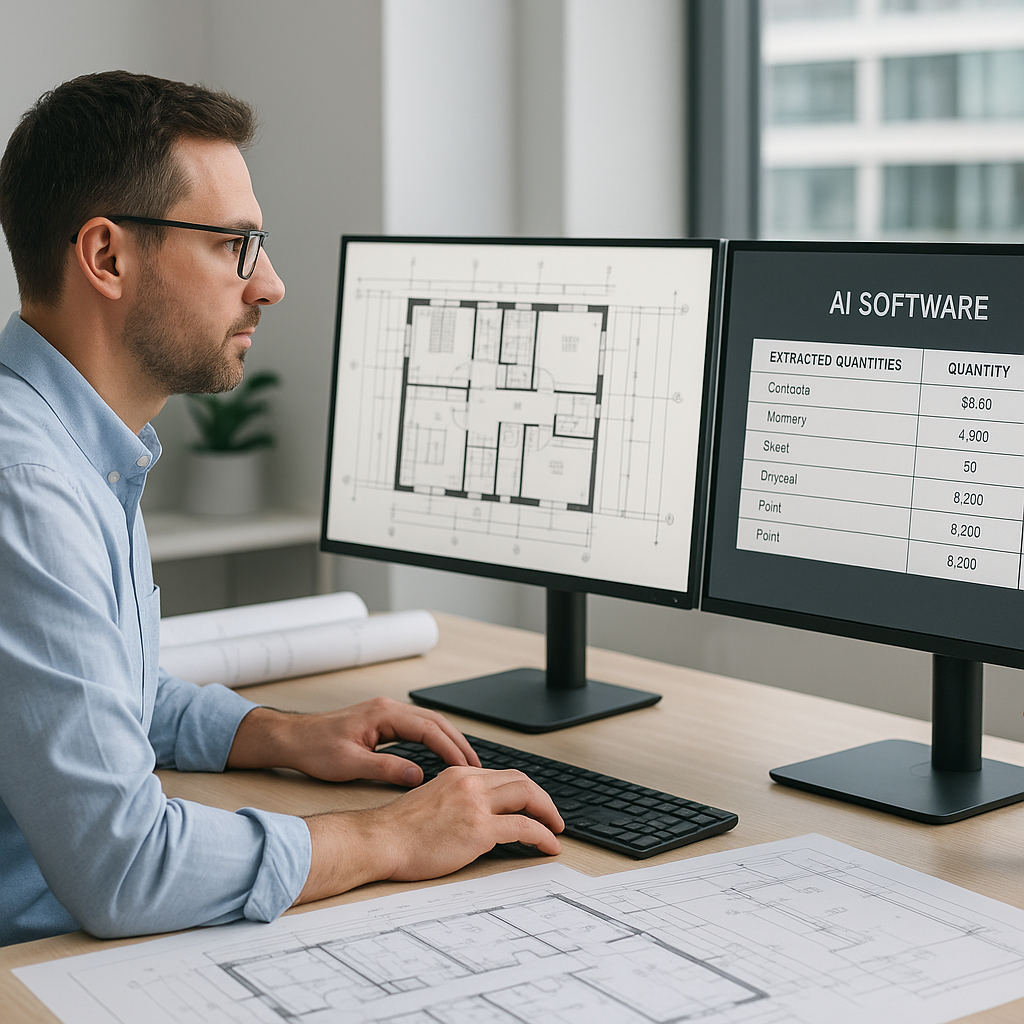
AI-powered tools are transforming the preconstruction process. Instead of manually tracing PDFs line by line, these tools allow you to upload drawings, and the AI extracts quantities automatically. It can identify room areas, wall lengths, and fixture counts directly from the file. This eliminates the need for manual calibration and reduces the likelihood of missed details, providing data that can be reviewed and trusted.
AI tools don’t replace the expertise of estimators—they enhance it. By automating repetitive tasks, estimators can focus on higher-value activities like negotiating with subcontractors or refining project markups.
What About Accuracy?
A common concern is whether AI can match the accuracy of human estimators. The answer is that AI can be highly accurate when combined with human oversight. Many AI tools include features like confidence scoring and manual override options, allowing users to review and adjust outputs as needed. This combination often results in fewer discrepancies compared to fully manual methods.
Benefits of AI in Preconstruction
Time saved through automation can translate into significant efficiency gains. For general contractors, automating takeoffs allows teams to allocate their time more effectively, potentially enabling them to respond to more bid packages. For subcontractors, the speed advantage can mean quicker turnaround times on pricing packages, which may improve competitiveness in the bidding process.
Common Skepticisms About AI Takeoffs
Here are some common objections and how AI tools address them:
-
“AI can’t understand complex drawings.”
While AI tools may not be perfect, they are continually improving. Many tools handle typical architectural drawings effectively, and manual overrides allow users to address edge cases. -
“It won’t work for small projects.”
AI tools are scalable and can be used for projects of various sizes, from small renovations to large infrastructure developments. -
“Learning AI tools takes too long.”
Most platforms are designed with user-friendliness in mind. Training is often straightforward, and interfaces are intuitive, especially for those already familiar with digital tools like Bluebeam.
Actionable Next Steps
If your team is struggling with the inefficiencies of manual takeoffs, it may be time to explore AI-powered solutions. These tools can help save time, improve accuracy, and free up your team to focus on more strategic tasks. Learn more about AI in preconstruction →
Don’t wait until your next project deadline to make the switch. Start exploring how AI can enhance your preconstruction workflow today.


