The Hidden Drag of Manual Rate Lookup in Estimation
If you’ve ever priced a construction bid, you know the drill. Flipping through a massive rate book, hunting for the cost of something like "precast concrete panels" or "HVAC duct installation." It’s not just slow—it’s error-prone. Miss one line item or misread a rate, and your bid loses its competitive edge. Worse, you’ve burned hours just to get there.
How Semantic Rate Matching Changes the Game
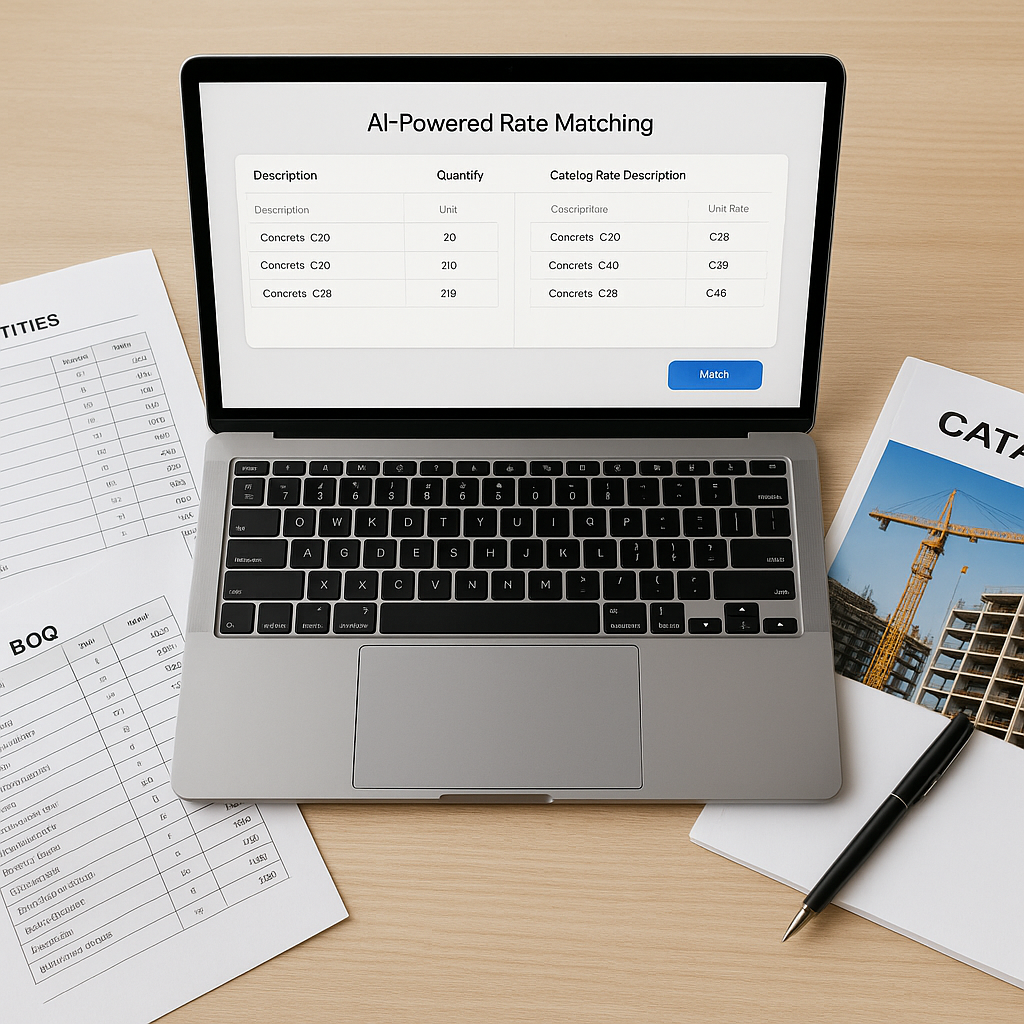
This is where AI-powered tools come in, specifically semantic search features. Instead of manually scanning catalogs, you type a query—"labour rate for installing pre-stressed concrete girders," for example—and the system returns a match in seconds. It’s like Google, but for construction rates.
Let’s break it down:
- Semantic Understanding: The AI doesn’t just search for exact phrases. It understands synonyms, context, and variations. "Concrete panels" might match "precast slabs" or "reinforced concrete elements."
- Catalog Breadth: These tools often leverage a wide range of catalogs, including regional standards like CPWD DSR for India, RSMeans for the U.S., and AECOM rates for GCC countries. This makes them versatile across markets.
- Custom Rates: Got your own rate library? You can upload it, and the AI integrates it seamlessly for future use.
- Feedback Loop: Every search improves the system. Reject a match, and the AI learns, improving accuracy over time.
Why It’s Not Just About Speed
Sure, cutting hours down to seconds is great. But the real value lies elsewhere:
- Error Reduction: Manual lookup often misses rates or misapplies them. AI removes much of that human error.
- Scalability: Whether you’re pricing a small renovation or a large infrastructure project, semantic rate matching scales effortlessly.
- Audit Trails: Every matched rate comes with a source reference, ensuring transparency. This can be invaluable during client meetings or audits.
Common Mistakes in Rate Matching
Even with AI, there are pitfalls:
- Quality of Input Data: Garbage in, garbage out. If your BOQ is poorly formatted or lacks detail, the AI can’t work miracles.
- Over-reliance on AI: While the system is accurate, human oversight is still essential. Always review the matches.
- Ignoring Customization: If you have unique rates, upload them. It’s a step many users skip, but it’s crucial for precision.
Conclusion
Manual rate lookup isn’t just a hassle—it’s a bottleneck. AI-powered semantic search tools flip the script, saving time and boosting accuracy. If you’re tired of the grind, it’s worth exploring.


