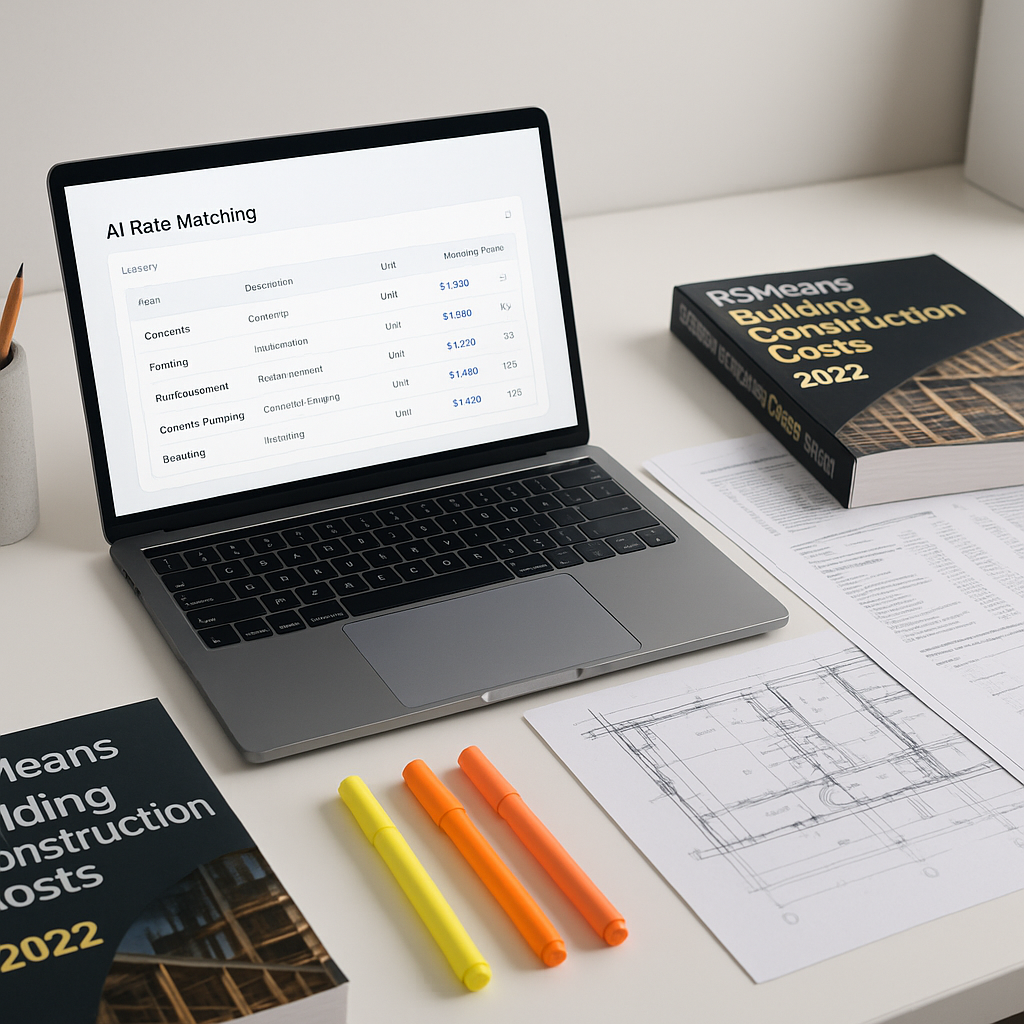
Why Rate Matching is the Real Bottleneck
It’s easy to overlook rate matching during preconstruction estimation. But if you’ve ever spent hours flipping through a 2,000-page rate book or searching PDFs for obscure material costs, you know the pain. Rate matching isn’t just tedious—it’s a bottleneck that slows everything else down.
Let’s say you’re pricing a high-rise project. You need rates for concrete mixes, structural steel, labor, and equipment. The problem? Those rates aren’t centralized. They’re scattered across catalogs like RSMeans, CPWD DSR, or state-specific SORs. Finding the right rate often means manual lookup, and that’s assuming the catalog isn’t outdated.
You might think, "Why not just use Excel or Procore for this?" The truth is, those tools don’t solve rate lookup—they just organize the chaos. AI, on the other hand, can fundamentally change how rate matching works.
What AI Does Differently
AI-powered rate matching isn’t magic, but it feels like it when you see it in action. Instead of manually searching through pages, you upload your Bill of Quantities (BOQ) to a platform. The tool scans your BOQ and matches each line item to the best-fitting rates from its database.
For example, if your BOQ calls for "pre-stressed concrete girders," you don’t need to know exactly which page or section to search in RSMeans. AI tools use semantic search—essentially understanding the meaning behind your query—to find the closest match instantly. You can even narrow results by location, ensuring labor rates align with regional costs.
This isn’t just faster; it’s more reliable. Manual lookup introduces human error—misreading a rate, missing a better match, or using outdated standards. AI reduces these risks by cross-referencing multiple catalogs and applying custom inflation factors.
Illustrative Example — Time Savings with AI Rate Matching
Consider a scenario where a contractor is pricing a large infrastructure project. Traditionally, rate matching for such a project might take several hours of manual effort. By using an AI-powered tool, this process could be completed significantly faster, allowing the team to focus on other critical aspects of the bid preparation.
Additionally, AI can help flag discrepancies between internal catalogs and external standards, ensuring compliance and reducing the risk of errors in competitive bids.
Common Questions About AI Rate Matching
Q: How accurate are AI-generated matches?
A: AI matches are generally accurate, but human oversight remains essential. Most tools allow you to review and adjust matches, ensuring they align with your project’s specific needs.
Q: Can AI handle custom or project-specific rates?
A: Yes. Many platforms allow you to upload your own rate catalogs, ensuring your estimates reflect real costs. Over time, the system learns from your adjustments.
Q: What if the catalog I use isn’t supported?
A: Most AI tools continuously expand their databases and allow users to request specific additions.
Q: How long does it take to learn AI tools?
A: AI estimation platforms are designed to be user-friendly. Training typically takes a short amount of time, and many tools integrate seamlessly with existing software like Bluebeam or Procore.
What to Watch For
- Input Quality: AI relies on the quality of your BOQ and rate catalogs. Incomplete or poorly formatted data can lead to inaccurate matches.
- Edge Cases: While AI handles common materials and labor rates well, it may struggle with niche or experimental items. Always review flagged matches.
- Over-reliance: AI simplifies the process but doesn’t replace your expertise. Use it as a tool to enhance, not substitute, your judgment.
Why This Matters
Preconstruction directors are under immense pressure to do more with less. Missed bid deadlines, indefensible pricing, and burnt-out estimators aren’t just theoretical risks—they’re real consequences of inefficient workflows. AI-powered rate matching is one of the few innovations that genuinely addresses these pain points.
The obvious objection is, "AI doesn’t think like an estimator." That’s true—it doesn’t. But it doesn’t need to. AI doesn’t replace expertise; it amplifies it. By handling grunt work like rate matching, it frees you up to focus on high-value tasks like negotiating with subs or refining your bid strategy.
The Bottom Line
If you’re still relying on manual rate lookup, you’re wasting time and leaving money on the table. AI-powered tools make rate matching faster, more accurate, and less stressful.


