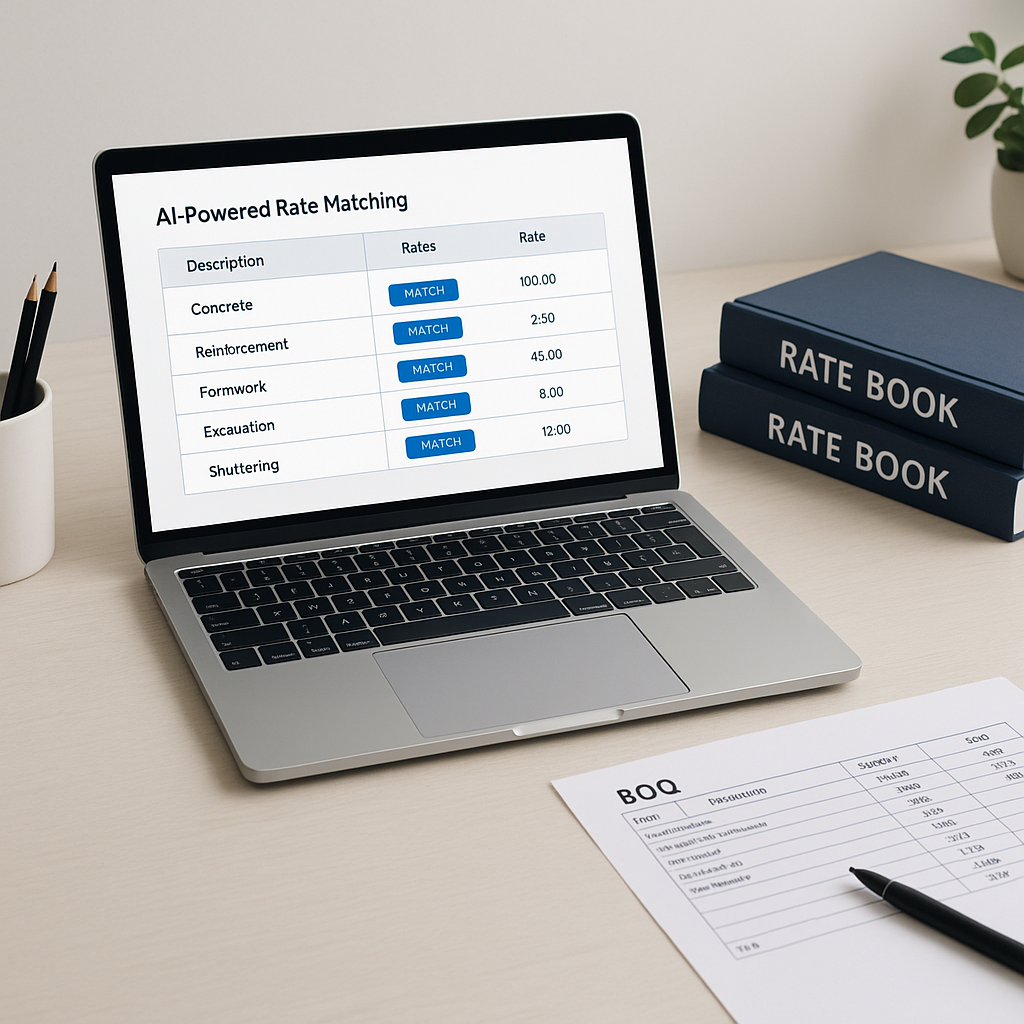
Rate Matching in Construction Estimation: Why It's a Pain
Estimators often spend significant time flipping through rate books like RSMeans or CPWD DSR. On large projects, this involves combing through extensive catalogs to find applicable rates. Rates can vary based on labor classifications, material standards, or regional adjustments, leading to inconsistencies and delays.
Much of this work is repetitive. For example, if you’ve priced out ductwork for one HVAC project, the data can often be reused for similar projects. However, traditional tools treat every estimate as a new task, lacking the ability to leverage past work. This is where AI-powered rate matching offers a solution.
How AI Rate Matching Works
AI-powered platforms use advanced search and learning algorithms to streamline rate matching. Here’s how they address common challenges:
-
Semantic Search Across Catalogs: Instead of manually searching through extensive PDFs, you input a query (e.g., "labor rate for installing pre-stressed concrete girders") into the system. AI identifies the closest matches across large datasets almost instantly.
-
Custom Catalog Integration: AI tools allow you to upload project-specific rates or catalogs. The system learns from these entries and applies them to future estimates, reducing repetitive work.
-
Regional Adjustments: AI can adjust rates for local labor costs, material prices, and currency fluctuations, ensuring compliance with regional standards and eliminating guesswork.
Practical Example: Fixing the Bottleneck
Illustrative example — Consider a subcontractor pricing a bid package with hundreds of BOQ lines. Traditionally, matching rates manually could take a significant amount of time, involving junior estimators searching through books and senior staff cross-checking for errors. With AI rate matching, this process can be significantly streamlined, allowing the team to focus on refining margins, negotiating with vendors, and strategizing the bid.
Common Questions About AI Rate Matching
Q1: How accurate is AI rate matching compared to manual methods?
AI-powered tools improve accuracy over time through self-learning algorithms and feedback loops. However, accuracy depends on the quality of input data, so human oversight remains essential.
Q2: Can AI handle custom rates?
Yes. Custom catalogs or specific rates for unique items can be uploaded, and the system integrates them seamlessly for future use.
Q3: Does it work for smaller projects?
Yes. AI scales to any project size, making it beneficial for both small and large firms by enabling faster turnarounds.
What to Watch For
- Input Quality: Ensure your BOQ and rate catalogs are clean and well-organized before uploading.
- Regional Compliance: Verify that your AI tool supports local standards like CPWD, CESMM3, or NRM2.
- Feedback Loops: Use the tool’s feedback features to improve accuracy over time. The system becomes more effective with consistent adjustments.
AI Rate Matching Saves Time and Improves Accuracy
AI-powered rate matching simplifies the estimation process by reducing manual effort and improving consistency. For preconstruction teams, this means fewer rushed bids, better accuracy, and the ability to focus on strategic tasks. Adopting AI tools for rate matching is a forward-thinking approach to modern construction challenges.


