How AI-Powered Rate Matching Improves Preconstruction Estimation
Manual rate lookup can be a tedious and error-prone process. Flipping through extensive rate catalogs or PDFs to find the right Standard Operating Rate (SOR) for a line item often consumes significant time and effort. This inefficiency can lead to mistakes, missed opportunities, and reduced trust with clients.
AI-powered rate matching offers a solution by automating and streamlining this process. Here’s an overview of how it works, why it’s effective, and what to consider when implementing it.
The Problem: Manual Rate Lookup Is Time-Consuming
Rate lookup is a critical but labor-intensive task in preconstruction estimation. Whether using catalogs like RSMeans, CPWD DSR, or others, finding the correct rate for a Bill of Quantities (BOQ) line item can take hours. The process is prone to errors, such as selecting the wrong rate due to similar-sounding descriptions or overlooking better matches buried deep in the catalog.
These mistakes can lead to inaccurate estimates, reduced bid competitiveness, and strained client relationships.
The Fix: How AI Rate Matching Works
AI rate matching automates the process of finding the right rates for BOQ items, significantly reducing the time and effort required. Here’s how it typically works:
- BOQ Upload: Users upload their BOQ in formats like Excel, CSV, or PDF.
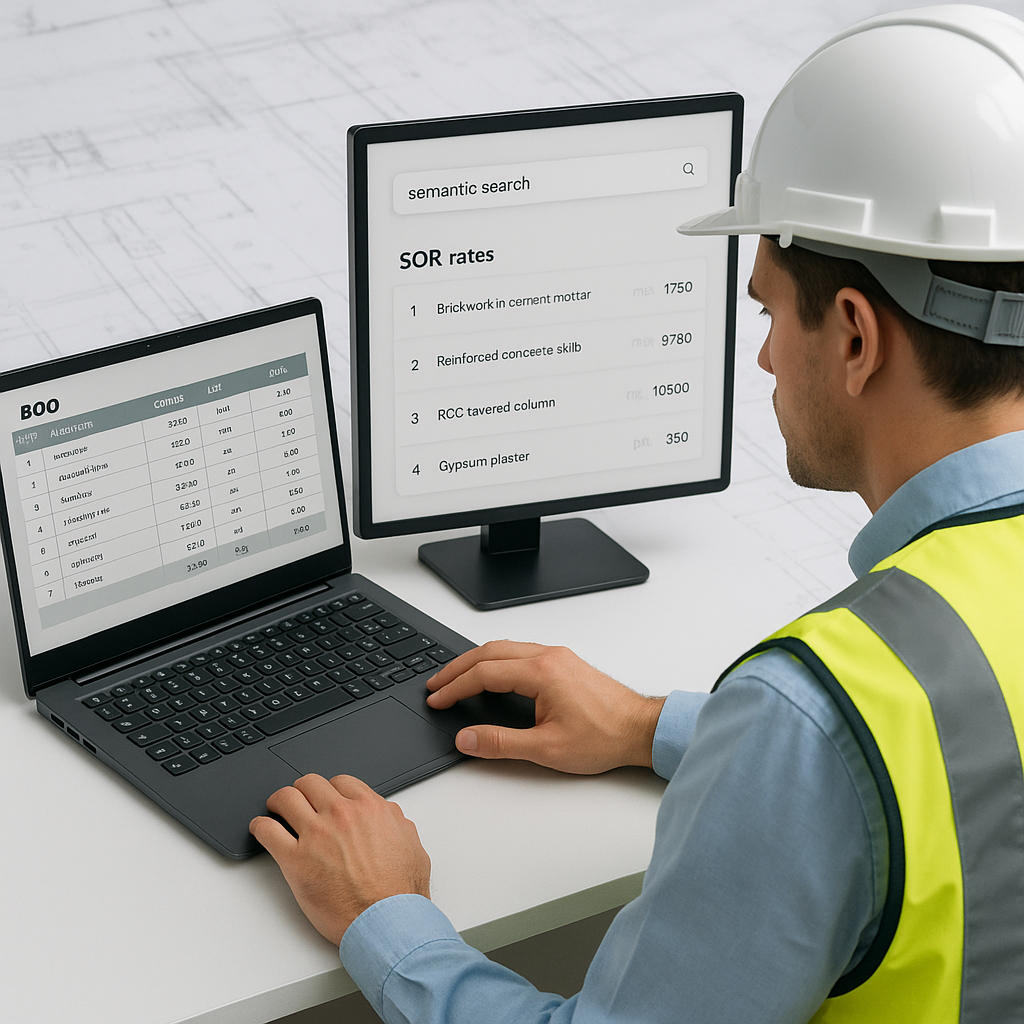
- Semantic Search: The AI uses natural language processing (NLP) to analyze BOQ descriptions and match them with SORs from extensive catalogs. It understands context, not just keywords.
- Ranked Matches: The system suggests the most relevant rate matches for each line item.
- Customization: Users can adjust matches, upload custom rates, or apply inflation factors to tailor the results.
This process eliminates the need for manual catalog searches, allowing estimators to focus on higher-value tasks.
Why It’s Better Than Manual Methods
AI-powered rate matching offers several advantages over traditional manual methods:
1. Speed
AI processes large BOQs and catalogs in seconds, saving significant time compared to manual lookup.
2. Accuracy
AI tools reduce errors by using up-to-date data and providing consistent results. Users can also add custom rates for unique materials or scenarios.
3. Consistency
Unlike human estimators, AI applies the same logic every time, ensuring uniformity across projects.
4. Scalability
AI tools can handle projects of any size, from small renovations to large infrastructure developments, without requiring additional resources.
Common Pushbacks (and Responses)
“AI doesn’t understand construction nuances.”
AI is not a replacement for human expertise. It complements your skills by handling repetitive tasks, allowing you to focus on strategic decisions like markup and contingencies.
“My rates are custom. Will AI work for me?”
Yes. Many AI tools allow users to upload custom rate catalogs and learn from adjustments made during use, improving accuracy over time.
What to Watch For
While AI-powered rate matching offers significant benefits, it’s essential to be aware of potential challenges:
- Data Quality: Ensure your BOQ is well-structured and accurate, as poor input can lead to suboptimal results.
- Human Oversight: Always review AI-generated matches to account for unique project requirements or edge cases.
- Learning Curve: AI tools often improve with use, so initial results may require more adjustments.
AI-powered rate matching is transforming preconstruction estimation by automating time-consuming tasks, improving accuracy, and enabling scalability. By integrating these tools into your workflow, you can focus on strategic decision-making and deliver more competitive bids.


