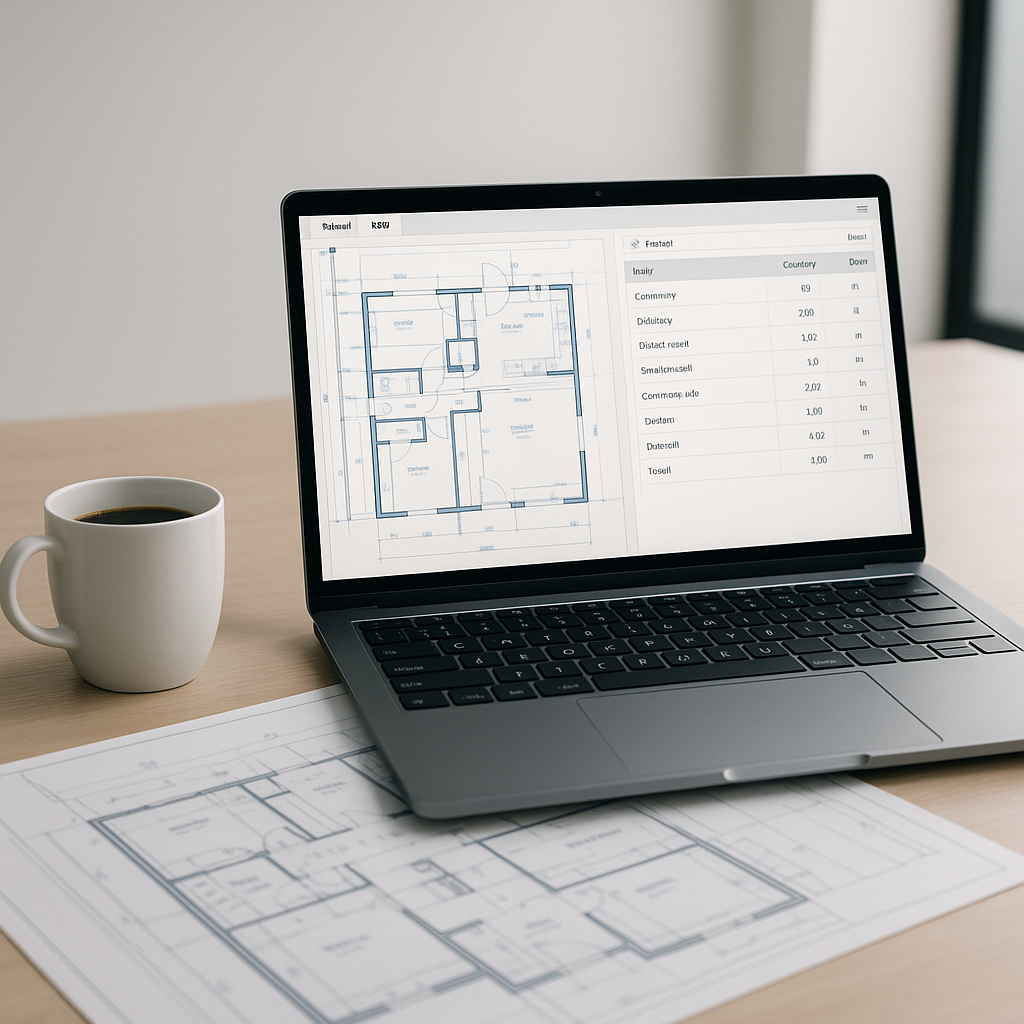
Tired of Spending Hours on Takeoffs?
Manual takeoffs remain one of the most time-consuming parts of preconstruction. If you've ever spent days measuring lengths, counting fixtures, or calculating volumes from PDFs, you know the pain. It’s tedious, error-prone, and worst of all, it’s wasted time your team could use elsewhere—like refining bid strategies or negotiating with subcontractors.
AI-powered tools are changing the game by automating these tasks. Let’s break down how these tools work and why they’re becoming a must-have for preconstruction teams.
How AI Automates Takeoffs
The process is remarkably simple, but the impact is significant. Here’s how it works step-by-step:
-
Upload Your Drawing Set: Start by uploading your PDFs or CAD files directly into the platform. AI handles everything from flat PDFs to complex blueprint sets.
-
AI-Driven Quantity Extraction: The software scans the drawings to identify key elements like wall lengths, room areas, and fixture counts. It even works across multiple pages and layers, so nothing gets missed.
-
Flagging for Review: AI tools often flag items for review, allowing you to double-check or override them. Think of it as a second set of eyes—not a replacement for your expertise.
-
Export to BOQ: Once the quantities are extracted, they’re automatically organized into a bill of quantities (BOQ). You can export this to Excel or integrate it directly with your existing tools.
Illustrative example — A general contractor using AI on a large project could save significant time on takeoffs, freeing up resources for higher-value tasks like optimizing bid margins. The platform not only speeds up the process but also reduces the likelihood of errors.
Why Manual Takeoffs Just Don’t Cut It Anymore
You might be thinking, “Sure, AI is fast, but does it get the details right?” That’s a fair question. Here’s why AI takeoffs are not only faster but often more reliable than manual methods:
-
Human Error: When you’re measuring hundreds of lines or counting thousands of fixtures by hand, mistakes happen. A missed dimension or miscounted item can throw off your entire estimate. AI doesn’t get tired or distracted.
-
Complex Revisions: Let’s say you get a revised drawing set halfway through your estimate. With manual methods, you’d have to start over. AI tools can compare revisions and instantly update quantities based on changes.
-
Scalability: Whether it’s a small renovation or a large infrastructure project, the same AI process applies. You’re not scaling your estimator headcount; you’re scaling your tool’s capacity.
In today’s fast-paced construction environment, sticking to manual takeoffs is like using a typewriter in the age of laptops. It might get the job done eventually, but at what cost?
Common Objections to AI Takeoffs (and Why They’re Wrong)
1. “AI Can’t Think Like an Estimator”
True, AI doesn’t replace your judgment. But it’s not supposed to. Think of it as a productivity multiplier. You’re still the one making critical decisions—AI just eliminates the grunt work.
2. “What About Unusual Designs?”
AI tools adapt to custom designs by learning from user feedback. The more you use it, the smarter it gets. Most users report significant accuracy improvements over time.
3. “It’s Too Expensive”
While there’s an upfront cost, AI tools often pay for themselves by saving time and reducing errors. Compare that to the cost of adding another estimator to your payroll—or losing bids because you couldn’t submit on time.
How to Get Started with AI-Powered Takeoffs
Ready to make the switch? Here’s how to integrate AI takeoffs into your workflow:
-
Start Small: Test the tool on a smaller project to understand its capabilities. Upload a simple drawing set and review the output.
-
Train Your Team: Most platforms are intuitive, but a quick training session can help your estimators get up to speed faster.
-
Use Feedback Loops: AI platforms improve with use. Each time you correct or confirm a quantity, the system learns and gets better for future projects.
-
Integrate with Existing Tools: Check if the platform works with your current stack. Many tools offer integrations with popular software like Procore, Bluebeam, and Excel.
-
Measure ROI: Track the time saved and projects completed to see the direct impact on your bottom line.
If you’re tired of wasting time on manual takeoffs, let AI do the heavy lifting. AI-powered tools can streamline your workflow, reduce errors, and free up your team to focus on what really matters.


