The Takeoff Problem in Preconstruction Estimation
Every estimator knows the grind: a new project lands on your desk, and the clock starts ticking. Before you can even think about pricing, you’re stuck on manual takeoffs—tracing lines, counting windows, measuring areas. It’s tedious, error-prone, and it eats up valuable time.
For many projects, takeoff work can be a significant time investment. And let’s not even get into the inevitable revisions when architects send updated drawings. Sound familiar?
Now imagine this: you upload that same set of drawings into a platform, and shortly after, you’ve got a complete quantity takeoff. No tracing, no guesswork, no headaches. That’s the promise of AI-powered tools.
How AI Takeoffs Work
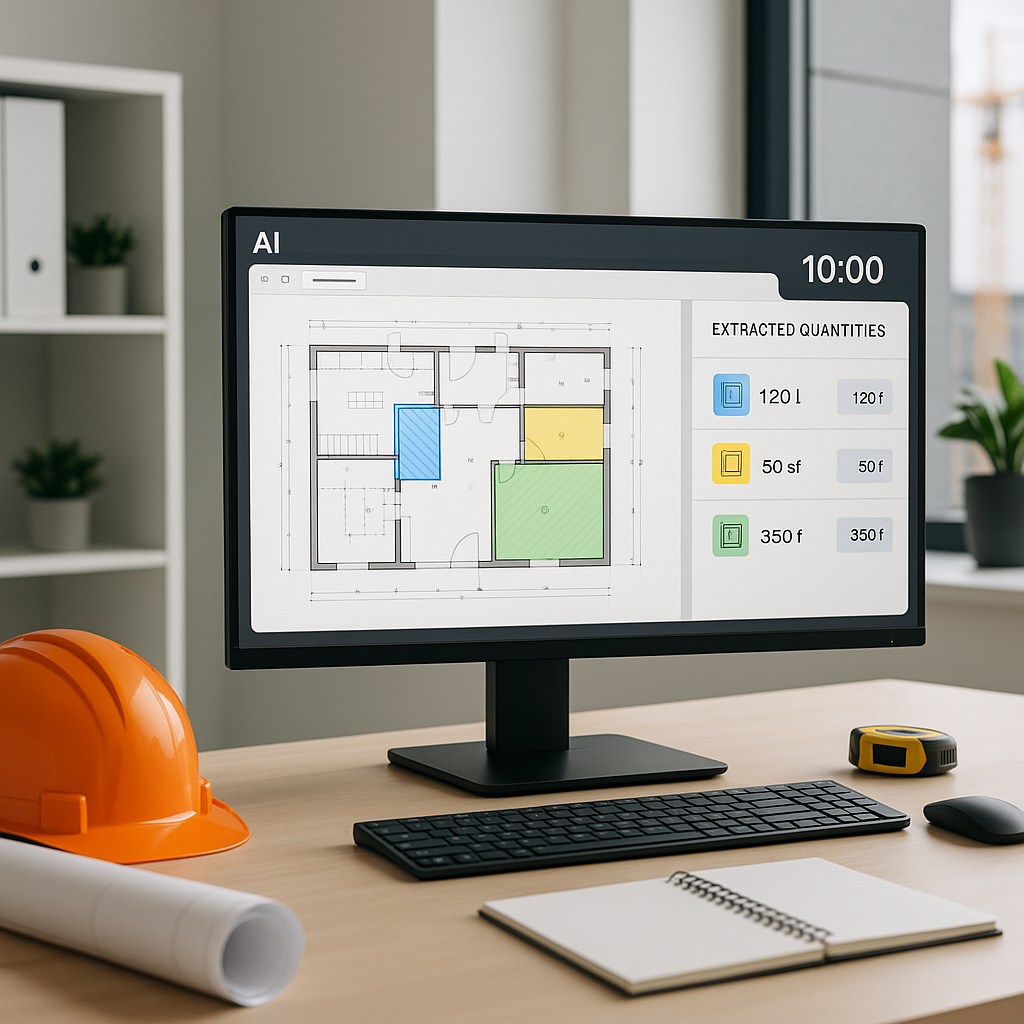
AI-powered takeoff tools use computer vision to analyze PDF drawings and extract quantities like room areas, wall lengths, and door counts. The system scans the entire file, identifies patterns, and cross-references them with pre-trained models. Think of it like having a junior estimator who works at high speed and never gets tired.
These tools can also flag low-confidence measurements for human review. For instance, if the software encounters a complex curve or an unclear boundary, it highlights the area for manual input, ensuring accuracy.
And revisions? No problem. Upload the new drawing set, and the AI will automatically compare it to the original, identifying changes. You won’t have to start from scratch.
Benefits of AI Takeoffs
AI takeoff tools can significantly reduce the time spent on manual tasks, allowing estimators to focus on more strategic activities like analyzing bids, building relationships with subcontractors, and optimizing project costs.
By automating repetitive tasks, these tools also help reduce errors. Manual takeoffs are prone to mistakes, which can lead to underbidding (and losing money) or overbidding (and losing the job). AI minimizes these risks by ensuring consistent, accurate measurements.
Why It Matters Now
The construction industry is under pressure. Labor shortages, rising material costs, and tighter deadlines mean you’re expected to do more with less. Manual processes simply don’t cut it anymore.
AI takeoffs aren’t about replacing estimators—they’re about empowering them. By automating the grunt work, these tools let your team focus on strategy: analyzing bids, building relationships with subs, and value engineering. In other words, the things that actually win you projects and boost margins.
Common Questions About AI Takeoffs
1. Are AI takeoffs accurate?
AI tools are designed to be highly accurate but not perfect. That’s why features like flagged items for manual review exist. You can review these and make adjustments as needed to ensure everything checks out.
2. What if my project has custom requirements?
Most AI platforms allow customization for project-specific needs. You can upload your own rate catalogs or define custom parameters to ensure accurate results.
3. How long does it take to learn these tools?
Most platforms are designed for ease of use. Training typically takes a short amount of time, and junior estimators often adapt quickly to these tools.
4. Can AI handle complex projects?
Yes. Whether it’s a small renovation or a large infrastructure project, AI scales to fit the scope. These tools are designed to handle a wide range of project complexities.
5. Does it integrate with my current software?
Yes. Most AI tools integrate seamlessly with platforms like Bluebeam, Procore, and Excel, allowing you to incorporate AI-generated data into your existing workflows.
Common Mistakes to Avoid
- Blind Trust in AI: Always review flagged items for accuracy. AI is a tool, not a replacement for human judgment.
- Skipping Training: Even the best tools need proper onboarding. Make sure your team knows how to use the platform effectively.
- Ignoring Revisions: Uploading revised drawings is critical for staying accurate. Don’t skip this step.
- Over-Relying on Defaults: Customize the tool for your specific project and market. Default settings won’t always capture unique requirements.
The Bottom Line
AI-powered takeoffs are becoming an essential tool in modern construction estimation. They save time, reduce errors, and free up your team to focus on what really matters: winning bids and delivering successful projects.
If you’re still relying on manual processes, it’s time to rethink. Tools like these can help you move from a drawing set to a priced estimate more efficiently, giving you a competitive edge.


