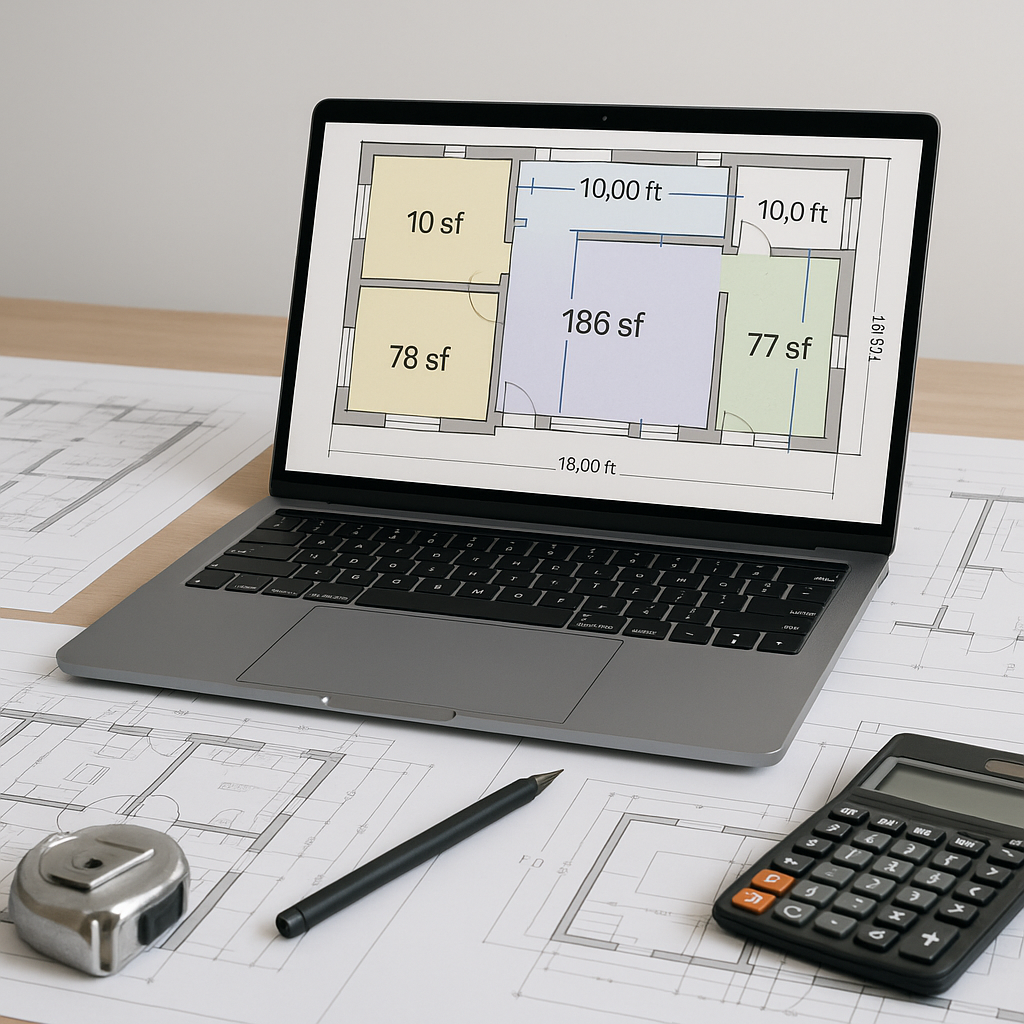
How AI-Powered Tools Improve Construction Takeoffs
Manual quantity takeoff is a challenging and time-consuming task for estimators. It’s repetitive and prone to human error, often requiring significant effort to trace room areas, wall lengths, and fixture counts from drawings. Despite its inefficiencies, manual takeoff remains common because alternatives have historically fallen short—until now.
The Problem: Takeoffs Are Time-Consuming and Error-Prone
Manual takeoff processes can take substantial time, especially for large or complex projects. Estimators often spend hours flipping through drawings and tracing measurements. This not only consumes valuable time but also increases the likelihood of errors. A missed line or incorrect measurement can lead to inaccurate estimates, which may inflate costs or reduce profit margins. Tight deadlines further exacerbate the risk of mistakes.
The AI Solution: Automating Takeoffs with Vision AI
AI-powered tools are transforming the takeoff process by automating the extraction of quantities from drawings. These tools use Vision AI to scan PDF drawings and identify dimensions, shapes, and annotations, significantly reducing the manual effort required.
How It Works:
- Upload Drawings: Users upload PDF drawings directly into the AI platform.
- AI Extraction: The AI scans the drawings to extract quantities such as square footage, linear measurements, and counts for fixtures.
- Review and Adjust: The system flags areas where confidence is low, allowing users to review and make adjustments.
- Export Data: Quantities are exported into a structured Bill of Quantities (BOQ), ready for further processing.
Illustrative example — A team working on a mid-sized project could save significant time by automating the takeoff process, reducing manual labor and improving accuracy.
Why AI Takeoffs Are More Efficient
Speed
AI tools drastically reduce the time required for takeoffs. Tasks that might take hours manually can often be completed in minutes using AI. This allows teams to handle more bids or focus on higher-value activities.
Accuracy
While AI tools are not infallible, they are consistent and less prone to fatigue or distraction compared to humans. Features like manual overrides and flagged low-confidence areas ensure that users can review and correct any discrepancies.
Scalability
AI-powered takeoff tools can handle projects of varying sizes, from small renovations to large-scale infrastructure developments. This scalability makes them versatile for different types of construction projects.
Addressing Common Concerns
Objection: “AI can’t replace human expertise.”
AI tools are designed to complement, not replace, human expertise. Estimators still make critical decisions, such as negotiating with subcontractors and applying markups. AI simply handles the repetitive tasks, freeing up time for strategic work.
Objection: “What if my drawings are messy?”
Modern AI tools are equipped to handle real-world challenges, including messy or incomplete drawings. They often include features for manual remeasurement and adjustments to ensure accuracy.
Best Practices for Using AI Takeoff Tools
- Ensure Input Quality: Provide clear and complete drawings for the best results.
- Review Low-Confidence Areas: Always double-check flagged quantities before finalizing estimates.
- Leverage Integrations: Use tools that integrate with your existing software to avoid manual data transfers.
AI-powered takeoff tools are revolutionizing the construction estimation process, offering significant time savings and improved accuracy. By automating repetitive tasks, these tools enable estimators to focus on higher-value activities, ultimately enhancing project outcomes.


