Why Manual Takeoffs Are Challenging for Margins
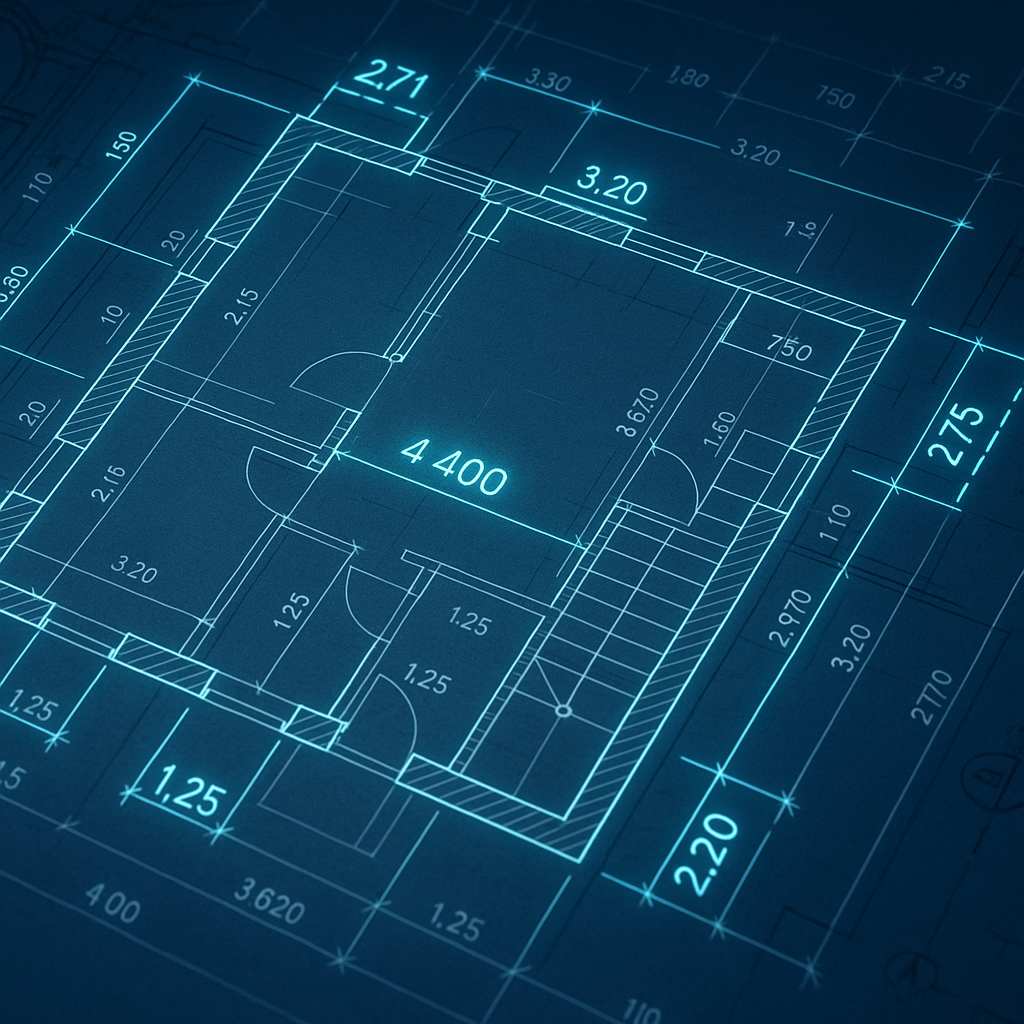
Manual takeoffs can be a time-consuming and error-prone process. Flipping through stacks of drawings, tracing every room, wall, and window is not only tedious but also slow. For mid-sized projects, teams often spend significant time just to get quantities ready. This is before rates, bid adjustments, or any meaningful work begins.
Errors in manual takeoffs can lead to missed dimensions or miscalculations, which can snowball into bids that either lose money or fail to win the job. This inefficiency affects contractors of all sizes, from small subcontractors to large general contractors, leading to increased overhead and reduced profitability.
The AI Fix: Streamlining Takeoffs
AI tools like Vision AI offer a solution to the inefficiencies of manual takeoffs. Instead of spending hours tracing PDFs or manually extracting dimensions, AI can process drawings in a fraction of the time. By uploading PDFs, calibrating the scale, and letting the AI analyze the drawings, contractors can quickly obtain room areas, wall lengths, door counts, and more — all extracted and categorized.
How It Works
AI uses computer vision to identify elements in the drawings, similar to how facial recognition technology operates. It doesn’t just detect lines; it understands the context. For example, a rectangle might be identified as a window or a door based on its placement and proportions. This approach ensures both speed and accuracy.
Why AI Accuracy Complements Human Expertise
Some may question whether AI can match the expertise of a seasoned estimator. While AI doesn’t replicate human judgment, it doesn’t need to. Instead, it handles repetitive, mechanical tasks, freeing up estimators to focus on strategic decisions and judgment calls.
According to a McKinsey report, early adopters of AI in construction estimation have seen significant cost savings per project. These savings are driven by fewer errors, faster processes, and better allocation of team resources.
Additionally, AI tools improve over time. With each project, the system learns from user corrections, becoming more accurate and efficient, much like training a junior estimator who retains all the lessons learned.
Common Questions About AI Takeoffs
Q1: Does AI replace estimators? No. It replaces the manual parts of their job, like tracing PDFs. Estimators remain responsible for decisions, adjustments, and final approvals.
Q2: What if the AI misreads something? Most tools, including Vision AI, highlight low-confidence areas for manual review, ensuring that critical elements are not overlooked.
Q3: Can AI handle complex drawings? Yes, but the quality of the input matters. Clean, well-labeled PDFs yield the best results. Poor-quality inputs can hinder performance.
What to Watch Out For
- Bad Input Data: Ensure your drawings are clean and well-scanned for optimal AI performance.
- Over-Reliance on AI: Always review the AI-generated outputs to ensure accuracy and completeness.
- Training Time: Be prepared for a learning curve when implementing new AI tools. Allocate time for your team to become proficient.
The Benefits of AI Takeoffs
Illustrative example — Consider a team that prices multiple projects each month, with each project requiring significant hours for manual takeoffs. By using AI tools to reduce the time spent on these tasks, the team can reallocate their efforts to more strategic activities, such as refining bid strategies or negotiating with subcontractors. This not only saves time but also enhances the quality and competitiveness of bids.
Final Thoughts
AI-powered takeoffs are becoming an essential tool in the construction industry, where speed and accuracy are critical for winning bids. By automating repetitive tasks, these tools allow contractors to focus on higher-value activities, improving both efficiency and precision. Whether you’re a general contractor or a subcontractor, adopting AI for preconstruction estimation can provide a significant competitive edge.


